How to grow scarlet sage? Detailed guide to sowing time, flowering months and flower meaning
Scarlet sage, also known as firecracker red and ivory red, is a plant of the genus Salvia in the Lamiaceae family. It has bright red color, a long flowering period and strong adaptability, and is the most commonly cultivated herbaceous flower in Chinese cities and gardens. So when should scarlet sage be sown? How many months after planting does it bloom? What is its flower meaning? How to grow it?
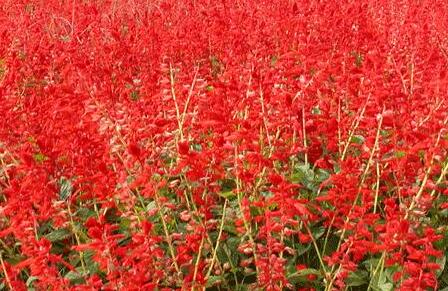
I. When should scarlet sage be sown? How many months after planting does it bloom?
In North China, scarlet sage can be sown in any season; in other regions, spring is preferable. Scarlet sage flowers relatively late; spring-sown plants bloom from September to October. If you want to advance the flowering period or harvest seeds, sow the seeds in a greenhouse or hotbed in early March. Apply a small amount of base fertilizer in the sowing bed, level the bed surface and water it thoroughly; after the water seeps in, sow the seeds and cover with a thin layer of soil. The seeds germinate 8-10 days after sowing. They bloom after about 100 days of growth, and the flowering period lasts about two months. For cuttings, use softwood shoots, preferably from March to May or September to October, combined with pinching off the terminal buds.
II. What is the flower meaning of scarlet sage?
Flower meaning of scarlet sage: red scarlet sage represents a heart in love, white scarlet sage represents abundant energy, and purple scarlet sage represents wisdom. The red-flowered variety is commonly used; in the crisp autumn air, the flowers are dense and the colors brilliant. It is often used as the main material for flower borders and flower beds. It can also be planted in ribbon flower beds or in natural-style pure plantings at the forest edge. It is often combined with light yellow canna, dwarf marigold, light blue or pink water peony, China aster, dwarf ageratum and so on. Dwarf varieties of scarlet sage are even more suitable for flower beds; besides combining well with red-flowered varieties for ornamental effect, the white-flowered variety generally has less ornamental value than the red-flowered variety, as do the purple-flowered varieties.
III. How to grow it?
1. Sunlight: Scarlet sage is a light-loving flower, and the cultivation site must have sufficient light, which is very beneficial to the growth and development of scarlet sage. If light is insufficient, the plant tends to grow leggy, with thin, elongated stems and leaves and pale green leaf color; if the light is poor for a long time, the leaves turn yellow and drop. If flowering plants are placed in a location with poor light, the flowers are often not bright and tend to drop. It is sensitive to photoperiod, and short days promote the opening of scarlet sage flowers.
2. Temperature: Scarlet sage is relatively sensitive to temperature when grown; seeds germinate at 21-23°C, are very difficult to germinate below 15°C, and germinate unevenly below 20°C. During the seedling stage in winter, 7-13°C is suitable, and during the growing period from March to June, 13-18°C is best. When the temperature exceeds 30°C, plant growth and development are hindered and the flowers and leaves become smaller. Therefore, during the high-temperature period in summer, cooling or appropriate shading is needed to control the normal growth of scarlet sage. Being at a low temperature of 5°C for a long time makes it prone to cold damage.
3. Pruning: After scarlet sage is planted out, pinch it immediately, and pinch at least 2 times during the growing period, so that the plant becomes short and sturdy with more flowering branches and dense flower spikes.
4. Pests: If scarlet sage is grown under high temperature, high humidity or insufficient light, it is prone to rot disease, so temperature must be adjusted to keep the air circulating. In addition, scarlet sage is prone to pests such as red spider mites and aphids, which can be controlled by spraying 1500-times dilute omethoate emulsion.
5. Fertilizing: Scarlet sage is relatively simple in terms of fertilizer; generally, basic fertilization of the soil before planting is enough.