Annual herbaceous garden balsam seed price per jin, planting methods and uses
Garden balsam, also known as henna, jixingzi, fengxian tougucao, golden phoenix flower, and peach red, is an annual herbaceous flower. People commonly use its flowers and leaves to dye their nails. So how much does a jin of garden balsam seeds cost? How do you plant it? What uses does it have? Learned from a Jiangsu seed company, the price of garden balsam seeds is around 39 yuan/jin, the sowing rate per mu is around 5--6 jin, the flower diameter is 2.5~6 cm, the total plant height is 45~80 cm, and the flowering period is 90~105 days. The flowering time differs slightly from region to region.
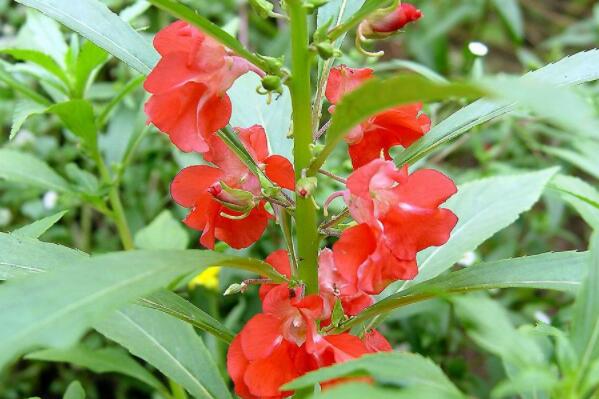
How do you plant garden balsam?
I. What kind of environment is garden balsam suited to
The quality of the soil directly affects how well garden balsam seedlings grow. If the soil quality is good and the living environment is good, then staff management will be much more convenient. Garden balsam has few restrictions on soil; it can be sandy soil, yellow earth, or clay, but soil with too much sand does not germinate well. Garden balsam fears water, so it requires higher terrain with smooth drainage. When the dog days arrive and rain increases, accumulated water must be drained away immediately, otherwise partial seedling death easily occurs. The key point of the terrain is that it helps drain accumulated water; ordinary soil quality is fine, and sufficient sunlight is needed.
II. Land preparation
1. Plowing: Garden balsam responds very quickly to fertility. If the soil fertility is sufficient, the flowers will be large and vivid and the plants sturdy. However, some garden site soils are terrain with only ordinary fertility. Because of this, to get vivid blooms, sufficient farmyard manure must be applied before planting, broadcasting 4.5~8 tons of cow dung and chicken manure per mu. After applying the manure, plow deeply once and harrow once, so that the soil and nutrients are mixed evenly together, with no large clods, making planting easier and improving the germination rate.
2. Making beds: To make it easier to water, weed, fertilize, and carry out the maintenance management needed during the one-year growth period of garden balsam seedlings, Changjing Landscape recommends that everyone make the land into beds of a fixed 1.5 m width and 12~22 m length, with the actual situation determined according to the land.
III. How to plant garden balsam
Garden balsam seeds are generally medium in size and have a very good germination rate. It is recommended to plant them shallowly, with the soil covering depth not exceeding 5 cm. Broadcasting is generally used for planting. Choose an environment with little wind, mix the garden balsam seeds into wet sand, and evenly broadcast them onto the ground. After broadcasting, you can cover the soil by raking manually or mechanically. After covering with soil, irrigate once, and after about 6~12 days the germination rate can be improved.
IV. How to care for garden balsam
There are relatively few management and care tasks during the garden balsam seedling stage. It has few diseases and grows well. The key matters are mostly concentrated during the flowering period. Before flowering, apply 40 kg of quick-acting fertilizer per mu. Applying chemical fertilizer before the flowering period is to make the flowering time longer, produce more flowers, and make the colors more beautiful. After flowering begins, no more fertilizer is needed. During the flowering period, garden balsam requires a lot of water. At this time, the number and timing of waterings should be decided according to weather conditions.
What uses does garden balsam have?
1. Treating paronychia and fungal nail infection. When it blooms in summer, crush the flowers and apply them to the nails, that is, wrapping the nails. It can promote blood circulation and remove blood stasis. The older woman in my family used it to treat fungal nail infection.
2. Hair dyeing. The elderly at home usually use this to dye their hair. It can promote blood circulation and is good for the body. However, pregnant women should not use it, as it is not good for a developing child.
3. Soaking feet. This still uses its blood-circulation effect. Grab a big handful and soak it in hot water to soak your feet. It can promote blood circulation. Since I started soaking my feet, I feel that my menstrual cramps have eased a lot.
4. Whooping cough. Take ten garden balsam flowers and stew them with rock sugar before taking, which will relieve coughing.
5. Venomous snake bites. Take a whole garden balsam plant, crush it, drink its juice, and apply the crushed residue to the place bitten by the snake. ps: Venomous snake bites are still very serious, and going to a doctor for treatment is the best solution.
6. Amenorrhea and abdominal pain. Collect garden balsam flowers, dry them in the sun, and brew them as tea.