Wormwood (Artemisia annua) of the Asteraceae family: seed prices, differences from mugwort, and its cultivation, effects and uses
Sweet wormwood (Artemisia annua), also known as cao hao, lin hao, yinchen hao, xie hao, xiang hao, ping hao, hei hao, bai ran gen and ku hao, is a plant with bisexual flowers. So how much does sweet wormwood seed cost per jin? How is it different from mugwort? How do you grow it? What are its effects and uses? From the sweet wormwood planting base in Chongqing we learned that the seed price is about 45 yuan/jin, and the sowing rate is 4-5 jin per mu. Sweet wormwood seeds should be sown shallowly, not too deep, preferably no more than 2 cm; after sowing, pay attention to tending and observe frequently, and water promptly when the soil is found to be dry.
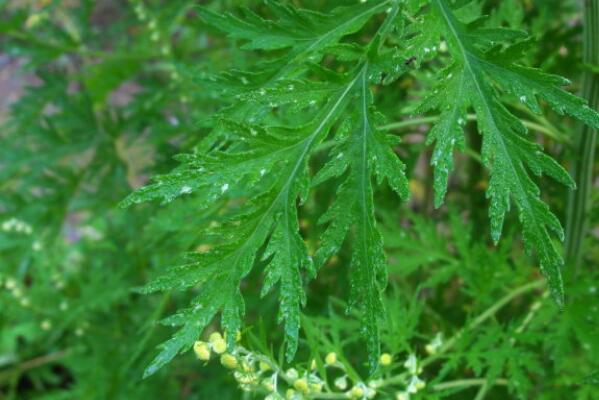
What is the difference between sweet wormwood and mugwort?
1. Both mugwort and sweet wormwood belong to the Asteraceae family. The scientific name of sweet wormwood is Artemisia selengensis, while the scientific name of mugwort is Artemisia argyi. Their names are similar, and both like places with abundant soil moisture such as field ridges, roadside edges and pond edges. But looking more closely, the biggest difference between them is height and leaf surface morphology. Moreover, mugwort has a long growth cycle, growing from March all the way to May, but once sweet wormwood passes Qingming Festival, it has passed its tenderest stage (this refers to the growth cycle of the leaves; not growing taller does not mean it has withered, but rather the process from tender shoots to mature leaves).
2. Sweet wormwood is shorter, its main stem is relatively slender, and the stem is dark red; the best-growing sweet wormwood is only about 10 cm tall. Mugwort is different: its main stem is slightly thicker and longer, the stem is light green, some can reach 1.5 cm in diameter, and the height is between 80 and 250 cm.
3. The surface of sweet wormwood leaves has a layer of white fuzz, soft and smooth, and the leaves are small, with deep serrated lines around them, and the whole leaf is narrow and elongated. Mugwort leaves, on the other hand, are grayish-green on the surface, with white fuzz on the underside, and the leaf surface is broad and fleshy.
How do you grow sweet wormwood?
1. Seed collection and land preparation: sweet wormwood seeds are collected around September to October. Cut back the mature sweet wormwood seeds to dry, then shake the seeds off, remove impurities and seed shells, and keep the seeds for storage. By February of the following year, they can be sown. Before sowing, choose sunny, moist land, with an environment at an altitude of 600-700 m being best. Add 2000-2500 kg of organic fertilizer to the chosen land, then plow it, turn the applied base fertilizer into the soil, level it, and make beds 1.3 m high.
2. Sowing and raising seedlings: before sowing, mix sweet wormwood seeds with seed ash first, evenly scatter them on the bed surface, then cover with a thin layer of plant ash, just enough to cover the seeds. After emergence, pay attention to drought prevention to avoid the seedlings being scorched by the sun. During the seedling stage, appropriately add human and livestock manure water, about 800 g per mu. When the plant height reaches 5-10 cm, they can be transplanted. When sowing sweet wormwood seeds, the seeding rate per mu is 100-150 g, which can yield 280,000-300,000 plants, enough to plant 2 hectares of land.
3. Land preparation and transplanting: for the sweet wormwood transplanting land, use 2000-2500 kg of farmyard manure per mu, add 100-150 kg of superphosphate, stir evenly, spread it on the ground, turn it into the soil and level it. Then make high beds 1.3 m wide, with a ditch depth of 10-15 cm, and they can be planted. Dig holes in the beds at a row spacing and plant spacing of 26.5 * 26.5, one plant per hole, using 7500-12000 sweet wormwood seedlings per mu. 4. From transplanting to harvest, sweet wormwood needs weeding 2-3 times, with topdressing combined with weeding, fertilizing 1-2 times. The first time is a shallow hoeing during the seedling stage; after hoeing, add 1000-1500 kg of light human and livestock manure per mu, 3-5 kg of urea, and 2-3 kg of superphosphate. Mix evenly and add it into the holes. The second time is intertillage and weeding before the rows close, adding 1000-1500 kg of human and livestock manure water, 10 kg of urea, 30 kg of superphosphate, and 10 kg of potassium chloride, and after mixing evenly, add it into the holes.
What are the effects and uses of sweet wormwood?
1. Sweet wormwood tastes bitter and slightly pungent, is cold in nature, enters the liver, gallbladder and kidney meridians, and is fragrant and clear, penetrating inside and out.
2. Sweet wormwood has the effects of clearing heat and reducing steaming, clearing summerheat and stopping malaria, and removing dampness and killing insects. It mainly treats yin deficiency with tidal fever and bone-steaming, externally contracted warm heat and summerheat-dampness, dizziness of the head and eyes, malaria, jaundice, diarrhea and dysentery, scabies, and itchy skin.