How to Grow the Orchid, One of China's Ten Famous Flowers, So It Blooms, Plus Watering Methods and Precautions
Orchid, also known as Chinese orchid, spring orchid, orchid grass, etc., is a perennial herbaceous flowering plant with fleshy roots in the genus Cymbidium of the family Orchidaceae. It originated in China, where it is widely distributed in Yunnan, Guizhou, Sichuan and Tibet; it is a traditional precious flower of China and also a famous flower of the world. Many flower lovers like orchids, so how do you grow orchids so they bloom? What are the precautions for growing orchids? Here is a brief introduction to the cultivation methods and precautions for orchids:
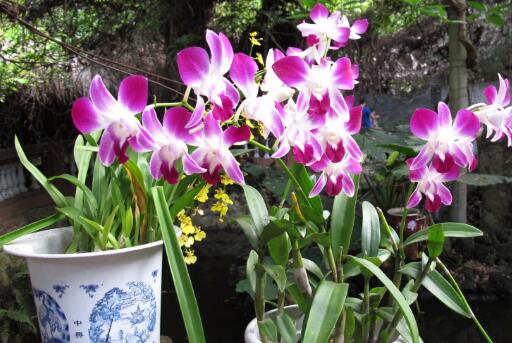
People have always regarded the orchid as a symbol of nobility and elegance, and together with plum, orchid, bamboo and chrysanthemum it is called the “Four Gentlemen.” For its delicate fragrance and understated elegance, the orchid is also grouped with chrysanthemum, narcissus and sweet flag as the “Four Elegant Flowers and Grasses,” with the orchid ranking first among the four. The orchid is plain and unadorned, with evergreen leaves that are soft yet firm, and flowers with a subtle fragrance that carries far; it has extremely high ornamental value and is a treasured plant for display in the living room, bedroom, or as an accent in the study or entryway.
We grow orchids mainly to enjoy their flowers, but if they are planted or managed improperly, orchids may fail to bloom. So how do you grow orchids so they bloom?
Orchid Cultivation Methods and Precautions
1. Soil Selection for Growing Orchids
The soil for orchids should be mainly humus, primarily leaf mold or mountain forest humus soil. In the south, the humus soil from the place of origin, commonly known as orchid mud, can be used; leaf mold, vermiculite, perlite, etc. can also be mixed artificially into a loose, airy, water-permeable growing medium. Generally, a growing medium is made by mixing 8 parts leaf mold and 2 parts river sand, or 7 parts leaf mold, 2 parts perlite and 1 part river sand, or 6 parts leaf mold (peat soil), 3 parts compost soil and 1 part river sand thoroughly mixed. All the growing media prepared above are slightly acidic.
2. Fertilization Methods for Growing Orchids
Orchid fertilization involves, first, applying base fertilizer into the growing medium, and second, topdressing during the growing period. Topdressing mostly uses liquid fertilizer or foliar fertilizer, and the concentration should be lighter than for other flowers. Orchids have their growing medium changed once a year, so less topdressing can be applied during the growing period, and timing should be noted. Generally, in the growing season, a fully decomposed dilute cake fertilizer solution of about 15%, or 0.1% urea solution plus 0.2% potassium dihydrogen phosphate solution, can be applied as topdressing once every 15-20 days; from before flowering to the flowering period, 0.2% potassium dihydrogen phosphate or plant ash water can be sprayed on the leaves 2-3 times to promote the development of roots, stems and flowers. Orchids have fleshy roots, so fertilizer that has not been decomposed must not be applied, to avoid root rot.
3. Watering Methods for Growing Orchids
Watering orchids depends on the species, growth conditions and local climate, and should achieve moist but not wet, dry but not parched; watering must not be too much or too little, and the principle of not dry in autumn and not wet in winter should be followed. In winter, when temperatures are low, the plants are in a dormant state, so watering should be controlled, generally once every 5-7 days, but Cymbidium sinense, which blooms in winter, needs more water;
In spring and autumn, water once every 2-3 days; in summer, when temperatures are high and orchids are in their vigorous growth period, water on average 1 to 2 times a day. When watering, be careful to prevent water droplets from splashing on the leaves, so as to avoid black spots that affect the ornamental effect. During the orchid's growth period, water should often be sprayed on the leaves, and in summer water should also be sprinkled on the ground around the flowerpot to increase air humidity and promote the growth and development of the orchid. For watering orchids, rainwater and snow water are best; if tap water is used, it should be stored for 2-3 days before use.
4. Temperature Requirements for Growing Orchids
For potted orchids in the north, they should be moved indoors around the Frost's Descent solar term when the temperature drops to 5°C, and in the early period after being brought indoors the windows should be opened often to keep the air circulating. In winter, the indoor temperature should preferably be kept at around 10°C. After Grain Rain, move them outdoors for care. The suitable temperature for orchid growth is 16-24°C; in winter the indoor temperature is generally required to be relatively low, preferably 10-12°C during the day and 5-10°C at night, and the temperature and humidity must not be too high; in summer the temperature should not exceed 30°C.
5. Light Requirements for Growing Orchids
Orchids like shade and fear direct strong light, so shading should be provided in spring, summer and autumn. For growing orchids at home, to control the amount of light, it is best to place them on a balcony windowsill or under the eaves with a bamboo curtain for shade, generally shading from 9 a.m. to before 6 p.m., and pulling the curtain open in the morning and after 6 p.m. so they receive scattered sunlight. In winter they should be moved indoors to a place with visible scattered light, but direct sunlight should also be avoided. Among orchids, Cymbidium sinense has the strongest shade tolerance, followed by Cymbidium ensifolium, while Cymbidium goeringii and Cymbidium faberi have weaker shade tolerance.
6. Potting Methods for Growing Orchids
The environment for cultivating orchids should be well ventilated, humid and pollution-free. The orchid pot should be a tall pot, wider at the top and narrower at the bottom, with multiple drainage holes, or with drainage holes in the pot wall. The orchid pot itself should also have ornamental value.
Since orchids grow slowly, they can be repotted once every 1-2 years after the flowers fade. When potting, first fill the bottom of the pot with about 3 cm of tile pieces, furnace slag, etc. to facilitate drainage. Then, put in a layer of growing medium, place the orchid seedling in the center of the pot, straighten the roots and let them spread naturally; when the soil is filled to halfway, lift the orchid seedling gently while shaking the pot so that the soil and roots combine tightly; when the soil is filled to 2-3 cm from the pot rim, press lightly with the hand. After planting, water thoroughly and place in a cool place, spraying water once each morning and afternoon, and after about 7-10 days move it to a mottled-shade cool place for care.
7. Precautions for Growing Orchids
(1) Orchids are mainly distributed in the southeast and southwest regions. They mostly grow wild in humid valleys under sparse forest and in shaded spots by rocks, so they like a warm, humid climate, prefer shade and moisture, require 70%-90% shading, and avoid high temperatures, dryness and strong light.
(2) During orchid cultivation, withered yellow old leaves and diseased or insect-damaged leaves should be constantly cut off to facilitate ventilation. After flower buds emerge from the soil, each plant should keep one strong flower bud and the rest should be cut off, so as to avoid consuming too many nutrients and affecting flowering the following year. After the flowers fade, the flower stalks should be cut off.
(3) In winter, attention should be paid to cold protection. Terrestrial orchids have strong cold resistance, while tropical orchids require a higher overwintering temperature and should be moved indoors early or protected with a plastic shed to avoid freezing; the room temperature is best kept at 10-15°C, and ventilation should be noted during indoor care. As the climate gradually warms in spring, the orchids should gradually be moved to the courtyard or balcony.
(4) For growing orchids at home, natural rainwater, stream water, well water and river water are best; if tap water is used, it should first be stored in a vat and exposed to the sun to remove the bleaching powder before use, because long-term use of tap water to water flowers will gradually alkalize the growing medium. Ferrous sulfate can be applied once every so often to increase soil acidity; in addition, watering orchids with fermented rice-washing water can also keep the soil in a slightly acidic state.
8. Propagation Methods for Growing Orchids
Orchids are mostly propagated by division and tissue culture, while seed sowing is used for breeding varieties.
(1) Division propagation: Division is carried out in spring and autumn, varying with the species. Species that bloom in winter and spring should be divided in late autumn; species that bloom in summer and autumn should be divided in early spring before sprouting. Generally, divide once every 2-3 years. Before division, reduce watering to make the potting soil suitably dry; when dividing, hold the pot with the hands, gently knock the mother plant out of the pot, remove the soil, cut off rotten roots and leaves, then wash clean with water, place in a shady spot to air-dry for 3-5 hours, and when the surface water has disappeared and the roots turn white, soften and slightly wrinkle, cut apart from the middle of the pseudobulb with a sharp knife, coat the cut with plant ash for antisepsis, and plant immediately after air-drying. Be careful during division to avoid injuring the leaf buds and fleshy roots. After potting, place in a shady spot, and transfer to normal management after growth resumes.
(2) Rapid propagation by tissue culture: In recent years, China has used tissue culture technology for large-scale orchid production. Besides propagating orchids, tissue culture technology is also widely used for propagating tropical orchids such as Phalaenopsis, Cymbidium hybridum and Dendrobium.
Orchid Variety Selection
There are many orchid varieties, and beginners growing orchids at home often do not know which orchids to choose and feel at a loss. As ordinary enthusiasts who grow them for appreciation and do not spend much money, they can choose common Cymbidium goeringii, Cymbidium faberi, Cymbidium ensifolium, Cymbidium sinense and Cymbidium kanran. If they want to raise the grade of their orchid growing, they can choose some famous varieties.
Among Cymbidium goeringii, famous varieties to choose include Song Mei, Shiyuan, Longshi, Hanshi, Wanshi, Wentuan, Yumei, Zhengtonghe, Gaihe, Xishen, Yu Hudie, etc. If conditions permit, Yangshi Suhe, Yangshi Sudie, Huanqiu He Ding and Lvyun can also be grown; they are all the most representative and generally recognized better orchids among Cymbidium goeringii.
Among Cymbidium faberi, Cheng Mei, Da Yipin and Jinshan Aosu can be chosen.
For Cymbidium ensifolium, Dayemen and Longyan Su can be chosen.
For Cymbidium kanran, Suxin Hanlan can be chosen.
Among Cymbidium sinense, Suxin Molan, Yinbian, Datun Qilin, Shenzhou Qi, etc. can be chosen.
Common Orchid Leaf Disorders:
1. Leaves yellowish, growth normal: caused by too strong light.
2. Leaves turning yellow, new shoots smaller: excessive light, lack of nitrogen fertilizer and necessary humidity.
3. Old leaves yellowing and falling off: normal aging or caused by repotting.
4. Old leaves rapidly yellowing and falling off: too much and too frequent watering, improper repotting and planting.
5. New leaf tips scorched: excessive fertilization, unclean planting material.
6. Both new leaves and old plants have black scorched tips: excessive damp heat in the pot, with rotten roots among the root system.
7. New shoots stop growing after emerging from the soil: there are rotten roots or unclean matter beside the new shoots; turn over the growing material around the new shoots and remove the unclean matter and growth resumes.
8. Scorch spots on leaves with no yellow around the edges: scorch spots from blazing sun.
9. Leaf tips showing scalded, shrunken heads: the water temperature for watering is too high; the air temperature is too high when watering; exposure to sudden showers during high summer temperatures, etc.
10. New shoots with rotten hearts: after water is poured into the shoot heart, the water cannot evaporate and be absorbed, and the growing material in the pot is unclean, producing leaf rot disease, etc.
11. Spots on leaves with water-soaked edges: excessive humidity, stuffiness caused by potting moisture combined with air humidity, accompanied by leaf rot bacteria. Poor ventilation and aeration.
12. Yellow-brown spots on leaves: caused by the roots being heated.
13. Irregular yellow spots on leaves, with leaf mesophyll tissue necrotic and sunken: caused by viral disease, also called “Barras.”
14. Small yellow spots on leaves: caused by scale insects.
15. Purple-black on leaves while the leaf underside is still green: caused by low-temperature frost. It can also occur with phosphorus deficiency.
16. Leaves dehydrated, pseudobulbs wrinkled and shrunken: caused by long-term excessive dryness and dehydration in the pot.