How much does a holly sapling cost per plant? A detailed guide to types, characteristics and planting methods
Holly, an evergreen tree, is a type of flowering plant; its seeds and bark can be used medicinally; the leaves have a heat-clearing and detoxifying effect; tannin extract can be obtained from the bark; the wood is hard and can be used as a material for fine work. So what does holly look like? How much does a sapling cost per plant? What types are there? How is it planted? According to data, holly is about 2 to 25 m tall and is divided into trees and shrubs. The bark is gray or light gray, with longitudinal furrows, and the twigs are light green and hairless. The leaves are thinly leathery, narrowly elliptic or lanceolate, with acuminate tips, cuneate bases, and shallow rounded serrations along the margins; after drying they turn reddish brown and glossy. The petals are purplish red or light purple and curl outward. The fruit is elliptic or nearly spherical, turning dark red when ripe.
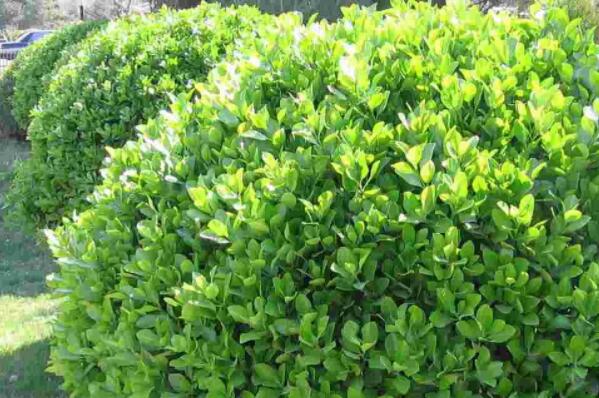
How much does a holly sapling cost per plant?
| Nursery stock name | Height (cm) | Price | |
| Large-leaf boxwood sapling | 10~15 | 0.1~0.12 | |
| Large-leaf boxwood | 35~50 | 0.55~0.8 | |
| Large-leaf boxwood | 45~65 | 0.65~0.8 | |
| Large-leaf boxwood | 55~70 | 0.7~0.9 | |
What types of holly are there?
1. Large-leaf holly: a plant in the Aquifoliaceae family; its leaves are larger and thicker than those of large-leaf privet, which I once saw at the Nanjing Zhongshan Botanical Garden. It is an evergreen tree in the genus Ilex, Aquifoliaceae. The trunk is straight, the branches and leaves are luxuriant, and the tree shape is beautiful, resembling a southern magnolia. The colors of the leaves, flowers and fruit vary richly.
2. Large-leaf privet: a commonly used landscaping tree species. Oleaceae, genus Ligustrum. An evergreen large shrub or tree.
3. Small-leaf privet: usually pruned into a ball shape; it is also a good material for making bonsai and a commonly used rootstock for grafting osmanthus.
4. Japanese holly: Zhejiang is a producing area. It seems to be a thorny plant.
5. Red-fruited holly: it bears red fruits, has a tall crown, stays evergreen through the four seasons, and is laden with red fruits in autumn and winter. Also known as firethorn, flame tree, red fruit, auspicious fruit, etc. An evergreen shrub with thorny branches. Leaves are simple and alternate; it flowers in spring and fruits in autumn. The flowers are white as snow, usually blooming in early May; the fruits are red and clustered, ripening in autumn and remaining on the plant for a long time. From a distance it looks like flames. In winter, under a covering of white snow, it has a particularly charming appeal. In the spring of the following year, it blooms as soon as the fruit drops. Its ornamental value is extremely high.
6. French holly: native to France, generally used as a hedge. Its leaves are thick and glossy, and it is mostly clustered.
How is holly planted?
1. Holly saplings are generally propagated by cuttings: softwood cuttings of holly are best taken during the plum rain season. The cuttings should be 6-8 cm long; remove the lower leaves, keep only 1-2 leaves and shorten them, insert to a depth of 1/2. Sandy soil is needed as the substrate. After inserting, build a shade frame, spray water frequently, and keep it moist; roots can form after about 1 month. You can first cut obliquely from the middle-upper part of the crown, take vigorous side branches 5-10 cm long, remove the lower small leaves, and keep all the upper leaves. Then treat with rooting powder and insert the cuttings downward into the seedbed. The seedbed site should be chosen in a ventilated, shade-tolerant place; cuttings can also be taken under shade, and the survival rate is extremely high.
2. Watering and fertilizing
After saplings planted that year are watered thoroughly once, they can be left to grow naturally. Depending on soil moisture, water once every 15 days. Combined with cultivating and weeding, apply fertilizer appropriately 1-2 times each spring and autumn, generally with a dilute liquid fertilizer based mainly on nitrogen.