Silk Tree: Weihai City Tree Sapling Prices, Suitable Planting Areas, and How Many Years Until Blooming, Plus Planting Methods
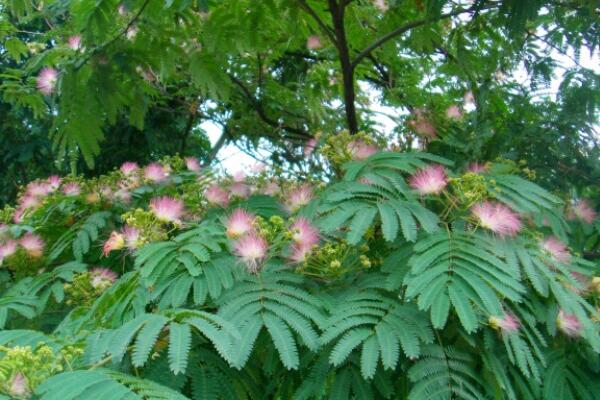
The silk tree generally refers to Albizia julibrissin, also called Persian silk tree, velvet flower tree, hehuan, night-blooming tree, and bird velvet. It is native to China, Japan, South Korea, and North Korea. It is the city tree of Weihai. So how much does a silk tree sapling cost? Where is it suitable to plant? How many years until it blooms? What are the methods? According to Fabaceae data, silk tree flowers generally bloom from April to September, and will wither or bloom fully depending on hot and humid conditions. The flowering period is not fixed, because hot and humid conditions differ from place to place! From sowing to flowering takes more than 5 years. If it is transplanted nursery stock, it depends on the size of the stock; generally, one with a diameter at breast height of 5 cm can bloom the same year it is transplanted. The annual flowering period is 1 to 2 months.
How much does a silk tree sapling cost?
| Nursery Stock Name | Meter Diameter (cm) | Unit Price (yuan) |
| Silk Tree | 5 | 65~75 |
| Silk Tree | 6 | 85~110 |
| Silk Tree | 7 | 150~180 |
| Silk Tree | 8 | 230~280 |
| Silk Tree | 9 | 320~360 |
| Silk Tree | 10 | 360~400 |
| Silk Tree | 11 | 380~450 |
| Silk Tree | 12 | 550~650 |
| Silk Tree | 13 | 750~900 |
| Silk Tree | 14 | 1100~1300 |
| Silk Tree | 15 | 1300~1500 |
Where is the silk tree suitable to plant?
The silk tree is suitable for planting in subtropical regions.
The silk tree is produced in the provinces and regions from Northeast China to South China and the Southwest. It is distributed in Africa, Central Asia to East Asia; it is also cultivated in North America.
Distribution areas: East China, South China, Southwest China, as well as Liaoning, Hebei, Henan, and Shaanxi in China.
Growth habits:
It grows on hillsides or is cultivated. The silk tree is a sun-loving species and likes a warm, humid climate environment; saplings are resistant to severe cold, drought, and poor soil. In summer, the bark cannot tolerate strong sunlight, and exposure to the sun easily causes peeling and disease. The silk tree grows better in sandy soil, and fears waterlogging and damp, waterlogged conditions; the land where silk trees are planted must drain smoothly, must not accumulate water in any season, and must have abundant sunlight.
What are the planting methods for silk trees?
1. Silk tree propagation is through seed reproduction. The best sowing seasons are February, March, April, and May. The soil for planting silk tree saplings should be loose, breathable yellow soil, with sandy soil being best. Before sowing, first level and finely break up the soil, clear weeds, tree roots, and other debris, then make beds and build ridges. Before sowing, the seeds must also be sprouted by soaking them in warm water for 20 hours, then taking them out to dry and sow. The surrounding environment of the seedling bed must also have no tall shade-casting buildings, large trees, woodland, and so on, to facilitate irrigation and watering, with sufficient fertility. Seedlings emerge in 10-15 days. The sowing density is preferably 12-15 jin of seed per mu (pure seedling raising), and in the second year they are cut back and divided for transplanting.
2. After one year of growth, the silk tree seedlings of that year can grow 1.2-1.5 m tall. In the second year they are moved out and divided for transplanting, with a plant-to-row spacing of 60×100 cm. After transplanting, they are cut back, and in that year they can grow 2.5-3 m tall, with a diameter of more than 1.5-2 cm. The best transplanting season is February; after transplanting, the temperature gradually warms up. After budding, keep one of the strongest terminal buds per plant and remove the other shoots. Do not fertilize before the new branches grow to 50 cm; just water thoroughly. Apply the first fertilizer at the end of March and the beginning of April, using 80 kg of compound fertilizer per mu, broadcast it, then water. Spring is dry with little rain, so water as conditions require. It is best for nursery bases to install drip irrigation channels. Apply the second fertilizer in mid-May, still using compound fertilizer, 50 kg per mu. After May, East China and South China are about to enter the plum rain season; this is the last fertilization of the first half of the year, and no fertilizer should be applied during the high summer temperatures. In August, when the temperature cools again, apply fertilizer once more, with 0 kg of compound fertilizer per mu. In winter, broadcast farm fertilizers such as chicken manure, cow manure, and pig manure, 3-4 tons per mu. After 2-3 years of growth, when they reach 4-5 cm in diameter, they can be finally planted out and divided. The trunk height varies from place to place and should be decided accordingly; it is recommended to branch at 2.5-3 m.