Shrub Mulberry Seedling Prices, High-Yield Varieties, Planting, Pruning and Uses
Mulberry generally refers to the mulberry tree (Morus), a deciduous tree or shrub of the genus Morus, growing up to 15 m tall. The tree is rich in milky sap, and the bark is yellowish-brown. It flowers in May with catkins. The fruit ripens from June to July. So how much does a mulberry seedling cost? Which variety has high yield? What uses does it have now? How to plant and prune? According to a nursery base in Jiangsu, the price for 60CM height is about 0.9 yuan/plant; 100CM about 1.2 yuan/plant; 150CM about 1.8 yuan/plant.
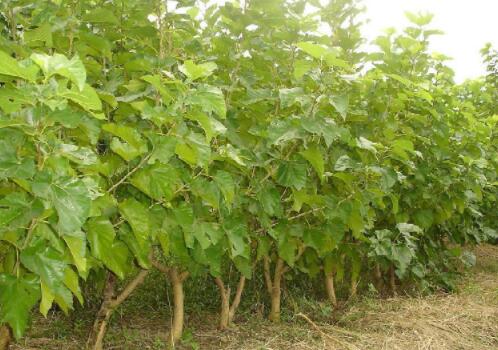
Which mulberry seedling variety has high yield?
Traditional mulberry varieties were bred for the purpose of harvesting leaves to raise silkworms, bearing no mulberries or only small fruit, and could not form large-scale industrialized production. Now a series of fruit mulberry varieties with large fruit shape and high fruit yield have been bred.
Fruit mulberries: Wuhe Da 10, Hongguo No. 2, Baiyu Wang, Fushihong, Taiwan Changguosang, Taiwan Four-Season Fruit Mulberry, etc.
Silkworm mulberries: Quercus mulberry, Xianghai mulberry, mountain mulberry, Hu mulberry, Lu mulberry, dragon mulberry, Qiuyu mulberry, etc. Traditional mulberry varieties were bred for the purpose of harvesting leaves to raise silkworms, bearing no mulberries or only small fruit, and could not form large-scale industrialized production. Now a series of fruit mulberry varieties with large fruit shape and high fruit yield have been bred.
What uses does mulberry have now?
Mulberry is a deciduous tree of the family Moraceae, cultivated throughout the country, especially in the Jiangsu and Zhejiang area, with a long history. The leaves, fruit, wood and branches of the mulberry can be used for feeding silkworms, food, wine-making, weaving baskets, paper-making and making various utensils. At the same time, its leaves, roots, bark, young branches, fruit spikes, wood and parasites are also good medicines for preventing and treating diseases.
1. Mulberry leaves: The leaves of the mulberry tree, best harvested after frost, are called frosted mulberry leaves or winter mulberry leaves. Their nature and flavor are bitter, sweet and cold, entering the lung and liver meridians, with the effects of dispelling wind and clearing heat, cooling blood and stopping bleeding, clearing the liver and improving eyesight, and moistening the lungs and stopping cough. They are often used to treat wind-heat common cold, lung-heat cough, liver-yang headache and dizziness, red eyes and blurred vision, blood-heat bleeding and night sweats. In modern times they are also used to treat elephantiasis of the lower limbs. They can be taken internally or applied externally, and have also been made into injections. In addition, after breaking the veins of fresh mulberry leaves, the white sap that seeps out is called mulberry leaf juice, bitter in taste and slightly cold in nature, skilled at detoxifying, clearing heat and stopping bleeding, mainly treating carbuncles and boils, goiter and tumors, traumatic bleeding and centipede bites. The distilled liquid of mulberry leaves can also be used to treat eye diseases.
2. Mulberry twigs: The young twigs of the mulberry tree, harvested in late spring and early summer. Their nature and flavor are bitter and neutral, tending to enter the liver meridian, skilled at dispelling wind-dampness, unblocking meridians and collaterals, benefiting the joints and promoting water flow. They are mostly used to treat wind-dampness arthralgia, limb contracture, edema, body itching and other syndromes, especially good at treating arthralgia of the upper limbs. They can be decocted or made into a paste for internal use, or decocted in water for external washing. In addition, after burning the twigs of the mulberry tree, a juice can be dripped out, called mulberry drip. Books such as the “Compendium of Materia Medica” record that it can treat “severe wind sores and scabies”, tetanus, and rotten sores on the body and face of children.
3. Mulberry root: Dug up in winter, with the cork layer removed for medicinal use. Its nature and flavor are sweet and cold, entering the lung and spleen meridians, with the effects of purging the lungs and calming asthma, and promoting water flow and reducing swelling. It is often used to treat lung-heat cough and asthma, excessive phlegm, edema, beriberi, difficult urination and other syndromes. It is mostly used in decoctions and powders, and can also be pounded into juice or decocted in water for external use. Mulberry root with bark can also be used medicinally; books record that it is slightly bitter in taste and neutral in nature, and can treat convulsions, muscle and bone pain, high blood pressure, red eyes, oral thrush, uterine bleeding and so on. In addition, the white sap in the bark of the whole mulberry tree is called mulberry bark juice, which can treat mouth sores in children and traumatic bleeding.
4. Mulberry fruit: The fruit spike borne by the mulberry tree, harvested in summer. Its nature and flavor are sweet and cold, entering the heart, liver and kidney meridians, with the effects of tonifying the liver and kidney, nourishing yin and blood, promoting fluid and moistening the intestines, and calming wind. It is often used to treat dizziness, dim vision, tinnitus, insomnia, premature graying of hair and beard due to yin deficiency and blood deficiency, as well as thirst from fluid damage and constipation from intestinal dryness. It can be decocted, made into a paste, eaten raw, steeped in wine, or used for external washing.
5. Mulberry wood: The wood of the mulberry tree has three medicinal uses. First, the ash burned from the wood, called mulberry wood ash, can treat edema, bleeding from metal wounds, red and swollen eyes, etc. Second, the crystalline substance obtained by adding water to mulberry wood ash to make a juice, then filtering and evaporating it, is called mulberry frost, which can treat food blockage and masses as well as carbuncles, gangrene and furuncles. Third, the nodules on the wood of old mulberry trees, called mulberry galls, were believed by the ancients to dispel wind and dampness, and to treat wind-dampness arthralgia and crane-knee wind in the elderly. Unfortunately, mulberry wood is now rarely used clinically.
6. Mulberry tree parasites: The wood ear fungus parasitic on the mulberry tree, called mulberry ear in ancient medicinal books, is sweet and neutral in nature and flavor, and can treat intestinal wind, bleeding hemorrhoids, nosebleeds, and uterine bleeding, vaginal discharge, and heart and abdominal pain in women. In addition, the mulberry mistletoe currently used clinically is the branches and leaves of various plants of the family Loranthaceae, but the ancients believed that those parasitic on mulberry trees were the best. Its nature and flavor are bitter and neutral, entering the liver and kidney meridians, skilled at dispelling wind-dampness, tonifying the liver and kidney, strengthening muscles and bones, and nourishing blood and calming the fetus. It is used to treat wind-dampness arthralgia, soreness and pain of the waist and knees, and uterine bleeding, vaginal discharge, and restless fetus in women.
How to plant and prune mulberry?
Planting techniques:
1. Sowing method
Selecting and preparing the seedling land well is the first step. It is advisable to choose fertile, loose soil with convenient drainage, sandy loam, as the nursery. 4~6 days before sowing, it is best to spray herbicide comprehensively. For each mu of land, 2~3 jin of chlordane powder pesticide can also be spread, then harrow the land lengthwise and crosswise. Depending on drainage conditions, generally make beds 4 cun high and 4 chi wide. The bed surface should preferably be fine, crumbly and level.
Mulberry seeds should be sown as soon as possible after purchase. Mix each portion of seeds with five portions of fine soil, (if the land has not been spread with pesticide, pesticide should also be mixed in). Divide by bed according to weight, with a thickness such that the bed soil is faintly visible. After covering, carry out the first watering. If conditions permit, germination can be promoted before sowing. The method is to soak the mulberry seeds in clean water for 24 hours, take them out and spread them in a shallow tray, with a thickness not exceeding 1 cun, cover with a wet cloth, and place in a relatively warm place (23~30°C) to promote germination, sprinkling water and turning once or twice a day, always keeping them moist. Sow after most mulberry seeds show white (that is, the young roots emerge). The mulberry sprouts must not be allowed to grow too long, so as to avoid damage during sowing.
After sowing, water is the lifeline, especially for germinated seeds. Within half a month just after sowing, water must be given every morning and evening, always keeping the soil surface moist. Management after sowing is the key to full and strong seedlings. When the mulberry seedlings are about 1 cun tall, remove the overly dense mulberry plants, with a plant spacing of 1 cun. When the seedlings are 2~3 cun, use the thinned mulberry plants to fill gaps, with a plant spacing of 1~1.5 cun. Thinning and filling are best done after rain or after watering, ensuring about 80,000 to 150,000 seedlings per mu. After the mulberry seedlings grow, remove the grass as appropriate.
2. Grafting for seedling raising
Generally, seedlings propagated from local mulberry varieties' seeds are used as rootstock, and branches of excellent mulberry varieties with high yield and good leaf quality are used as scions. Check whether they have survived 10 to 15 days after grafting; those that have not survived need to be regrafted. Also pay attention to preventing diseases and pests, removing rootstock sprouts, and timely irrigation and fertilization to promote the growth of new shoots.
3. Cutting propagation for seedling raising
Hardwood cutting uses new shoots cut during spring pruning as cuttings, inserted in early April; greenwood cutting uses new shoots cut during summer pruning as cuttings, inserted in late May. Before cutting, cut the branches into 16-20 cm lengths. The upper cut of each branch should be a cross-section, with a plump bud 1 cm from the cut; the lower cut should be close to the leaf scar and cut into a smooth slant. Then place them indoors in sand storage for 15-20 days. The specific method is: tie the sand-stored branches into a bundle, soak in 50ppm ABT rooting powder solution for 35 hours, then bury them upside down in an open-air rooting pool lined with fine sand, cover with 15 cm of sand, and then cover with nylon film. After days, take out the branches and plant them in the seedbed, with the buds not exposed after planting.
Pruning:
1. After the trees shed their leaves in autumn, the first pruning can be carried out, cutting off small, thin branches. The purpose is to prevent nutrients from being absorbed and wasted by small branches throughout the winter.
2. Then wait until before sprouting in early spring of the following year, and prune again. At this time, the main target of pruning is the top of the plant's branches, that is, the tip. The purpose of doing this is to inhibit the plant's apical dominance, so that more leaves and flower buds can be forced out on the branches. (With this method the plant will grow very robustly and bear a lot of fruit.)
Other pruning methods can be summarized as pruning for the plant's shape, determined according to your own needs, but the principle is not to prune thick main branches easily, because the plant's wounds can also become “infected” (rot). If you really want to prune off the main branches, then after pruning, wrap the wounds well with plastic film, mainly to prevent water.