Introduction to the price, flowering time, planting and pruning methods of young Sophora japonica 'Pendula' trees
Sophora japonica 'Pendula' is a bud-sport variety of the Chinese scholar tree (Sophora japonica), also called weeping pagoda tree or coiled pagoda tree. It is a tree reaching up to 25 m tall; the bark is grayish-brown with longitudinal cracks. Current-year branches are green and hairless. So how much does a young Sophora japonica 'Pendula' sapling cost approximately? When does it bloom? How do you plant and prune it? What does it symbolize? According to Fabaceae data, Sophora japonica 'Pendula', as a bud-sport variety of the Chinese scholar tree, usually blooms in July and August and fruits in September and October. Every blooming season, pale yellow inflorescences cover the branches, like a yellow umbrella blocking the view; the flowers are yellowish-white or pale yellow, each with 5 petals, with a green pistil in the center and yellow stamens around the green pistil, fresh and elegant. The flower language of Sophora japonica 'Pendula' is “crystal-clear, beautiful, and free from vulgarity”.
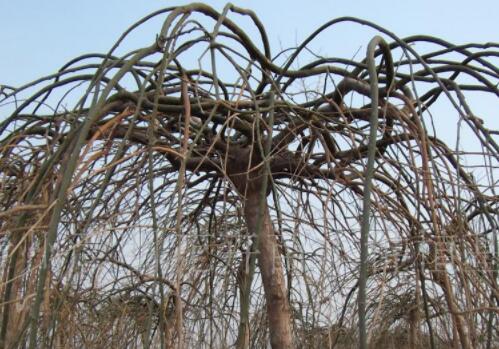
How much does a young Sophora japonica 'Pendula' sapling cost approximately?
| Nursery stock name | Meter diameter (cm) | Graft point (cm) | Unit price (yuan) |
| Sophora japonica 'Pendula' | 5 | 160~200 | 130~150 |
| Sophora japonica 'Pendula' | 6 | 160~200 | 190~240 |
| Sophora japonica 'Pendula' | 7 | 160~200 | 380~450 |
| Sophora japonica 'Pendula' | 8 | 160~200 | 480~550 |
| Sophora japonica 'Pendula' | 9 | 160~200 | 580~650 |
| Sophora japonica 'Pendula' | 10 | 160~200 | 850~1000 |
How do you plant and prune Sophora japonica 'Pendula'?
Planting:
1. Sophora japonica 'Pendula' by nature likes light and heat, and has a certain tolerance for shade. It can adapt to dry and cold climates and tolerates waterlogging. It is suitable for growing in fertile soil with normal drainage, including loess; black soil and red soil also work. It requires deep, moist, fertile, well-drained sandy loam. Sophora japonica 'Pendula' is a deep-rooted tree species with a well-developed root system, strong wind resistance, strong sprouting ability, and a long lifespan. It is propagated by grafting, with the Chinese scholar tree as the rootstock. The graft point is generally 2 m or more than 2 m high, and the grafting method is cleft grafting. The best time is the middle of the second lunar month, when the ground has thawed and before the trees sprout, around Qingming Festival.
2. Sophora japonica 'Pendula' is produced by grafting onto the Chinese scholar tree and cannot reproduce under natural conditions. Before sprouting in spring, take one-year-old Sophora japonica 'Pendula' branches and graft them by cleft grafting; after 3~5 years of growth, they take shape. The planting techniques and methods for Sophora japonica 'Pendula' are the same as for the Chinese scholar tree, requiring fertile soil and water, sufficient light, and smooth drainage.
Pruning:
I. Summer pruning of Sophora japonica 'Pendula'
In summer, Sophora japonica 'Pendula' grows vigorously. To form a more perfect tree shape as early as possible and improve its ornamental value, summer pruning is especially important. During the vigorous growth period, shorten the current-year weeping branches, generally cutting off 2/3 or 3/4 of the branch, to encourage more branches to emerge at the cut and expand the shape of the crown. When shortening, the bud at the cut should be an upper bud or a lateral bud on the branch, so that the new shoots that sprout extend outward in a parabolic shape.
II. Winter pruning of Sophora japonica 'Pendula'
In winter, after Sophora japonica 'Pendula' has lost all its leaves, the interlacing branches can be seen clearly, so pruning at this time should be more careful and meticulous. First, adjust the shape of the crown, using ropes or galvanized wire to change the growth direction of the branches, pulling branches growing too densely nearby to positions where branches are missing and fixing them there, so that the branches of the whole crown are evenly distributed. Second, cut off, one by one, the dead branches, diseased and weak branches, and overly dense branches inside the crown, then, according to the thickness of branch growth, shorten the branches at the highest point of curvature while keeping an upper bud, generally requiring thick and strong branches to be left longer than thin and weak branches.
III. Special shaping of Sophora japonica 'Pendula'
1. Green corridor pruning method
For Sophora japonica 'Pendula' on both sides of a park entrance, after planting, a trellis can be set up at the entrance, and the branches on both sides near the path can be led onto the trellis to grow toward each other. After a few years, when the branches interweave and are fixed together, the trellis can be removed. In this way, a green corridor appears at the park entrance, forming a distinctive landscape.
2. Ripple umbrella-surface pruning method
In the first year, shorten the reserved branches at the highest point of curvature while keeping an upper bud. In the second year, prune the weeping branches starting from the bottom end, leaving about 15 cm and keeping an outer bud. In the third year, as in the first year, shorten at the highest point of curvature while keeping an upper bud. After several years, a rippled umbrella surface forms, which is very beautiful whether planted as a specimen or in rows.
What does Sophora japonica 'Pendula' symbolize?
The pagoda tree is considered to represent “lu” (official salary/fortune) and is an auspicious tree species. In feng shui, the pagoda tree is regarded as the king of all trees; planting a pagoda tree can increase one's “lu” and authority, and it also has the effect of guarding the home. Sophora japonica 'Pendula' is a variant of the pagoda tree and has even higher ornamental value.