A detailed guide to palm trees: evergreen trees, seedling prices, transplanting, planting, and whether the fruit is edible
The palm tree is an evergreen tree. Its trunk is cylindrical and often retains old leaf stalks and the leaf bases below them. It is native to China, blooms from April to May, and its fruit ripens from October to November. So about how much does a palm seedling cost per plant? When should it be transplanted? How should it be planted? Can its fruit be eaten? According to Mr. Li of a Nanjing nursery, a palm 0.5M tall costs 12 yuan; a palm 1m tall costs 35 yuan; a palm 1.5m tall costs 75 yuan; a palm 2M tall costs 120 yuan; a palm 2.5m tall costs 180 yuan; a palm 3m tall costs 280 yuan; the real-time sapling price may fluctuate up or down according to the time and season, market conditions, the size of the soil ball, and the quality grade.
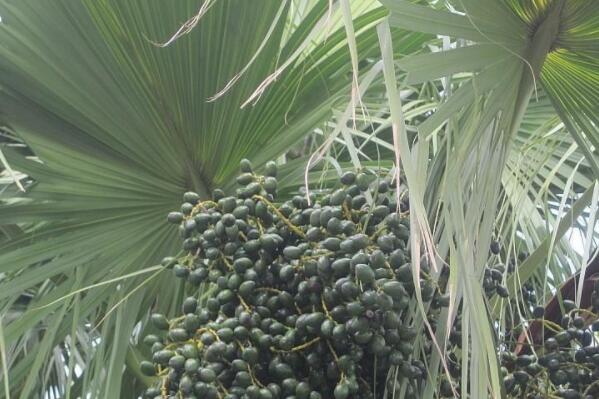
When should palm trees be transplanted?
Palm plants are best transplanted within a period after they sprout and take root. At this time the seedlings are smaller and can be transplanted with the seed, and since they have few fibrous roots, the root system is not easily damaged during transplanting. Use nutrient bags for raising seedlings; the size depends on how long the seedlings will be grown. Generally speaking, for 1-year-old seedlings a 16 cm × 18 cm container is suitable, and for 2-year-old seedlings use 19 cm × 20 cm. Nutrient bags that are too small are not conducive to rapid seedling growth. For the nutrient soil, use loose topsoil, burnt soil and wheat bran, mix them evenly in a 5:2:1 ratio with a small amount of phosphate fertilizer, then fill the bags. First fill half the bag with the mixed soil, then place the seedling, then hold the seedling upright, fill the bag full and press it firm so that the seedling roots adhere closely to the mixed soil, then water thoroughly. Palm plants must not be planted too deep, otherwise it will affect seedling growth. If planted too deep, pull the seedling upward so that the seedling roots spread out.
How are palm trees planted?
Pre-planting management:
1. Selection of the planting site. Palms like a warm and humid climate, so the author chose a planting site that is sheltered from the wind and faces the sun, with relatively good microclimate conditions. Two meters to the north is a five-story building, and on both the east and west sides flower shrubs such as lilacs are planted. The soil at the planting site is sandy loam, with a pH value of 8.5 and a salt content of 0.15%. Because palms have a certain resistance to salinity and alkalinity, no measures such as bringing in foreign soil were taken; only debris such as bricks was cleared away.
2. Digging the hole and planting. The planting hole size is 100 × 100 × 80 cm. When digging, pile the topsoil and subsoil separately, and mix 0.15 kg of sulfur powder into them. At the bottom of the pit, place decomposed and fermented leaf fertilizer and cow and horse manure, about 15 cm thick, and cover it with 35 cm of soil. Put the plant into the pit, hold it upright, then fill with soil, tread it firm layer by layer, water it, and cut open the straw rope tied around the tree body so that it can stretch out naturally. Then carry out leaf thinning, keeping only 5 to 6 leaves per plant, and finally spray the tree body.
Post-planting management:
1. Watering. After planting is completed, water a second time on the third day and a third time on the seventh day, and spray the leaf surface of the tree body every day in the morning and afternoon when sunlight is abundant (stop after one month). After summer arrives, water thoroughly about once every 30 days; delay watering on cloudy and rainy days; water thoroughly one last time at the end of September; in early November water with winterizing water and earth up the roots. In the following years, only water once each in early spring and early winter with green-up water and winterizing water respectively, and at other times no special watering was done, letting it grow by relying on rain. Besides doing the watering work well, standing water must also be drained promptly on rainy days.
2. Fertilizing. Because base fertilizer was applied when the palms were planted, in the first year no additional fertilizer was applied except for one application of chicken manure before winter combined with watering winterizing water. After that, apply chicken manure or sesame paste residue once each after the beginning of spring and before freezing every year.
3. Shading. In the summer of the year of planting, shade it from mid-June to mid-September; after the second year, no more shading is used.
4. Cold protection. Cold protection is the key factor for successful introduction. In order to allow the plants to overwinter safely, methods of burying soil at the roots, wrapping the trunk with straw rope, and covering the tree body with film were adopted. Insulation was done in mid-November of that year; after the Beginning of Spring the following year, holes were gradually punched in the film for ventilation, and after Qingming it was removed completely. Through the above measures, all the planted palms overwintered safely with no freezing damage. In the following years, no measures were taken in winter, and they were left to overwinter naturally.
5. Pest and disease control. During the introduction process, a small amount of scale insects and scarab beetles were found causing damage. When the number is small, they can be removed by hand; when there are many, they can be killed by spraying with a 1000-fold solution of 40% omethoate emulsifiable concentrate. No diseases were found during the introduction process
Can palm tree fruit be eaten?
Delicious, deep-fried, a satisfaction for the taste buds.
When the palm flower is still at the bud stage, its appearance looks like a fish. The outside is wrapped in layer after layer of a shell similar to bamboo shoot sheaths, and inside are densely packed small flower buds, just like fish roe. The palm flower is a very good vegetable-fruit, rich in nutrients, and has the medicinal effects of reducing inflammation, clearing internal heat and lowering blood pressure. It can be eaten raw or cooked.
Some palm flowers are bitter, some are sweet. In terms of form, the sweet ones are broad, plump and full-bodied, while the bitter ones are round, thick and slender.
Cooking methods: stir-fried with diced meat or cured meat, stewed with chicken, made into soup, with auxiliary ingredients of ginger, scallion white, chili and pickled cabbage. It is colorful and fragrant, crisp and refreshing.