Can the evergreen small shrub heavenly bamboo (Nandina domestica) survive in northern China? Seedling prices and planting methods
Heavenly bamboo is also known as Nantianzhu, Hongpazi, Tianzhuzi, Honggouzi, Zuanshihuang, Tianzhu and Lanzhu. Because of its elegant and refined form, it is often used to make bonsai or potted plants to decorate windowsills, entrance halls, conference venues and so on. So can heavenly bamboo survive in northern China? How much does a seedling cost? What are the planting methods? What are its effects and functions? According to a nursery stock base in Jiangsu, 1 cm heavenly bamboo seedlings cost about 0.6 yuan each; 60 cm ones about 1.2 yuan each; and 120 cm ones about 18 yuan each.
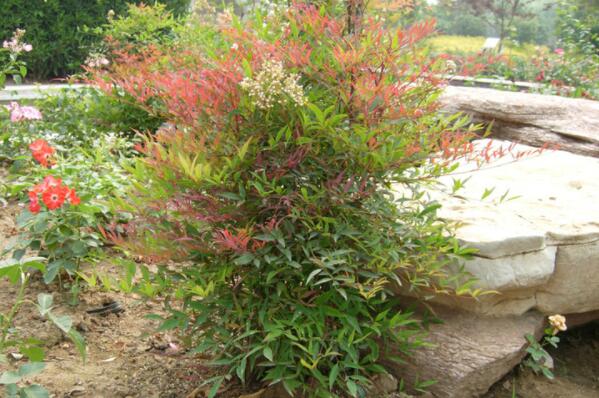
Can heavenly bamboo survive in northern China?
Yes, it can.
Heavenly bamboo likes warmth and humidity, and it adapts widely to the soil and climate south of the Yellow River. In North China it is still mainly grown in pots, and in a few places it has already been cultivated in the open field; for example, it has been grown in the open field in the courtyard of the Wofo Temple in the Western Hills for many years. Therefore, in courtyards with a favorable microclimate in urban Beijing, it has good prospects for wider planting. Choose an environment that can shelter it from wind and cold in winter, such as planting at the base of a wall, where the microclimate temperature can be 3-5C higher than in open areas; more importantly, replace the soil and apply fertilizer, choosing good humic acid soil, which can retain water and nutrients and bring the soil pH to neutral to slightly alkaline; do not expose it to excessive sunlight. If such a small courtyard environment can be created, heavenly bamboo can completely overwinter safely and grow vigorously in Beijing.
What are the planting methods for heavenly bamboo?
Propagation methods
Propagation is mainly by sowing and division, and can also be done by cuttings. Seeds can be sown as soon as the fruit matures, or sown in spring. Division should be done before spring sprouting or in autumn. Cuttings should be taken before the new buds sprout or in summer when the new shoots stop growing. Indoor care should strengthen ventilation and light transmission to prevent the occurrence of scale insects.
Seed propagation
Collect seeds in autumn and sow immediately after collection. On a prepared seedbed, open furrows 33 cm apart and about 10 cm deep, sow the seeds evenly, with a sowing rate of 90-120 kg per hectare. After sowing, cover with plant ash and fine soil, and press firmly. In the second year the seedlings grow slowly, so weeds should be removed frequently, the soil should be loosened, and light human and livestock manure and urine should be applied. After that, pay attention every year to intertillage and weeding. For topdressing, after 3 years of cultivation the plants can be lifted from the nursery and planted out. Transplanting is best done after rain in spring. The spacing between plants and rows is 100 cm each. Before planting, dig up the seedlings with soil; if they cannot be kept with soil, the roots must be dipped in thin mud slurry, so that they are easier to keep alive after planting.
Division propagation
In spring and autumn, dig out the clumping plants, shake off the old soil, cut them apart at the weak points where the bases join, keeping 2 to 3 stems per clump, with part of the root system, and at the same time cut off some of the larger pinnate compound leaves, then plant in the ground or in pots; after one or two years of cultivation they will bloom and bear fruit.
Site selection and land preparation
Choose sandy loam with deep, fertile soil and good drainage and irrigation. Slopes and level ground with good drainage and neutral to slightly alkaline soil can also be planted. Corner and gap plots can also be used for cultivation. Before planting, prepare low beds or high beds 120-150 cm wide.
Field management
Heavenly bamboo is suitable for slightly acidic soil, and it can be mixed in a ratio of 5 parts sandy soil, 4 parts leaf mold, and 1 part manure soil. Before planting, first cover the small drainage hole at the bottom of the pot with broken tiles; adding a layer of charcoal is even better, as it helps drainage and sterilization. Generally the root ball of the plant carries soil; if there are broken roots, torn roots, blackened roots or excess roots, they should be cut off. Plant the plant in the usual way by adding soil, water it thoroughly, and place it in a shady place; after about 15 days it can be exposed to sunlight. Repot once every 1-2 years; usually take the plant out of the pot, remove the old potting soil, cut off most of the root system, remove thin, weak and overly short branches and shape the trunk, keeping 3-5 plants as appropriate, plant them into the pot with potting soil, keep them shaded for care, and after half a month return to normal management. Heavenly bamboo is best cared for in semi-shade, cool and humid places. Under strong light, the stems become short and thick and turn dark red, the young leaves are “burned”, and the mature leaves turn red; in very shady places, the stems are thin and the leaves are long, and the plant clump is loose, which damages its ornamental value and is also unfavorable for fruiting. The suitable growing temperature for heavenly bamboo is about 20℃, and the suitable temperature for flowering and fruiting is 24-25℃. In winter, move it into a greenhouse, generally not lower than 0℃. After Qingming Festival the following year, move it outdoors.
Watering heavenly bamboo should follow the principle of watering when dry and withholding when wet. In dry seasons, water frequently to keep the soil moist; in summer, water once a day and spray the leaf surface 2-3 times to keep the leaves moist and prevent the leaf tips from scorching, which would harm the appearance. When flowering, special attention should be paid to watering so that the potting soil does not dry out, and water should be sprinkled on the ground to raise air humidity, so as to help increase the pollination rate. In winter the plant is in a semi-dormant state, so do not let the potting soil become too wet. As for watering time, in summer it is best done in the morning and evening, and in winter at noon. During the growing period, thin seedlings should be given a light fertilizer about once every half month (organic fertilizer rich in phosphorus is suitable). Adult plants are given dry fertilizer three times a year, in May, August and October respectively; the third application should be made when they are moved indoors to overwinter. Fertilizers can include fully fermented cake fertilizer and sesame paste residue. The amount applied should generally be less for the first and second applications, and can be increased for the third. During the growing period, cut off root suckers and densely growing branches, cut off branches with longer fruit spikes, and keep 1 or 2 lower branches, so as to maintain a beautiful plant shape and promote flowering and fruiting.
In the first year after planting, carry out intertillage, weeding and topdressing once each in spring, summer and winter, and also fill in gaps where seedlings are missing. After that, carry out intertillage, weeding and topdressing only once each year in spring or winter.
Four to five years after planting heavenly bamboo, some old stems can be cut and harvested in winter. After 6-7 years, the whole plant can be dug up, the soil shaken off, the leaves removed, and the stems and roots split into thin slices and dried in the sun for later use. In October-November, when the fruit turns red or yellowish-white, harvest it and dry it in the sun for later use.
Appendix: Effects and functions of heavenly bamboo
Functions and indications
Damp-heat jaundice, gastroenteritis, urinary tract infection, conjunctivitis, cough, wheezing, whooping cough, indigestion, diarrhea, blood in the urine, lumbar muscle strain.
Root and stem: clear heat and remove dampness, unblock meridians and activate collaterals. Used for cold and fever, conjunctivitis, cough due to lung heat, damp-heat jaundice, acute gastroenteritis, urinary tract infection, and traumatic injuries.
Fruit: bitter, neutral. Slightly toxic. Relieves cough and calms wheezing. Used for cough, asthma, and whooping cough.