Pittosporum: Can It Be Grown in Pots, When Does It Bloom, Seedling Prices and Planting
Pittosporum is also called pittosporum flower, shanfan, qilixiang, baozhuxiang, and shanruixiang. It belongs to the genus Pittosporum and is an evergreen shrub or small tree, reaching up to 6 m tall. So when does pittosporum generally bloom? How much does a seedling cost per plant? Can it be grown in pots? How do you plant it? According to the nursery base in Shuyang, Jiangsu, pittosporum seedlings at 40CM are 1.2 yuan/plant; 50CM are 1.6 yuan/plant; 55CM are 2.5 yuan/plant; 100CM are 30 yuan/plant.
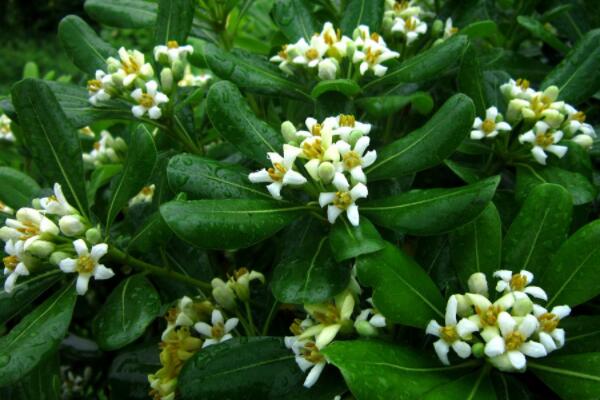
When does pittosporum generally bloom?
1. Pittosporum must be grown for 2 years before it blooms. Pittosporum is a biennial plant; usually in the year the seed germinates it only grows roots and leaves, and it does not bloom and set seed until the second year of cultivation. Pittosporum has strong adaptability to climate, can withstand cold, and is also quite tolerant of heat. It is relatively easy to plant and needs no special management.
2. Pittosporum's blooming time is roughly March to May each year, and a single flowering period generally lasts about 10-20 days. The flowers of pittosporum are umbels or corymbose umbels, terminal or nearly terminal, and the flower color is white. When in bloom they are clear, beautiful and fragrant, with high ornamental value.
Can pittosporum be grown in pots?
Pittosporum can be grown in pots.
1. Pittosporum likes warm, humid environments, likes sunlight, and also tolerates partial shade. It requires loose, fertile soil. In the south it is mostly propagated by sowing, while in the north it is mostly propagated by cuttings in spring. For pot cultivation, young plants should be repotted once each spring, and mature plants once every other year. When repotting, remove dead branches, add new fertile potting soil, and use a small amount of bone meal as base fertilizer.
2. During the growing season, often spray water on the leaf surface to help maintain leaf gloss. Water according to “water when dry, stop when wet”. Apply 1~2 times of thin cake fertilizer water before and after flowering. Stop fertilizing during the flowering period, and appropriately control the amount of watering to prevent flower drop. In the north, move indoors after the Cold Dew solar term to overwinter. After moving indoors, place it in a sunny spot, keep the room temperature above 5℃, and pay attention to proper ventilation and increasing indoor air humidity. If scale insects are found, control them promptly. When the indoor temperature is low in winter, strictly control watering so it can fully rest, which helps growth and flowering the following year.
3. Pittosporum has strong branching ability and tolerates pruning. To keep it from growing into a clump-forming shrub, prune starting from the seedling stage. When the plant grows to about 30 cm, retain about 20 cm and pinch off the top to encourage side branches to sprout. When the side branches reach a certain length, pinch them again, and promptly cut off root suckers. After autumn each year, before moving indoors, do another cutting back, shaping the crown into a round ball to improve ornamental value.
How do you plant pittosporum?
1. Pittosporum is relatively drought-tolerant. In summer it consumes a large amount of water, so water frequently; in winter, if the temperature is low, the amount of watering should be reduced accordingly. Air humidity should be around 50%. It requires fertile soil. During the growing season, apply fertilizer 1-2 times a month; at other times, no fertilizer is needed. Young plants should be repotted once a year, and mature plants once every 2-3 years. For the potting mix, use 1/3 leaf mold plus 2/3 clay or loam. It has strong sprouting ability and tolerates pruning. It can be pruned into various shapes each spring.
2. Pittosporum is easy to cultivate and needs no special management. Field transplanting is generally done in March. If planting in autumn, it should be around October. Before digging up large seedlings, they must be tied with rope to prevent branches from breaking, and when digging they must be kept with a soil ball; the size of the soil ball depends on the thickness of the trunk. Small seedlings can be transplanted bare-rooted, but it must also be done promptly. Potted pittosporum should be repotted once each spring. When repotting, cut off dead roots, and the potting soil should be supplemented with new culture soil containing more organic matter.
3. Pittosporum has strong branching ability and tolerates pruning. At the beginning of spring it needs pruning and shaping to maintain a beautiful tree form. If you want to restrain its growth and make its branches and leaves lush, cut off the top when it grows to the corresponding height. Some also prune it into various forms. In summer it can be placed outdoors; if conditions allow, it can be placed in a shaded spot under flowers. Strong light does not harm the plant. Air humidity is around 50%. The suitable growth temperature is 15-30℃. In winter, place it indoors where it is cool but does not freeze, with a minimum temperature of 5℃. In summer it consumes a large amount of water, so water frequently; in winter, if the temperature is low, reduce the amount of watering accordingly. During the growing season, apply fertilizer once every two weeks; at other times, no fertilizer is needed. Although pittosporum tolerates shade, the planting site should not be too shady, and plants should not be too dense; otherwise it is prone to damage by cottony cushion scale, and flies often gather during flowering, so attention should be paid to prevention and control.