Symptoms of blackleg disease in tobacco, potato, cabbage, and geranium, and the pesticides used for its control
Blackleg is a bacterial disease. The pathogen can overwinter on plant residues in the soil or on diseased tubers during storage, but it cannot survive in the soil for too long. It occurs on crops such as tobacco, potato, cabbage, Chinese cabbage, and geranium. So what are the symptoms of blackleg disease? What pesticides should be used?
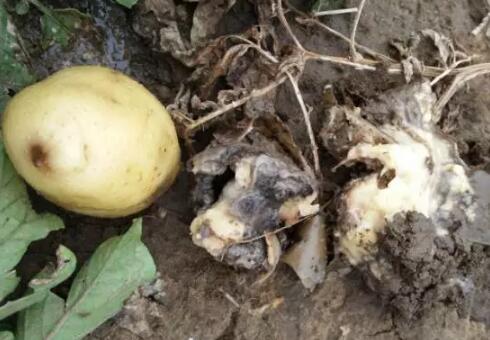
Potato blackleg
Potato blackleg is a bacterial disease that infects vascular bundle tissue, and it can occur throughout the entire growth cycle of the potato. Warm and humid conditions favor the invasion of this pathogen, especially in years with abundant rain; in low-lying areas, potatoes suffer even more severe damage from blackleg.
Symptom manifestation
Seed tubers: Infected seed tubers rot into a slimy mass, do not sprout, or rot in the soil just after sprouting and fail to emerge.
Seedlings: Infected seedlings generally show symptoms at a plant height of 15-18 cm; the plants are stunted with shortened internodes, or the leaves curl upward and turn chlorotic and yellow, or the stem base turns black and the plant wilts and dies. A cross-section of the stem shows three main vascular bundles turning brown.
Tubers in the field: Infected tubers start at the navel end and spread radially toward the pith; the diseased area is dark brown, and a cross-section shows the vascular bundles are also dark brown. When pressed by hand, the skin and flesh do not separate. Under high humidity, the tubers turn dark brown, rot, and give off a foul odor, which distinguishes it from bacterial wilt.
Transmission routes and patterns
Seed tuber transmission: Seed tubers carry the bacteria, while the soil generally does not. Contamination by the cutting knife when cutting seed potatoes is the main route of disease spread. The pathogen first spreads and expands infection through cut seed pieces, causing more seed tubers to become diseased, then enters the plant through the vascular bundles or pith, causing disease in the aboveground parts.
Field transmission: In the field, the pathogen can spread through irrigation water, rainwater, or insects, invading through wounds to cause disease. Later, the pathogen on diseased plants is transmitted from the aboveground stems through stolons to newly formed tubers.
Storage transmission: During storage, the pathogen enters healthy tubers through wounds or lenticels via contact between diseased and healthy tubers, causing infection.
Morphological characteristics
Potato blackleg is a bacterial disease; the pathogen belongs to the genus Erwinia. The bacterial cells are short rod-shaped with rounded ends, bear 4-5 peritrichous flagella, have no spores, and are Gram-negative. On agar medium, the colonies are grayish-white and round. The pathogen can grow well within the range of 10-38°C, with the optimum at 25-27°C, and loses viability above 45°C.
Control methods
(1) Select disease-resistant varieties.
(2) Select disease-free seed tubers and establish disease-free seed production fields.
(3) Sterilize the cutting knife promptly with alcohol or potassium permanganate when cutting seed potatoes. After cutting, treat the seed pieces with Jiasuomi or Cailong, then dry them in the shade and sow immediately.
(4) Sow early at the appropriate time, pay attention to drainage, reduce soil moisture, raise soil temperature, and promote early emergence.
(5) Strictly select seed tubers before storing them in the cellar, strengthen management after storage, and keep the cellar temperature at 1-4°C to prevent excessively high cellar temperature and excessive humidity.
(6) Chemical control:
After emergence, use 100 mL of Jiasuomi or Cailong for foliar spraying as a preventive measure; in the early stage of disease, use 300 mL of Jiasuomi or Cailong for root drenching in drip-irrigated fields, and 500 mL for root drenching in sprinkler-irrigated fields. In the middle and late stages of disease, use 200 g/mu of Jiaruinong for drip irrigation and 300 g/mu for sprinkler irrigation.
Tobacco blackleg
Symptoms
When seedlings become diseased, most first develop black spots on the roots and stems near the soil surface; the diseased area expands upward and downward, extending to all stems, leaves, and the main root. The base of the diseased stem becomes constricted and thin, easily causing damping-off. Under high humidity and rainy conditions, the diseased seedlings rot completely, producing white cottony mold on the surface, and rapidly spread to nearby seedlings, causing tobacco seedlings to rot and die in patches. If the weather is dry, the diseased seedlings dry up and turn dark brown. When seedlings are only mildly affected, the symptoms are not obvious. After tobacco seedlings are transplanted to the field, they are highly prone to disease under high temperature and high humidity. Most first begin to blacken at the junction of the root and stem near the soil surface and expand upward, often reaching as high as 0.6-1 chi, hence the name blackleg disease. Sometimes the middle part of the stem becomes diseased and black, causing the tobacco plant to die; sometimes the stem shows no lesions but the plant withers and dies. When the diseased plant is pulled up, the main root and branch roots are seen to be black and rotted. Although this disease has various symptoms, the common feature is that the leaves of diseased plants gradually turn yellow, droop, and wilt from bottom to top; in the early stage of disease, they can recover after the night passes. After 4-5 days, all leaves wither, and finally the whole plant dies. Because most of the fine roots of diseased plants rot, they are very easy to pull up. When the affected stem is cut longitudinally, in addition to the cortex turning black, the pith also turns dark brown and shrinks and dries into overlapping sheets, with sparse white mold growing between the sheets. In rainy and humid weather, white mold also grows on the surface of the diseased tissue.
Control methods
1. Select and plant disease-resistant varieties.
2. Strengthen cultivation management. In cultivation, spring tobacco should be developed and transplanting should be advanced so that the infection stage avoids the rainy season. Implement crop rotation of more than three years; ridge and hill up soil, open ditches for drainage, and ensure that tobacco fields do not accumulate water or let “passing water” flow through; after ridging, the surface flowing water should not contact the stem base to reduce infection opportunities; apply clean fertilizer and keep flowing water from being contaminated by the pathogen; diseased plants that are pulled out and diseased leaves that are picked off should be centrally disposed of.
3. Chemical control. Based on the three characteristics of the blackleg pathogen - that zoospores move in the surface soil layer to cause secondary infection, that it mainly infects the stem base, and that the infection stage is after transplanting and before budding - chemical control can generally achieve more than 60% control efficacy. This is especially necessary for some high-quality varieties with poor disease resistance. Dexon can be used at 7 liang per mu, mixed evenly with 30-40 jin of dry fine soil, and applied as medicated soil once before closing the hill and once before ridging, scattered around the tobacco plants, then immediately covered with soil to prevent Dexon from losing effectiveness due to light exposure.
Cabbage blackleg
It mostly occurs in high-temperature, high-humidity areas and seasons, and can be damaged at both the seedling stage and the adult plant stage, causing plant death in severe cases. In addition to harming cabbage, this disease also harms Chinese cabbage, rapeseed, cauliflower, turnip, radish, head cabbage, Chinese kale, and celery, etc.
Symptoms
At the seedling stage, light brown lesions appear on cotyledons, true leaves, and young stems. The lesions are round or oval, with small black dots scattered on them. The lesions on young stems are slightly sunken, and severely diseased seedlings quickly die. At the adult plant stage, leaf lesions are the same as at the seedling stage, and purple-black streaks form on the main and lateral roots, causing root rot, or the plant breaks and falls at the diseased stem.
Control methods
Seed treatment: Soak seeds in warm water at 50°C for 20 minutes. Chemical seed dressing: Dress seeds with 50% thiram wettable powder, with the pesticide weight being 0.4% of the seed weight. Soil treatment: Use 40% thiram wettable powder or 40% quintozene powder at 8-10 g per square meter, mixed with 30-40 kg of fine dry soil, and spread on the bed surface at sowing. Crop rotation: For heavily affected fields, change crops in time or rotate with non-cruciferous vegetables; rotation with field crops is better, with an interval of more than 3 years. Chemical control: Spray pesticide in the early stage of disease, using 75% chlorothalonil wettable powder at 600 times dilution, or 40% polysulfide suspension concentrate at 600 times dilution, or 60% duofu wettable powder at 600 times dilution, etc., spraying once every 8-10 days for 2 consecutive sprays.
Geranium blackleg
Symptoms
This disease occurs on both cuttings and adult plants, with cuttings suffering more severely. Rot begins from the stem base and develops upward, causing death. After adult plants become diseased, they turn black and the disease expands upward, leaves drop off, and eventually the entire plant withers and dies.
Pathogen
Pythium splendens, belonging to the subphylum Mastigomycotina. The hyphae are well developed, branched, and non-septate, appearing white and cottony when growing vigorously. Sporangia are filamentous, round, or nearly round, and produce zoospores that cause infection.
Control methods
1. When taking cuttings, cut shoots from healthy plants and insert them in a seedbed free of the pathogen.
2. When transplanting, change to a new plot or replace the potting soil to prevent transmission of the disease. If necessary, apply 70% Dexon wettable powder at 1000-1500 times dilution to the soil surface.
Broccoli blackleg
[Symptoms] Also called root rot, black root disease, etc. It can be damaged at both the seedling stage and the adult plant stage. At the seedling stage, grayish-white irregular lesions can appear on cotyledons, true leaves, or young stems. When the stem base is infected, the disease spreads to the roots, forming dark purple streak-like lesions. In severe cases of stem base canker, diseased plants easily break and dry up. At the adult plant stage, irregular to angular grayish-white large lesions form on leaves, with many small black dots on them, namely the pathogen's pycnidia. Infection of flower stalks and seed pods is similar to that on stems. In seed plants, infection during storage causes dry rot of the head; when the diseased stem is cut open, the vascular bundles of the diseased roots turn black.