Mucuna birdwoodiana seed price per jin, planting and flowering time, planting methods and benefits
Mucuna birdwoodiana, also known as niumateng, evergreen mucuna, and daxueteng, is deep purple and called heque flower, also known as que'er flower. It is an excellent vine for trellises and vertical greening. So how much does a jin of Mucuna birdwoodiana seeds cost? When is it planted and when does it bloom? How is it planted? What benefits and effects does it have? Learned from the Jiujiang nursery stock base, the price of Mucuna birdwoodiana seeds is around 26 yuan/jin, but prices vary slightly between different varieties and batches.
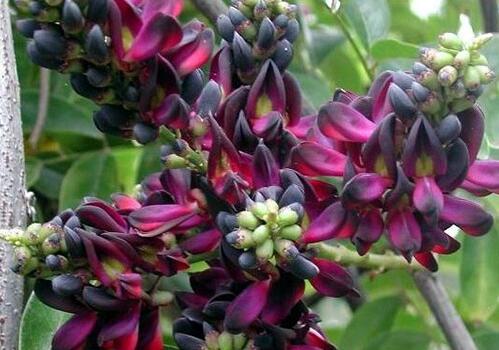
When is Mucuna birdwoodiana planted and when does it bloom?
Planting:
Generally in late autumn, select robust 1- to 2-year-old branches (with 3 to 4 buds), cut them into cuttings, dry them in the shade and store them in sand, and by early spring of the following year, begin cutting before the sap starts flowing. For softwood cuttings, the time is generally from May to September; the method of cutting the cuttings is basically the same as for hardwood cuttings, but a small number of leaves should be retained, generally 1 leaf or half a leaf, no more than 2 at most, and the cuttings should be inserted as soon as they are taken.
Flowering:
Mucuna birdwoodiana blooms every year from early January to early February in spring, but temperatures and environments differ by region, so the flowering period also differs. In the south of the country, most Mucuna birdwoodiana flowers bloom around the New Year period, while north of the Yangtze River the weather is relatively cool, and most bloom from early February to mid-March; the flowering forms vary, and the flower colors are also partly affected by temperature and soil conditions, making them different. Mucuna birdwoodiana can be used in park greening construction, residential area greening, scenic tourist areas, green spaces and so on; it can be planted in large areas to form a spectacle flower sea, or planted as a single plant to form a solitary landscape, and can be combined with landscape stones for a unique scene. In addition, Mucuna birdwoodiana can also be planted as Mucuna birdwoodiana hills, Mucuna birdwoodiana gardens, Mucuna birdwoodiana valleys, Mucuna birdwoodiana roads and so on.
How is Mucuna birdwoodiana planted?
1. To sprout and awaken the seeds, as with most seeds, soak them in clean water, then remove the seeds and place them in a ventilated place, keeping the seeds moist at all times.
2. Choose the planting soil. Mucuna birdwoodiana seeds have strong adaptability and extremely strong drought and cold tolerance, and they are not strict about soil requirements, though most are grown mainly in well-drained humus soil. Just choose a flat, sunny plot of soil for sowing.
3. Sowing method: prepare the land in advance, weed, fertilize, water, and keep the sowing depth at about 1—2 cm. Sow the seeds in cups and bags filled with nutrient soil, cover with grass, and spray water frequently to keep them moist.
4. Tending and management. Mucuna birdwoodiana is shade-tolerant and likes light and a warm, humid climate, so when tending Mucuna birdwoodiana, be sure to keep the soil moist, and just check on it from time to time.
5. Mucuna birdwoodiana is not strict about soil requirements, but calcareous soil with good drainage is most suitable for cultivation. When planting, place 2 to 3 plants per hole and bury them in soil, and "dig deep and bury deep."
6. In terms of management, apply fertilizer with a nitrogen, phosphorus and potassium ratio of 1:1:1 in spring and autumn, and stop fertilizing in summer and winter. In summer, before the branches and leaves have covered the wall, spray water frequently to cool it down, to prevent the aerial roots from being scalded by excessively high wall temperatures. For 1- to 2-year-old seedlings, autumn growth should not be too vigorous; before winter begins, the autumn shoots should be appropriately shortened and sufficient freezing water should be applied.
What benefits and effects does Mucuna birdwoodiana have?
1. Mucuna birdwoodiana promotes blood circulation and nourishes blood, and unblocks meridians and invigorates collaterals. It treats joint rheumatism pain, traumatic injuries, blood deficiency, irregular menstruation and amenorrhea.
2. Mucuna birdwoodiana grows rapidly, with thick vines, dense leaves and deep shade. Its inflorescences hang from twisted old stems and look like small birds, making it strange, beautiful and attractive. It is an excellent shade-providing and flowering vine in southern regions. It is suitable for climbing greening on large trellises, green corridors, walls and so on. It can be used for vertical greening on retaining walls, steep slopes, rock faces and so on, and can also be shaped into landscape shrubs of different forms, and can also be used for concealed cover greening. It can also be used for slope protection greening along expressways, forming a unique landscape. Because of its tenacious life, it can coil around trees, climb rocks and pass through crevices, and can also be used in gardens for configuration among mountain rocks, piled stones and woods, with a rather natural wild charm. This tree species can be promoted and planted in areas south of the Yangtze River.