Tall grass reed seedlings: plant price, planting, flowering and harvest times, and cultivation techniques
Reed is also called wei, lu, lu sun, and jian jia. Reed leaves, reed flowers, reed stems, reed roots, and reed shoots can all be used as medicine. It grows beside irrigation ditches, on riverbanks, in marshes, and so on, and grows all over the world. So how much does a reed seedling cost? When is it planted, when does it flower, and when is it harvested? What are the cultivation techniques? According to Mr. Yang from Baoding, Hebei, reed seedlings with a diameter of 1 cm, a height of 360 cm, a crown width of 12 cm, and a ground diameter of 60 cm cost about 0.1 yuan each.
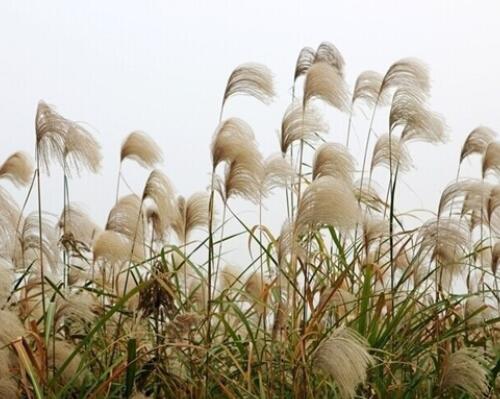
When are reed seedlings planted, when do they flower, and when are they harvested?
Planting time:
Those generally growing on gravelly riverbed soil are around the Mid-Autumn Festival; those growing on muddy riverbanks or soil banks farther inland are around October; those growing on abandoned or disturbed hillside land are around November; the colder the place, the later it is, and they can still be seen as late as December.
Flowering time:
The reed flowering period is generally about 2 months; reeds bloom roughly from August to December.
Reed flowers usually bloom in summer and autumn, in a panicle, terminal, loose, 10-40 cm long, slightly drooping, with spikelets containing 4-7 flowers, monoecious, the inflorescence about 15-25 cm long, the spikelets 1.4 cm long, white-green or brown, with the spikelets at the very bottom of the inflorescence being male and the rest being bisexual.
Harvest time:
Generally after the Start of Winter, reeds enter the harvest period.
In addition, in the Baiyangdian area of the North China Plain, the sprouting period is early April, the leaf-unfolding period is early May, the growth period is from early April to late July, the booting period is from late July to early August, the heading period is from early to late August, the flowering period is from late August to early September, the seed maturity period is early October, and the leaf-fall period is after the end of October. In the Shanghai area, buds grow from underground rhizomes in mid- and late March, emerge in large numbers in April-May, bloom in September-October, and bear fruit in November. In Heilongjiang, seedlings emerge in May-June, only vegetative growth occurs in that year, overwintering buds form in July-September, the overwintering buds sprout in May-June, bloom in July-August, and mature in August-September.
What are the reed cultivation techniques?
1. In daily life, there are mainly two methods of raising reed seedlings: one is propagation by seed, and the other is spread by underground roots. The second method is relatively simple, so it is easier to carry out. In ponds, wetlands, and lakes, reed is a relatively common aquatic plant, or more precisely a waterside plant, and is much loved because of its strong reproductive capacity, good greening effect, and wide range of uses.
2. Reed seedling planting mainly uses the root-cutting method. Take 30 cm of underground rhizome and insert it by a wetland riverbank or pond, with at least 30 cm or more of mud. When the temperature reaches about 8 to 10 degrees in spring, it can take root and send up new shoots. The rhizome has very strong vitality and can remain buried underground for a long time. A rhizome of 1 m or even more than 1 m can still develop into new branches once conditions are suitable.
4. Reed is an economic plant with relatively high economic value. China has records of using reed in daily life and production since very early times. Especially in the past hundred years, with the development of science and technology, new uses for reed have been continuously developed. In addition to civilian use and pulp and papermaking, the medicinal functions, health-care functions, and roles of reed in environmental protection and soil and water conservation have gradually become recognized. In particular, reed's role in maintaining the ecological functions of wetlands and degrading various pollutants has increasingly attracted attention from all sides. At present, many places in China with suitable conditions treat the development of reed cultivation as an important part of ecological construction, and many wetland parks also use reed to purify water resources.