How much does an Oriental paperbush (dream flower) sapling cost? Blooming period, cutting propagation method, and medicinal effects
Oriental paperbush, also known as knotting flower and three-fork wood, is a deciduous shrub about two meters tall, with yellow flowers that bloom before the leaves appear. It is suitable for solitary planting, row planting, or cluster planting in front of courtyards, beside roads, at wall corners, in lawns, or as an accent beside rockeries and rocks, and can also be grown in pots. So how much does an Oriental paperbush sapling cost? When does it bloom? How do you propagate it from cuttings? What are its medicinal effects? According to Thymelaeaceae data, the blooming period of Oriental paperbush is in late winter and early spring; due to differences in climate conditions, cultivation locations, and varieties across regions, it may bloom from February to April.
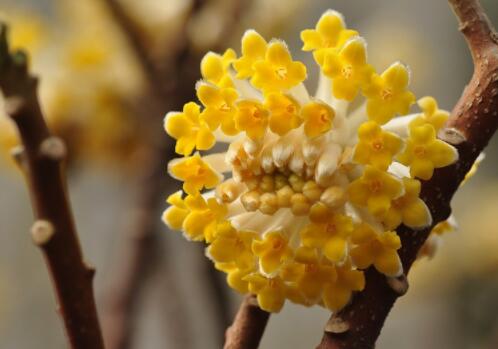
How much does an Oriental paperbush sapling cost?
Oriental paperbush is best planted in spring and autumn; planting in the second winter; planting in the third summer with pruning and leaf removal gives a 50~85% survival rate. The prices below are compiled for reference only.
| Sapling name | Height (cm) | Unit price (yuan) |
| Oriental paperbush | 40 | 2.8~3.5 |
| Oriental paperbush | 60 | 4~6 |
| Oriental paperbush | 80 | 12~17 |
| Oriental paperbush | 100 | 20~25 |
How do you propagate Oriental paperbush from cuttings?
1. Oriental paperbush prefers a warm climate, tolerates partial shade and also tolerates sunlight, but is not cold-tolerant. It grows well in fertile, well-drained soil, and tends to produce clusters of suckers at the root crown.
2. It can be propagated by division, cuttings, layering, and other methods. Division: before sprouting in early spring, take sturdy small sucker shoots, cut the roots connecting them to the mother plant, and plant them separately in the ground, and they will survive.
3. Cuttings: generally carried out from February to March; select vigorous branches 10 cm to 15 cm long, use a sharp knife to cut the lower end into a horse-ear shape with a single slice, insert about half of it into the soil, firm it down, water thoroughly, shade it and keep the soil moist; roots will form in 50 days, and it can be transplanted the following year. Layering: select sturdy sucker-cluster branches, make a half-ring bark cut on the side to be pressed into the soil, reaching down to the xylem, bury it in the soil with the branch tip exposed, keep it moist; the following year the mother branch can be cut off and cultivated separately.
Appendix: Medicinal effects of Oriental paperbush
1. Medicinal use
Oriental paperbush not only has high ornamental value, but also has a unique effect on protecting the environment and suppressing termites; at the same time, it is a high-grade fiber plant and a superior raw material for making high-grade paper, rayon, and cotton. The whole plant is used as medicine; it can reduce swelling and relieve pain, and can treat bruises and rheumatic pain; it has the effects of relaxing muscles and promoting blood circulation, reducing swelling and relieving pain. It can also be used as a homemade pesticide. The flowers are dried and used in traditional Chinese medicine, where they are called “mengqiu flower”.
2. Uses
Oriental paperbush has insect-repellent effects; its roots, stems, and flowers are all fine traditional Chinese medicinal materials, with the effects of relaxing muscles and promoting blood circulation, reducing swelling and relieving pain.
3. Daily necessities
Oriental paperbush is a plant in the Thymelaeaceae family, and its appearance resembles a beautiful bonsai. Its flexible branches curve and twist, giving a feeling of tenderness. In the mountainous areas of western our province, women are accustomed to tying knots with branches on Oriental paperbush trees to make wishes, in order to seek their dream lover, and therefore the Oriental paperbush flower is called “dream flower”.