How much does a Malus spectabilis 'Riversii' sapling cost? Blooming period, cultivation techniques and bonsai introduction
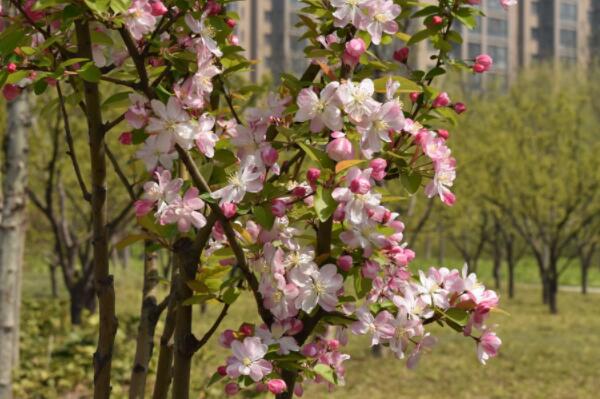
Malus spectabilis 'Riversii' is a plant in the Rosaceae family, Malus genus, a small tree reaching 2.5-5 m tall, with strong upright branches, and is endemic to China. How much does a Malus spectabilis 'Riversii' sapling cost? When does it bloom? What are its cultivation techniques? How do you care for a bonsai? According to Rosaceae records, Malus spectabilis 'Riversii' is delicate and charming when in bloom. Ordinary crabapple flowers have no fragrance; even the finest of crabapples——Malus spectabilis 'Riversii'——has no fragrance either, it is simply more gorgeously colored than other crabapples when it blooms. Before the flowers open, the buds are bright red, like dots of rouge; after opening they gradually turn pink, like rosy clouds at dawn. The blooming period of crabapple is generally April—May, and the fruiting period is August—September.
How much does a Malus spectabilis 'Riversii' sapling cost?
| Seedling name | Ground diameter | Price |
| Malus spectabilis 'Riversii' | 2 | 6~9 |
| Malus spectabilis 'Riversii' | 3 | 15~24 |
| Malus spectabilis 'Riversii' | 4 | 35~70 |
| Malus spectabilis 'Riversii' | 5 | 65~110 |
| Malus spectabilis 'Riversii' | 6 | 150~180 |
| Malus spectabilis 'Riversii' | 7 | 330~380 |
| Malus spectabilis 'Riversii' | 8 | 450~700 |
| Malus spectabilis 'Riversii' | 10 | 900~1200 |
| Malus spectabilis 'Riversii' | 12 | 2100~3000 |
What are the cultivation techniques for Malus spectabilis 'Riversii'?
Crabapples are usually propagated by grafting or division, and can also be propagated by sowing, layering and root cuttings. Seedlings obtained by grafting can bloom earlier and retain the original excellent characteristics.
1. Sowing method
Although seedlings grow slowly, they often produce variation, so the sowing method is still used when obtaining large quantities of rootstock or for cross-breeding. Common rootstock species in northern China include Malus baccata, Malus spectabilis 'Riversii', Malus toringoides, etc.; in the south, Malus hupehensis is used. Before sowing, crabapple seeds must undergo 30 to 100 days of cold stratification. Fully stratified seeds sprout quickly and uniformly, and have a high germination rate; unstratified seeds cannot germinate, or germinate very little. Alternatively, in autumn the fruit can be harvested, the flesh removed, and after brief drying the seeds sown directly in a sand bed to let them after-ripen naturally. The covering depth is about 1 cm, covered with plastic film to retain moisture; after germination remove the plastic film and promptly spread a layer of loose fertilized soil. Strengthen fertilizer and water management during the seedling stage, and by late autumn of the same year they can be transplanted.
2. Grafting method
Use seedlings propagated by sowing as rootstock for cleft grafting or bud grafting. In spring, when the sap flows and buds sprout, do cleft grafting; in autumn (between July and September) bud grafting can be done. For cleft grafting, cut grafting, cleft grafting and other methods can be used. Select well-developed 1-year-old branches as scions, take the middle section (with 2 or more plump buds), and after grafting cover the scion with fine soil. For bud grafting, the "T" method is mostly used; about 10 days after grafting, if the bud is fresh and the petiole falls off at a touch, it is proof that the graft has taken, and after a few days the binding can be removed. When the seedling reaches 80 cm to 100 cm in height, train the scaffold branches, and thereafter only prune overly dense branches, inward-growing branches and overlapping branches to keep a rounded crown.
3. Division method
Carry out before budding in early spring or after leaf fall in autumn and winter. Dig out the suckers sprouting from the root zone, divide them into several individual plants, or take 2 to 3 rooted suckers as a clump for transplanting. After dividing and planting, water thoroughly in time, pay attention to moisture retention, provide shade if necessary, and water during drought.
How do you care for a Malus spectabilis 'Riversii' bonsai?
1. Water and fertilizer requirements
The Malus spectabilis 'Riversii' bonsai should be kept with the pot soil moist at all times, but not waterlogged. During the growing season in spring and summer, water a little more; in the heat of midsummer, water promptly and adequately.
Malus spectabilis 'Riversii' likes fertilizer and can be given a little more; after blooming in spring, mainly apply nitrogen fertilizer to promote branch and leaf growth. In summer and autumn, apply more phosphorus and potassium fertilizer to favor flower bud differentiation.
2. Placement location
The Malus spectabilis 'Riversii' bonsai should be placed in a spot with plenty of sunlight and good ventilation.
In summer, shading is not necessary. It is relatively cold-hardy; in winter it can be buried pot and all outdoors in a wind-sheltered, sunny spot, or moved indoors with good light to overwinter, with the temperature kept at around 0°C.