Introduction to the price of red plum tree saplings, a deciduous small tree, and transplanting, flowering and planting methods
Red plum is a type of plum blossom, a deciduous small tree in the Rosaceae family, Prunus genus. The tree is about 10m tall, the trunk is brown-purple with many longitudinal furrows, and the young branches are green. So how much does a red plum tree sapling cost? When should it be transplanted and when does it bloom? How is it planted? What pruning methods are there? According to the Suqian nursery stock base, red plum tree saplings are generally best transplanted in March before the plants begin to grow, or in October when the plants finish growing.
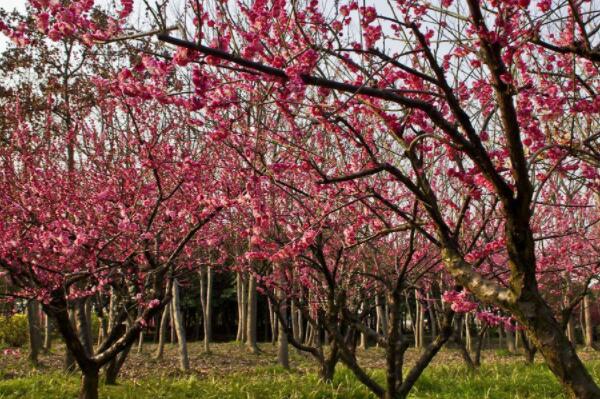
How much does a red plum tree sapling cost?
| Nursery stock name | Ground diameter (cm) | Price |
| Red plum blossom | 2 | 11~16 |
| Red plum blossom | 3 | 15~25 |
| Red plum blossom | 4 | 33~45 |
| Red plum blossom | 5 | 60~90 |
| Red plum blossom | 6 | 110~160 |
| Red plum blossom | 7 | 220~270 |
| Red plum tree | 8 | 350~350 |
| Red plum tree | 9 | 380~450 |
| Red plum tree | 10 | 450~800 |
When does the red plum tree bloom?
In southwestern China it blooms from December to January of the following year, in central China from February to March, and in northern China from March to April. From first bloom to full bloom takes 4~7 days, and until the end of blooming 15~20 days.
How is the red plum tree planted?
1. Site conditions. Red plum likes warmth and sunshine, can tolerate drought and poor soil, and fears waterlogging. It is not strict about soil and can grow well in well-drained clay, loam, sandy loam and slightly alkaline soil. It is best to choose a wind-sheltered sunny slope or semi-sunny slope with sandy loam rich in humus for planting.
2. Land preparation and hole digging. The red plum tree is a deciduous small tree and can be planted appropriately densely as needed, generally with a plant spacing of 3—5 m. The red plum tree is a shallow-rooted species, with roots distributed in the top 40 cm of soil, so a tree hole size of 50cm×50 cm×40cm is generally sufficient.
3. Seedling selection. In line with ecological requirements and matching tree to site, 2-year-old grafted seedlings are best. For example, for upright-branch plum, Huannangongfen, double-petal green calyx, etc. can be used; for weeping plum, Shuangbi Weizhi, Jinhong Weizhi, etc. can be used; for early-flowering types, Pink Cinnabar, Xuemei, etc. can be used; for mid-flowering types, Pink, Xiaogongsha, etc. can be used.
4. Planting time. Planting can be done from November to March of the following year. It is generally best to plant before winter, as this helps the plum take root and grow earlier. When planting, mix in composted fertilizer in the dug tree hole. If the soil is too clayey, fine sand and gravel, chopped straw or coal ash must be added to the tree hole to help drainage. Before planting, trim overly long roots; if conditions permit, it is best to dip the roots in mud slurry before planting. Rooting powder, carbendazim, plant growth regulators, etc. can be added to the mud slurry. The planting depth should be the same as the original ground level of the seedling. After planting, water thoroughly. When the sapling is 50—70 cm, cut it back. To prevent shaking by strong wind, it can be fixed with triangular bamboo or wooden stakes.
Appendix: Pruning methods for the red plum tree
Red plum has different pruning methods for different tree ages, and its growth and flowering states also differ, so the pruning method at each stage is also different;
1. Young trees: Young trees grow very vigorously during the growing period, so there will be many water sprouts; in order to expand its crown, increase the number of flowers and make it bloom earlier, the extended parts on the main branches should be cut off, while other branches can be allowed to grow long, so that more water sprouts can grow and the flower-bearing shoots it produces can bloom.
2. Mature trees: The branches of mature trees grow very slowly, and their water sprouts decrease noticeably, so they produce many flowers; in order to improve their growth state, prevent the lower branches from aging and withering, and maintain a good tree shape, the number of prunings increases year by year at this time, and the trunk must be renewed in time so that the lower branches remain healthy; in addition, if the inner canopy becomes hollow, the strong branches on the upper part and outer periphery should be pruned in time to restore normal growth.
3. Fine pruning: In order for the red plum tree to produce many flowers, thin, diseased and weak, short, and sparsely flowering dead branches must be heavily pruned again, causing its scaffold branches to retract; the method is to choose a position 3-6 years old for heading back, so that its latent buds sprout and grow into new branches, thus restoring the vitality of the red plum tree and producing large numbers of flowers.
Pruning for different growth vigor:
Growing conditions differ from place to place, and management methods differ as well. Many trees of the same variety and same age differ greatly in growth state; therefore when growth is vigorous, the amount of pruning should be small, otherwise too much pruning will cause many water sprouts, a dense crown, few flowers, and poor flower quality; for those growing weaker, pruning should be heavier instead, to promote new branches and increase flowering.
Pruning methods for potted plum blossoms:
The main feature of potted plum blossom flowering is that flower buds form on the new growth of the current year; in order for red plum to bloom more, it must be pruned in time to form enough new branches; the specific method is to prune once every year in early spring after the flowers fall, cutting off the upper part of the current-year branches and leaving only 2-3 tender buds; when the new branches have four or five leaves, pinch off the tips, leaving only two or three leaves at this time, thereby forming more flowering branches. Repeating this process can form a graceful shape and produce many flowers as well.