Short-lived Tree: Torch Tree Seedling Price, What It Looks Like, and How It Affects People
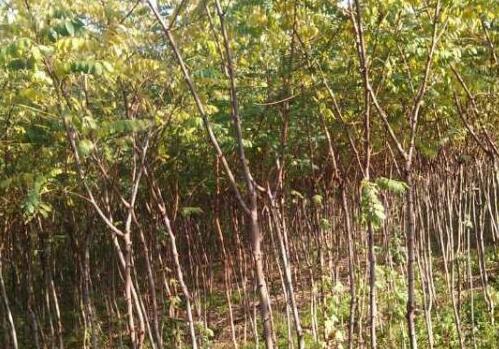
The torch tree is also known as deer antler sumac, torch lacquer, and Canadian sumac. It is cultivated more in the provinces (regions) north of the Yellow River basin, mainly used for barren hill greening and also as a landscape forest tree species for saline-alkali wasteland. So about how much does a torch tree seedling cost? What does it look like? Is it harmful to people? How is it cultivated and planted? According to records in the Anacardiaceae family, the torch tree is a deciduous small tree in the genus Rhus of the Anacardiaceae family. Its odd-pinnate compound leaves are alternate, oblong to lanceolate. The upright panicle is terminal, and the fruit cluster is bright red. The fruit is oblate, with red stinging hairs, densely clustered into a torch shape. After the fruit matures in September, it remains for a long time, and after autumn the leaves turn red, which is very spectacular.
About how much does a torch tree seedling cost?
Prices differ for different specifications and sizes. The following is compiled information, for reference only.
| Seedling name | Meter diameter (cm) | Unit price (yuan) |
| Torch tree | 3 | 10~18 |
| Torch tree | 4 | 22~38 |
| Torch tree | 5 | 35~50 |
| Torch tree | 6 | 65~90 |
| Torch tree | 7 | 70~130 |
| Torch tree | 8 | 110~180 |
| Torch tree | 10 | 180~300 |
Is the torch tree harmful to people?
1. As an exotic species, the torch tree has a very strong reproductive capacity. Although whether the torch tree is an invasive tree species is still not conclusively determined, it is already imperative to control its mass reproduction within a small area.
2. Because the torch tree can secrete a unique chemical substance, this makes it difficult for other plants to grow around it. In addition, because it is low and dense and blocks light and covers the sun, plants growing under it are greatly affected, so it is very harmful to crops. Although farmers have cut down torch trees along the roadsides, cutting them down instead stimulated their expansion, and spreading seedlings still appear in farmland, forcing farmers to cut them with sickles and throw them at the edge of the fields to bake in the sun. But even so, the torch tree still cannot be eliminated.
How is the torch tree cultivated and planted?
1. Seeds
Sowing torch tree seeds: torch tree seeds are relatively small, with a hard seed coat, and the outside is covered with red stinging hairs. Before sowing, rub them with alkaline water to remove the red fuzz outside the seed coat and the waxy substance on the seed coat. Then soak them in 85°C hot water for 5 minutes, take them out, mix them with wet sand, bury them, and place them indoors at 20°C to promote germination, sprinkling an appropriate amount of water depending on evaporation. When buds appear after 20 days, they can be sown. The sowing rate per mu is 7 to 10 jin, with a row spacing of 35 cm. Scatter the seeds into furrows 2 cm deep, then cover with fine soil and make small ridges to help preserve soil moisture. Spray water appropriately to keep the soil moist. After 20 days they basically emerge completely. In the same year the seedlings are 80 cm tall, with a ground diameter of 1 to 1.5 cm. [2]
2. Root cuttings
The torch tree has many lateral roots, and they extend horizontally. Each year when seedlings are lifted from the nursery, select lateral roots with a thickness of more than 1 cm, cut them into 20 cm long root segments, and according to the polarity of the roots, with the top upward and the stem part downward, insert them vertically into the prepared nursery ground at a plant spacing of 40×30 cm. After insertion, cover the top of the root segments with 2 to 4 cm of thin soil, and spray water frequently to keep them moist. Usually adventitious buds first sprout, break through the soil and grow new branches, and then roots form and they survive. In the same year the seedlings are more than 1 m tall. [2]
3. Root suckering propagation
Around torch trees that are more than two years old, many root suckering seedlings often sprout. They can be retained according to row spacing, taking care to remove root suckers and excessive lateral branches, and cultivate them into strong seedlings with a good tree shape. In the same year the seedlings can reach 1.5 to 2 m tall. In the second year after propagation, they can be transplanted in mid-March. The planting row and plant spacing is 50×40 cm. Do well in watering, loosening the soil, and weeding, apply fertilizer once each between May and June, and stop water and fertilizer before the end of July. Torch trees generally do not suffer from diseases. Sown seedlings and root cutting seedlings after 3 years, and root suckering seedlings after 2 years, can reach a diameter at breast height of 3 to 5 cm and can be used for afforestation.