Deciduous tree pond cypress (Taxodium distichum) sapling price: how much per tree? Differences from dawn redwood and planting and cultivation
Pond cypress, also called pond bald cypress and swamp bald cypress, is a deciduous tree that can reach 25 m in height. It prefers deep, loose, moist acidic soil, blooms in March, and its fruit ripens in October-November. So how much does a pond cypress sapling cost per tree? What is the difference from dawn redwood? How do you plant and cultivate it?
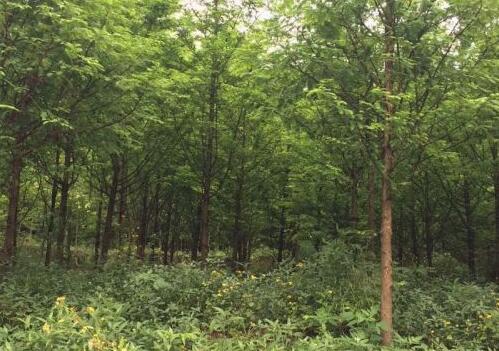
How much does a pond cypress sapling cost per tree?
Prices differ for saplings of different specifications. The following is a compiled price list for reference only.
| Nursery stock name | Diameter at breast height (cm) | Unit price (yuan) |
| Pond cypress | 3 | 8 |
| Pond cypress | 4 | 15 |
| Pond cypress | 5 | 28~38 |
| Pond cypress | 6 | 45~65 |
| Pond cypress | 7 | 70~110 |
| Pond cypress | 8 | 90~140 |
| Pond cypress | 9 | 120~180 |
| Pond cypress | 10 | 140~200 |
| Pond cypress | 11 | 170~240 |
| Pond cypress | 12 | 220~310 |
| Pond cypress | 13 | 260~480 |
What is the difference between pond cypress and dawn redwood?
1. Look at the height
Pond cypress can reach 25 m in height, and its trunk is very straight;
Dawn redwood can reach about 35 m in height, and its bark is mostly brown, gray or dark gray.
2. Look at the flowering period
Pond cypress blooms in March each year, and the fruit shape is oblong or spherical;
Dawn redwood blooms in February each year.
3. Look at the fruit
Pond cypress fruit ripens from October to November each year; the fruit is somewhat large and somewhat round;
Dawn redwood fruit ripens in November each year; the fruit is somewhat small and somewhat egg-shaped.
4. Look at the leaves
Pond cypress leaves do not spread out, and the leaflets grow close to the branches. The trunk has few branches and is straighter than that of dawn redwood. In addition, pond cypress leaves are slender and curve slightly downward;
Dawn redwood leaves are linear and alternate, the leaves spread out, and the leaflets lie in one plane; the trunk has many branches.
5. Look at the light
Pond cypress does not like light;
Dawn redwood likes light.
How do you plant and cultivate pond cypress?
1. Pond cypress plants are generally grown and sown for seedlings in fertile, moist sandy loam. Before planting, sufficient base fertilizer should be applied. At the same time, after covering with soil, cover with a layer of plastic film, which is more helpful for preserving soil moisture and preventing soil compaction. Under normal circumstances, pond cypress is suitable for planting in environments with saturated or waterlogged soil. Under dry environmental conditions, attention should be paid to watering to resist drought, so that pond cypress maintains a normal net photosynthetic rate.
2. During the emergence stage, the hypocotyl of the pond cypress plant is long and tender, and growers should promptly remove the covering grass, which can effectively prevent seedling injury. Entering the seedling stage, pond cypress seedlings are sensitive to water deficit, so water management should be especially careful, and the seedbed should often be kept moist. After that, topdressing should also be increased. From late May to mid-August, apply quick-acting fertilizer once every 2-4 weeks. Calculated as urea, the amount used per hectare is 150-225 kg. To effectively prevent seedling yellowing, an appropriate amount of ferrous sulfate should also be applied in time. After each fertilization and irrigation, growers should promptly loosen the soil and remove weeds.
3. Pond cypress is a fast-growing tree species, strongly heliophilous, relatively cold-resistant, extremely resistant to flooding, and also quite drought-tolerant. It prefers deep, loose, moist acidic soil. When planted around lakes and along both banks of rivers, knee roots often appear, and it has strong wind resistance; seedlings and young trees are sensitive to soil acidity and alkalinity. When the soil pH value is above 7, yellowing occurs to varying degrees and growth is poor; afforestation: it can be done in winter, or in spring between February and March.