Is it good feng shui to plant an apricot tree in the home courtyard? Grafting propagation, pruning and how many years until it bears fruit
The apricot tree generally refers to the apricot (Prunus armeniaca), an important economic fruit tree species and one of the common fruits, with a flowering period from March to April and a fruiting period from June to July, mainly propagated by seed. So is it good feng shui to plant an apricot tree in the home courtyard? How do you propagate it by grafting? How do you prune it? How many years of planting until it bears fruit? There is a proverb that says: "Peach three, apricot four, pear five, and the jujube tree pays for itself the very same year," which means the apricot tree flowers and bears fruit in four years, benefiting earlier, and enters full fruit-bearing in five years.
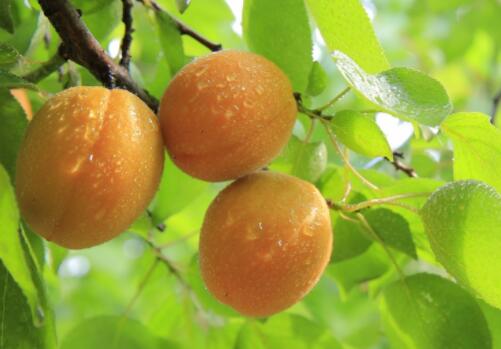
Is it good feng shui to plant an apricot tree in the home courtyard?
It can be planted. Apricot sounds the same as the xing in happiness and the xing in lucky; as for feng shui, it depends on specific factors such as the location, terrain and orientation of the residence.
How do you propagate an apricot tree by grafting?
1. To carry out grafting propagation, the first thing to do is select the scion. In the first step, we first select some fresh buds in the middle of the scion, make a horizontal cut above the fresh bud down to about the xylem of the plant, then cut from below the bud, stopping when you reach the horizontal cut above the bud. Use your fingers to gently peel back the skin on both sides of the bud, to a length of about 1.5 cm and a width of about 0.5 cm.
2. On the selected rootstock, at a height of about 5 cm to 10 cm from the ground, choose a smooth surface and make a horizontal cut with a knife, with a depth of about through the bark layer; do not cut too deep, and try not to cut into the xylem of the plant. Then cut downward, with a downward depth of about 1.5 cm being most suitable, so that the horizontal cut and the vertical cut form a T shape. After that, use the knife as an aid to twist left and right along the vertical cut; while prying up the bark layer, insert the scion. After inserting the scion, do not twist any more, so as to protect the growth point of the plant and ensure normal grafting. Also make sure the flat surface on the bud fits tightly against the flat surface of the T-shaped cut.
3. After grafting is completed, wrap it with a plastic bag; be sure to tie it tightly so that the scion and rootstock are closely joined. Also, the T-shaped cut must be sealed tightly to prevent disease from entering and causing pest and disease problems in the plant. The last key point is to be quick and reduce the time exposed to the outside, which helps improve grafting efficiency.
How do you prune an apricot tree?
1. In late May and early June, determine the trunk and shoots, selecting and keeping 7-12 shoots with better angles and removing the rest. When new shoots grow to 40 cm, select 2-4 for key training and train them into a "V" shape or open-center shape; pinch the remaining new shoots to promote a second flush of shoots, repeatedly pinch upright shoots on the back, and remove overly numerous and dense branches. In early November, spray urea to promote early leaf fall.
From fruit enlargement to before fruit ripening, pinch the new shoots multiple times to control vigorous new shoot growth and improve the fruit-setting rate and single-fruit weight. For upright new shoots on the back, remove or twist them to prevent "trees growing on trees" from worsening the light inside the canopy. After fruit harvest and film removal in early to mid-May, combine heading back with branch thinning to adjust the growth balance of the tree and prevent compensatory vigorous growth.
2. For young trees and trees just beginning to bear fruit, winter pruning should take into account both shaping and fruiting. For the main and lateral branches and extension branches, prune lightly and leave them long, generally cutting back to two-thirds of the total branch length. For developing branches that grow moderately and have a relatively open angle, leave them unpruned to promote the sprouting of medium and short branches and increase the number of fruiting branches; after flower formation or fruiting, head them back in time to train them into fruiting branch groups. Medium and short branches with wide angles form flowers easily and should be retained as much as possible. For weaker young trees, it is appropriate to cut back moderately, thin out overly dense and thin weak branches, retain more vigorous branches, and bend upright vigorous branches flat as auxiliary nurturing branches to promote the growth of thick, strong medium and short fruiting branches.
3. For trees in full fruit-bearing, according to branch vigor and the space conditions of each part of the canopy, thin appropriately and cut back weak parts to maintain a stable fruiting position and growth vigor. For weakened main branches, lateral branches, perennial auxiliary nurturing branches, fruiting branch groups and drooping branches, head them back at positions with strong branches to restore growth momentum. Timely renew and rejuvenate the lower part of the canopy and the inner branches so that the fruit tree continuously produces new, robust fruiting branches.
4. For trees in the aging stage, use vigorous upright branches with small angles in the middle and lower parts to replace the leader, or head back at relatively upright branch sections to stimulate latent buds to sprout and renew. For water sprouts in suitable positions, train them into scaffold branches and fruiting branch groups. For fruiting branch groups and fruiting branches, following the principle of "remove the weak and keep the strong," select and retain strong branches and strong buds for renewal pruning. For those whose tree vigor is extremely weak and renewal is difficult to make effective, on the premise of strengthening fertilizer and water management, carry out a whole-tree major renewal of the main and lateral branches and large branch groups at the 10-15-year-old parts, completing it in one go; a large number of new shoots can sprout that same year, and through summer bud removal, pinching and winter shaping and pruning, they can flower and bear fruit the next year, restoring a certain amount of yield.