Is orange jasmine (Murraya paniculata) toxic? A detailed guide to flowering time and care methods for promoting blooms
Orange jasmine (Murraya paniculata), also known as Qianli xiang, Wanli xiang, Jiuqiu xiang and Jiushu xiang, is a common small tree of the Rutaceae family in southern China. It is highly favoured by people for its long flowering period, rich fragrance and evergreen foliage. So, is orange jasmine toxic? When does it bloom? How should it be grown so that it flowers?
Is it toxic?
At present, there is no record of orange jasmine being toxic in any literature or reference material. So it is non-toxic.
Flowering time:
The flowering period of orange jasmine is relatively long. It generally blooms between April and September each year, and sometimes it also flowers in autumn and winter. After orange jasmine blooms, it produces fruit, and the fruiting period is between September and December.
Flower form:
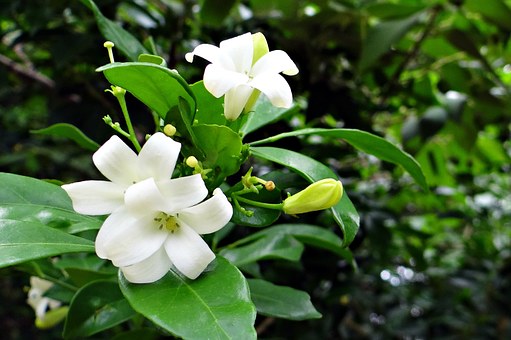
The flowers of orange jasmine are mainly terminal or axillary. Generally, fewer than 10 flowers bloom, and in abundant cases more than 50. The petals of orange jasmine are obovate-lanceolate or long elliptical. When fully open, they curl slightly, and the flowers are mainly white but bear some pale yellow oil dots. The flowers of orange jasmine carry a fragrance that is extremely rich.
Planting techniques:
1. Germination
Soak the seeds in warm water (at about the temperature of face-washing water) for 12-24 hours, until the seeds absorb water and swell. For very common seeds that germinate easily, this step can be skipped.
2. Sowing
For tiny seeds that are difficult to pick up with the hands or other tools, moisten one end of a toothpick with water and stick the seeds one by one onto the surface of the substrate, then cover with substrate 1 cm thick. After that, place the sowing pot into water, with the water depth at 1/2 to 2/3 of the pot's height, and let the water slowly soak upward (this method is called the "pot immersion method").
For larger seeds that can be picked up with the hands or other tools, place the seeds directly into the substrate and sow them in spots at a spacing of 3 × 5 cm. After sowing, cover with substrate to a thickness 2-3 times that of the seeds. After sowing, use a sprayer or a fine-holed watering can to wet the sowing substrate. Later, when the potting soil is slightly dry, water again, still taking care not to water too forcefully, so as not to wash the seeds out.
3. Management
After sowing in late autumn, early spring or winter, when a cold wave brings low temperatures, you can wrap the orange jasmine pot in plastic film to help keep it warm and moist. After the seedlings emerge, uncover the film in time, and let the seedlings receive sunlight before 9:30 every morning or after 3:30 in the afternoon; otherwise the seedlings will grow very weak and spindly. After most of the seeds have sprouted, appropriate thinning is needed: pull out the diseased and unhealthy seedlings so that the remaining seedlings have a certain amount of space between them. When most of the seedlings have grown 3 or more leaves, they can be transplanted.
4. Other
Orange jasmine can also be propagated by cuttings, though generally softwood cuttings are taken from current-year branches in late spring and early autumn, or hardwood cuttings are taken from the previous year's branches in early spring.