Lucky Bamboo (Dracaena sanderiana) Foliage Plant: Taboo Placement, Propagation, General Pruning and Care
Lucky bamboo generally refers to Dracaena sanderiana, also known as wan shou zhu, ju hua wan shou zhu, kai yun zhu, fu gui ta, and so on. It is full of bamboo charm, which is why people love it so much. So what are the taboo placement spots for lucky bamboo? How do you plant the seeds? How do you prune and care for it? How many stalks generally bring the most luck?
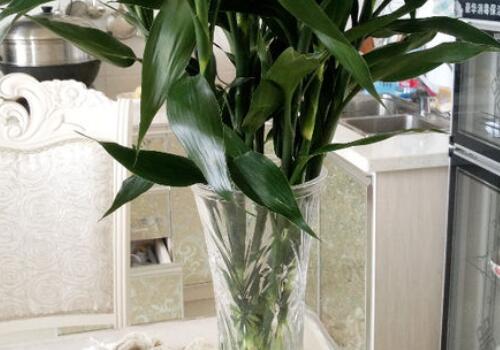
What are the taboo placement spots for lucky bamboo?
1. Lucky bamboo should not be placed in the wealth position. Placing it in the wealth position or the sha position will worsen your fortune. Many people mistakenly believe lucky bamboo is a feng shui item for boosting wealth, but this is not so. Placing lucky bamboo in the wealth position of the whole house will lead to losses in wealth luck.
2. It is best to avoid placing it in the bedroom, because lucky bamboo is a plant and belongs to the yin element in the five elements.
3. Lucky bamboo must not be placed beside a TV or in places where an air conditioner or electric fan blows constantly, so as to avoid dry conditions that cause the leaf tips and leaf edges to dry up.
How do you plant lucky bamboo seeds?
Lucky bamboo is generally propagated by raising seedlings and cuttings.
1. Raising seedlings
Generally, a leafless stem segment is cut as a cutting, 5-10 cm long, preferably with 3 nodes, and inserted into a sand bed or half-mud sandy soil. Be careful not to insert it upside down. In spring and autumn, it generally roots in 25-30 days, and can be potted or transplanted to the field in 35 days.[4]
2. Cuttings
First cut off a top shoot branch or a side-bud top shoot, about 15-20 cm long (4-5 nodes). After treatment, insert it directly into sandy loam or half-mud sandy loam in the field, burying 2 nodes in the soil. After insertion, water once a day to keep the soil moist. It generally roots in 30-35 days in spring, and in 35-45 days in autumn and winter.
How do you prune and care for lucky bamboo?
Pruning:
1. The buds of lucky bamboo have grown very long, almost longer than the original bamboo, so pruning is needed.
2. For pruning you need a pair of garden shears (or another sharp knife will do), and potassium permanganate (generally available at pharmacies, 1 yuan/pack; when using, add just a tiny bit).
3. The cutting position should be about 0.5 cm from the mother plant.
4. Let the cut dry, then place the cut into a suitable amount of potassium permanganate solution to disinfect and soak for about 30 minutes, to prevent the cut from becoming infected.
5. Reinsert the cut treated with potassium permanganate solution into the vase for care.
Care:
1. Pay attention to pruning the roots when first inserting. When first inserting, remove the leaves at the base so as not to affect the bamboo's growth; the specifics depend on the size of your vase. Just remove the leaves below the mouth of the vase. In addition, use scissors or a knife to cut off a small part of the root at an angle, so the bamboo can absorb water better. Make the cut as smooth as possible.
2. Water volume control and choice of water. Water up to one third of the vase is enough; do not use more than two thirds. Before rooting, change the water once every 3 days. After rooting, do not change the water again; just add water directly to the vase. When the weather is dry and stuffy, spray water on the leaf surface. It is best to use well water or purified water. If using tap water, it is best to store it for a day before use.
3. Maintain indoor temperature. Lucky bamboo is suitable for growing between 16°C and 26°C. Cold easily causes the plant to die. In winter, do not place it on a balcony, beside a window, or in other colder places, and never let the water freeze. Take anti-freeze measures when necessary.
4. Ensure sufficient light. Water-cultured lucky bamboo is generally placed indoors. Although it does not demand much sunlight, if it cannot get any sunlight at all, the leaves will also turn yellow and growth will be poor. So place it in a bright, ventilated environment as much as possible so it gets plenty of light.
5. Fertilize once a month. For water-grown plants, we generally neglect fertilizing, but this is not right. Fertilizing can make the plant grow better. Water-cultured lucky bamboo only needs fertilizing once a month. You can go to a flower market to choose professional fertilizer, or just drip a few drops of dissolved vitamin C1 into the water when adding it.
How many stalks of lucky bamboo generally bring the most luck?
1. 1 stalk or 4 stalks. When lucky bamboo is grown in a water bottle, it is exactly "one is water." Therefore, if growing it in water, 1 stalk is best. This can attract wealth and ensure the water is not absorbed by other lucky bamboo, and it also carries the beautiful wish of "unfolding a grand plan."
If you think one stalk does not look good, you can grow 4 stalks. Metal generates water, and plants cannot lack water. In feng shui, the number 4 is the number of Wenchang. Lucky bamboo mainly plays a role in improving feng shui and attracting wealth.
2. 2 stalks or 5 stalks. When lucky bamboo grows in soil, 2 is fire, fire generates earth, earth generates metal, metal generates water. 5 is earth (4 long stalks and 1 short stalk), which helps expand the power of earth. Placed in the Wenchang position of a house or room, lucky bamboo will not easily die. If you think 5 stalks are too many, you can choose 2 stalks as a yin-yang setup potted in soil.
3. 6 stalks or 9 stalks. People often say "six six great smoothness," and there really is some fortune in it. If you want to attract more wealth, you can buy a square plate and place a round vase or other container on it to hold the lucky bamboo. You can put copper coins in the water, and of course the number should be 9 or a multiple of 9. If you find the roots have turned yellow, change the water in time and supplement nutrients.
4. Ten stalks. It implies perfection in every way. Not only that, lucky bamboo also helps improve the environment. It can help improve air quality in rooms that are not often ventilated, effectively absorb exhaust gas, regulate air humidity, and improve the private environment of the bedroom.