Spider Lily (Lycoris radiata): Does It Have Seeds, Price per Jin, How to Grow It at Home, and Blooming Period
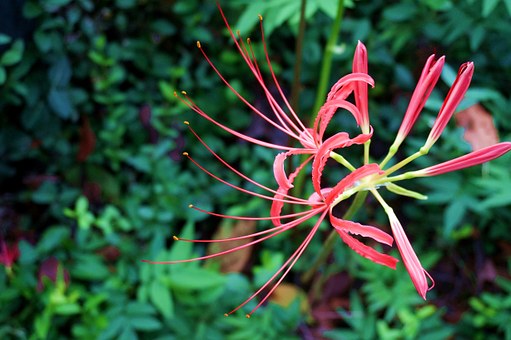
Spider lily, also known as black garlic, spider lily, manjusaka, mandarava, and Lycoris radiata, is a common Amaryllidaceae flower in mountains and woodlands, widely planted because its blooms are incredibly beautiful. So does spider lily have seeds? How much are the seeds per jin? Can it be grown at home? How do you grow it? When does it bloom?
Seed price:
Spider lily is generally propagated by bulbs, and bulbs cost about 1-2 yuan each. Spider lily seed propagation is generally used only for hybrid breeding. The seeds have no dormancy, and should be sown immediately after harvesting; at 20°C, the radicle can be seen emerging after 15 days. When sown in a natural environment, only a few seedlings put out a single leaf in the first growth cycle. The seedlings can be transplanted once during the seedling stage, and seedlings take about 4-5 years from sowing to flowering.
Can it be grown at home?
Yes. Many people like to place spider lilies in their living room, on the balcony, and elsewhere at home, as they all serve to beautify the environment.
Although spider lily is highly ornamental, its rhizome is toxic. The bulb contains the alkaloid lycorine, which can cause vomiting, spasms, and other symptoms. It must not be eaten casually, but it can be used for sedation, inhibiting drug metabolism, and anticancer effects. Despite being toxic, the bulb can be eaten after processing and is also used as a medicinal material. "Galanthamine" extracted from the rhizome of Lycoris radiata can be used to treat polio. Spider lily has the effects of dispelling wind and reducing swelling, and of detoxifying and fighting cancer. It is used to treat stomach cancer, esophageal cancer, and liver cancer. According to records in traditional Chinese medical texts, the spider lily bulb is warm in nature, bitter in taste, and toxic; as medicine it has the effects of inducing vomiting, removing phlegm, reducing swelling, relieving pain, and detoxifying. However, if eaten by mistake, it may cause poisoning, with mild cases involving vomiting and diarrhea. According to pharmacological research, spider lily has a certain anticancer activity and can also fight inflammation, reduce fever, sedate, and induce vomiting, and it is also effective against amoebic dysentery.
Growing techniques:
1. Soil: Spider lily is not picky about soil, but it grows best in loose, fertile soil rich in humus. Its native habitat is red soil, and it is accustomed to slightly acidic soil.
2. Temperature: Spider lily loves a warm climate, with a suitable growing temperature of 15-25°C, but it is highly cold-tolerant, and its high-temperature limit that it can endure is a daily average temperature of 24°C.
3. Light: Spider lily likes a semi-shaded environment, but it can also withstand full sun. It enters dormancy in summer, so direct sunlight should be avoided and it should be placed in a cool environment for growing.
4. Water: Spider lily likes moisture, but it can also tolerate drought. However, planting it in well-drained soil and maintaining a sufficient water supply will make spider lily grow better.
5. Fertilizing: Before planting spider lily, sufficient organic fertilizer should be buried in the soil, after which a topdressing should be applied once every two months. Homemade decomposed compost or a three-element fertilizer can be used.
Blooming time:
For this plant, it mainly blooms in two periods. The first period is from February to March. The second period is from July to September, and among these, the flowers bloom best in July, which is its full-bloom period. According to legend, those that bloom around the spring equinox are called "spring equinox flower" (Higanbana), and those that bloom around the autumn equinox are called "autumn equinox flower" (Higanbana). Generally speaking, it blooms very punctually.
It generally blooms from July to September, and July is its full-bloom period. There is a saying that the three days before and after the spring equinox are called the spring equinox flower, while the three days before and after the autumn equinox are called the autumn equinox flower. Spider lily blooms during the autumn equinox flower period, very punctually, so it is called spider lily.