Can a loquat tree be planted in a home courtyard? Blooming period, how many years until fruiting, pruning and planting techniques
Loquat tree, also known as: orange, golden pill, reed branch, often used for garden ornamental purposes; the plant's fruit, loquat, has the effect of treating lung-dryness cough. So can a loquat tree be planted in a home courtyard? When does it bloom? How many years until it fruits? How should it be pruned? What are the planting techniques? According to Rosaceae information, loquat belongs to the Rosaceae family as an evergreen small tree. The leaves are thick, oblong, with serrated edges. It blooms every year between September and October, and the flowers are pale yellow-white and fragrant. The fruit ripens between May and June of the following year.
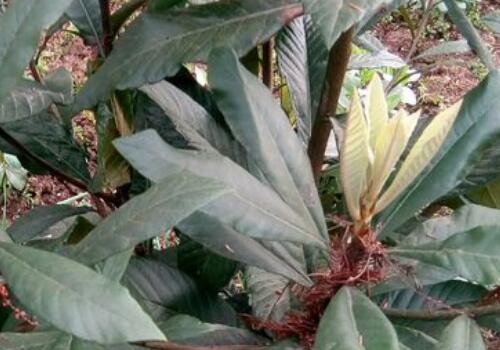
Can a loquat tree be planted in a home courtyard?
A loquat tree can be planted in a home courtyard.
1. Since ancient times, because the loquat weathers frost in autumn, blooms in winter, sets fruit in spring, and its fruit ripens in summer, the loquat has always been called by people a fine fruit that “contains the qi of the four seasons,” and it is also regarded by people as one of the auspicious foods. Moreover, since the Tang and Song dynasties, the loquat has been seen as a beautiful symbol of nobility, goodness, auspiciousness and prosperity.
2. Because the loquat fruits borne by the loquat tree always come in pairs, there is also a saying that it symbolizes marital harmony. If you care very much about loquat tree feng shui, and require that there absolutely must not be any bad implication, then it is suggested that you plant the loquat tree in the east or southeast direction, or you can plant the loquat tree behind the house or in a corner of the wall, so that there will be no bad implication.
How should a loquat tree be pruned?
1. Loquat is an evergreen fruit tree and sends out new shoots 3-4 times a year; it blooms in autumn and winter, and the fruit ripens and is harvested in late spring and early summer of the following year. Therefore, for young trees that have not yet fruited, pruning can be done after each shoot growth stops and before the next shoots emerge, especially before the spring shoots emerge and before the summer shoots emerge, when pruning must be done. Because adult trees have already bloomed and fruited, they are mostly pruned immediately after harvest, until before the summer shoots emerge. In spring, if too much fruit has set, the spring shoots also emerge sparsely; at the same time, because the fruit is hanging on the tree, excessive pruning is not advisable.
2. Summer pruning after harvest is the most important pruning for loquat, and it should be done early rather than late; moreover, in coordination with pruning, if you want a large number of renewal shoots to emerge, you should apply heavy fertilizer after harvest. Summer shoots are the most important shoots of the loquat tree in a year. On adult trees, they should emerge early, stop growth early, and form flower buds early, which requires early pruning and appropriately heavy pruning.
Pruning techniques include bud removal, thinning or heading back dense branches, pruning fruiting branches and branches after fruiting, and pruning water sprouts, etc. The specific requirements are:
① Thin out fine, weak, dense branches. Loquat often has lateral buds that sprout into 3-5 lateral branches; keep only 1-2 strong lateral branches, and thin out the other fine, weak branches.
② Cut off crossing branches. When two branches cross and impede growth, one branch should be cut off.
③ Head back or remove adjacent branch orders. When branch orders of 2 or more 3-4-year-old branches grow adjacent to each other, causing local density, head back or remove one of them.
④ Remove water sprouts. For water sprouts on large branches, they should be cut off from the base. If they do not disturb the tree shape, they can be headed back to encourage new shoots to emerge from the base, cultivating fruiting mother branches.
⑤ Fruiting branches and fruiting mother branches. Generally they are not pruned. After the fruiting branch is harvested, new shoots can emerge from the base and can send out panicles and bloom. However, some weak branches can be cut off from the base.
What planting techniques are there for loquat trees?
1. Selection of loquat seedlings
When selecting loquat seedlings for planting, choose plants that are robust, have smooth bark, and are free of pests and diseases.
2. Soil requirements
Soil cultivation in Tangqi orchards. Because its soil pH value of 5.9 is suitable for the growth of Tangqi loquat. Key points of watering: Tangqi loquat not only requires high heat, but also likes moisture; suitable rainfall and temperature are beneficial to the growth and development of loquat. A balcony is a concrete floor, which can only absorb water, so water must be thoroughly poured and moisture must not be lost. Usually water once a day, 2-3 times a day in summer, spray water at noon during high temperatures, and do not water on cloudy and rainy days.
3. Planting and fertilizing
① Grafted loquat seedlings can be planted in large pots or small pots, but the bottom of the pot should be covered with 5-10 cm of tile fragments or stones, with soil accounting for 70-80% of the pot. Fertilize 3-4 times a year: around late March before the spring shoots emerge and before fruit thinning;
② around late May before harvest; 3. after flower buds appear in October, when the flowers first open. Fertilization can use organic fertilizer, chicken and duck manure, decomposed cake fertilizer, and a small amount of compound fertilizer is also acceptable;
4. Disease prevention and pest control
Loquat pests and diseases are mainly prevented and controlled through ventilation and drainage. When disease occurs, use methyl thiophanate at 700 times, spray 2-3 times consecutively, or use 0.5-0.9% Bordeaux mixture for control. For pests, manual capture can be the main method, or 90% trichlorfon crystal at 1000 times or 20% fenvalerate at 5000 times can be sprayed to kill them.