Can the wintersweet (Chimonanthus praecox) 'Suxin' deciduous shrub be propagated by cuttings? Lifespan, flowering period, and grafting cultivation techniques
Suxin wintersweet, also called Suxin wax plum, is a deciduous shrub up to 4 m tall, often growing in clumps. Its distribution areas include mainland China, Korea, Japan, Europe, and the Americas. So can Suxin wintersweet be propagated by cuttings? How long does it live? When does it bloom? What grafting cultivation techniques are there? From wintersweet family information, we learn that Suxin wax plum flowers from November to March of the following year, and its fruiting period is from April to November.
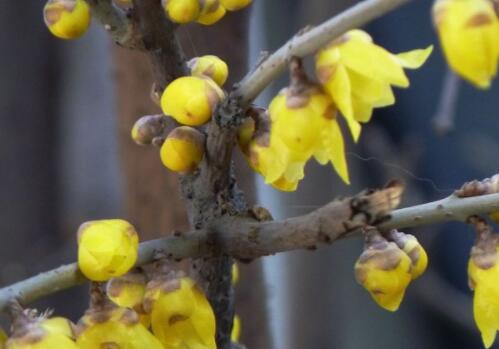
Can Suxin wintersweet be propagated by cuttings?
Suxin wax plum can be propagated by cuttings.
Wintersweet cuttings are best taken in spring after the flowers fade, when the sap has not yet begun to flow. At this time nutrients are relatively abundant. Select vigorous one-year-old branches, cut them into 15——20 cm lengths, and take heel cuttings.
How long does Suxin wintersweet live?
When Suxin wax plum grows in a good environment, its lifespan is very long; wintersweet trees several decades old are very common.
What grafting cultivation techniques are there for Suxin wintersweet?
1. Spring grafting: graft when the rootstock buds begin to sprout in spring. For the scion, choose thick, strong branches from the upper part of a superior cultivar, and the middle section of the branch is best. Wax-seal the scion before grafting. The grafting method can be chosen according to the size of the rootstock opening. If the rootstock opening is relatively thick, bark grafting can be used.
2. Greenwood cleft grafting: in May to July, when the new shoots produced by the rootstock have grown to a certain thickness, cut them off above after leaving 1-2 pairs of leaves, and split them down the middle of the stem for 2-3 cm. For the scion, take vigorously growing new shoots, cut a section equal in thickness to the rootstock, leave 2 leaves at the upper end, cut away most of the leaf blade and keep 1/3, and cut the part 2 cm below the leaf into a wedge shape. Then insert the scion into the cleft of the rootstock. Since both are the same thickness, the cambium on both the left and right sides can connect. Then bind the grafted area well with plastic strips. Be careful to keep the rootstock leaves below the graft union. After grafting, put a plastic bag over it to retain moisture. Shade it during exposure to strong sunlight. After 15 days the scion will have taken, and then remove the plastic bag.
3. Approach grafting is suitable in May, when both the rootstock and scion are growing vigorously. Generally, division seedlings or seedling-grown plants are used as the rootstock, and they need to be planted in flower pots; when grafting, they can be fixed to the branches of the scion tree. The approach grafting method is used. During the operation, the cut does not need to reach the xylem; remove a strip of bark 3-5 cm long from both the rootstock and the scion, with a width suitable for the cambium outside the xylem of both to connect. After grafting, bind the joined part well with plastic strips. Be careful to water the rootstock pot regularly. Approach grafting can achieve 100% survival, but it is relatively labor-intensive. One month after the graft has taken, cut off the rootstock above the graft union. At the same time, cut the scion off below the graft union in 3 stages, cutting 1/3 each time, with 7 days between cuts; that is, only 50 days after grafting does the scion separate from the mother plant.
4. Multi-head top grafting: for larger rootstocks, multi-head grafting must be carried out. In addition to the methods described above, grafting the scion onto the tips of the branches, side grafting can also be used to supplement the lower branches (see Figure 6-17). After multi-head top grafting, special attention must be paid to removing the rootstock's suckers. Because the same rootstock is used, its rootstock and scion branches and leaves are similar and easily confused with each other, so when removing sprouts, they must be clearly distinguished. Since rootstock suckers grow more vigorously than the scion, the scion can easily die because of rootstock sucker growth. Therefore, the sprouts on the rootstock must be removed in time to avoid grafting failure.
Cultivation techniques:
1. Open-field planting
Choose neutral or slightly acidic sandy soil with deep soil layers, shelter from wind, sunny exposure, and good drainage, and generally plant before sprouting in spring. For small seedlings, plant at a spacing of 30 cm × 50 cm between plants and rows; for 2-3 year old medium seedlings, plant at a spacing of 50 cm × 55 cm between plants and rows. For large seedlings planted permanently in a courtyard, the planting hole is 60-70 cm in diameter and 40-50 cm deep; place decomposed manure, bean cake, and other materials at the bottom of the hole as base fertilizer, cover the base fertilizer with a layer of soil, then place the wintersweet plant with its root ball into the hole, fill with soil, firm it by treading, and water.
2. Pot cultivation
Choose loose, fertile, well-drained sandy soil as the growing medium, place a layer of gravel over the drainage hole at the bottom of the pot or tub, select small plants with plump flower buds in early winter each year, dig them up with soil, and plant them in the pot; after flowering, they can be displayed for viewing. Usually keep them outdoors in a sunny place for care.