Can the fruit of the rockspray cotoneaster be eaten, and how to care for it as a bonsai: watering, pruning, and dealing with yellow leaves
Rockspray cotoneaster (Cotoneaster horizontalis), also known as gouci wood, yanlengzi, and shantou guniang, grows in shrub thickets at elevations of 2000-3500 m. The flowering period is May-June, and the fruiting period is September-December. So can the fruit of the rockspray cotoneaster be eaten? How do you grow it as a bonsai? How do you water and prune it? What should you do if the leaves turn yellow?
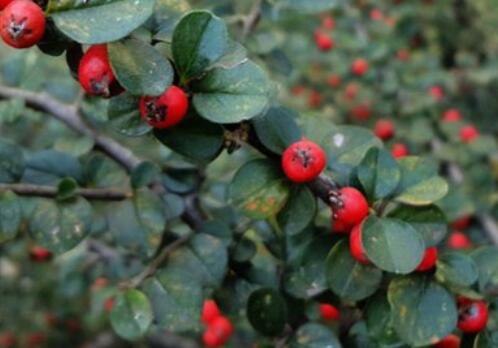
Can the fruit of the rockspray cotoneaster be eaten?
Generally, nobody eats the fruit of the rockspray cotoneaster.
The rockspray cotoneaster has a low, spreading habit with branches extending sideways. In spring, tiny pink flowers are scattered like stars among the dark green leaves. The leaves are small and dense, and the flowers crowd the branches. In late autumn the leaves turn red, and the plant is covered with red berries that stay on through winter. It is best used as a foundation planting material, a ground cover material, or for decorating buildings, especially the walls of memorial buildings. The red berries and emerald leaves are especially eye-catching. It is often planted in clusters on slopes, in rock gardens, beside ponds or rocks, or scattered on lawns, and is an excellent material for rock bonsai.
How do you grow a rockspray cotoneaster bonsai?
1. Water and fertilizer management
In early spring before buds break, repot once every 1-2 years. Use a fertile, loose leaf mold soil or sandy soil mix for the pot. After planting, water thoroughly, cut off some old roots, branches, and leaves, and place it in a bright spot. In normal care, keep the pot soil moist, and apply cake fertilizer water once a month during the growing season. In summer, spray water on the leaves to increase humidity and provide shade. In winter, move it indoors.
2. Temperature and light
The rockspray cotoneaster likes a warm climate environment and requires a semi-shaded environment with dry soil for growth. In summer it needs a certain semi-shaded environment; in the other three seasons, spring, autumn, and winter, sunlight exposure can be increased.
The rockspray cotoneaster likes warmth but can also tolerate cold. The average temperature of the coldest month is 1-2°C, the average temperature of the hottest month is 20-26°C, the annual average temperature is 15-18°C, and the annual accumulated temperature is 4500-5000°C.
The frost-free period is 210-250 days. Under such temperature conditions, the rockspray cotoneaster stays emerald green all year (with red, glossy leaves in autumn) and has high ornamental value.
3. Propagation methods
Mainly by sowing and cuttings. After the fruit ripens, collect it, soak it, rub off the peel, and sow immediately in autumn; sowing in the following spring gives a low germination rate. Take cuttings during the plum rain season, and they will root in about 40-60 days.
How do you water and prune the rockspray cotoneaster?
1. For potted plants, in addition to adding organic fertilizer when potting, proper fertilizer and water management should also be carried out during normal care. During the winter dormant period, the main task is to control fertilizer and water, with intervals of about 3-7 days; the interval should be shorter on sunny days or during high temperatures, and longer or no watering on rainy days or during low temperatures. For plants grown in the ground, apply fertilizer water 2-4 times in spring and summer according to drought conditions: first open a ring-shaped small trench 30-100 cm outside the root collar (the larger the plant, the farther from the root collar), with the trench width and depth both 20 cm. Spread 25-50 jin of organic fertilizer into the trench, or 1-5 liang of granular compound fertilizer (chemical fertilizer), then water thoroughly. After winter begins and before spring arrives, apply fertilizer once more in the same way, but do not water.
2. In winter, when the plant enters dormancy or semi-dormancy, cut off weak, diseased or pest-infested, dead, and overly dense branches. You can also tidy the branches in combination with taking cuttings.
3. As long as it is cared for properly, it will grow very quickly. When it grows to a certain size, consider giving it a larger pot so that it can continue to grow vigorously. For the potting soil and component ratios for repotting, you can choose one of the following: garden soil: cinder = 3:1; or garden soil: medium-coarse river sand: sawdust (mushroom residue) = 4:1:2; or one of paddy soil, pond mud, or leaf mold.
What should you do if the leaves of the rockspray cotoneaster turn yellow?
1. It may be that the air humidity is not enough. The rockspray cotoneaster likes a humid or semi-dry climate environment and requires the relative air humidity of the growing environment to be 50-70%. When the relative air humidity is too low, the lower leaves turn yellow and fall off, and the upper leaves lose their gloss.
2. You can place the rockspray cotoneaster on a balcony in a bright, ventilated spot. It is a light-loving, drought-tolerant plant, so water only when the soil is completely dry; alternating between dry and moist is better. Frequent watering and high humidity are not good, and failing to water in time is also not good. It is better to spray water on the leaves and branches often.