Lupine (Lupinus) Annual Herb: Suitable Planting Regions and Blooming Period
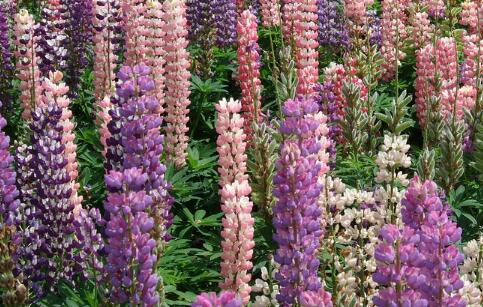
Lupine, also called “lupin,” is a plant in the order Rosales, family Fabaceae, genus Lupinus. The flower spikes are upright and abundant, with bright, colorful blooms in variations of white, red, blue and purple, and the blooming period is long. It can be used for mass planting or grouped planting in ribbon flower beds, and it is also a good material for cut flower production. So where is lupine suitable for planting? When does it bloom?
Lupine is the transliteration by people in Taiwan, China of its English name lupin. Many Hakka people regard lupine as the “Hakka mother flower,” representing ordinary beauty and sorrow.
Where is lupine suitable for planting?
Lupine is distributed in Mediterranean region countries such as Italy and Spain, where there is an annual wild type. It is cultivated more extensively in the Soviet Union, the Netherlands, Belgium, the United States, New Zealand and elsewhere. It prefers cool conditions and full sunlight, dislikes heat, and tolerates slight shade. It has a deep root system and few root nodules. It grows in sandy soil and requires deep, fertile, loose, well-drained acidic sandy loam (pH 5.5); plants grow poorly in neutral and slightly alkaline soil.
When does lupine bloom?
Under natural conditions, autumn sowing is best for lupine, that is, sowing from September to mid-October, with the blooming period from April to June the following year.
How is lupine planted?
Lupine is generally grown from seed or cuttings. The specific planting methods are as follows:
Seed propagation
Under natural conditions, autumn-sown lupine blooms earlier and grows better than spring-sown lupine, so it is best to choose autumn for sowing. Lupine seeds germinate uniformly at high temperatures of 21-30°C. Of course, spring sowing is also possible, but after spring sowing in March, the growing period coincides with summer; affected by high heat, some varieties may fail to bloom or the proportion of blooming plants may be low and the flower spikes short, resulting in poor ornamental effect. So unless there is no other choice, it is best to sow from September to mid-October, so that it can bloom from April to June the following year.
When sowing, use 72-cell or 128-cell plug trays for spot sowing and cover. The seedling medium should be loose and uniform, breathable and water-retentive; specialized seedling medium or a mix of peat soil and perlite is best. The seeds are relatively large, plain or coated, about 40 seeds/gram. The optimum germination temperature is about 25°C; keep the medium moist, and the seeds will emerge and germinate in 7-10 days, with a high germination rate.
2. Cutting propagation
For cutting propagation, in spring cut shoots sprouting from the rhizome into 8-10 cm lengths, preferably with a little rhizome attached, and insert them in a cold frame. In hot, rainy summer areas, lupine often cannot survive the summer and dies, so it can be grown as a biennial. It should be planted early in spring in the cultivation site at a spacing of 40 cm; early planting promotes early bushing out and earlier flowering and seed setting. After setting seed before summer, the aboveground part withers, and new plants sprout again in autumn, or seeds can be harvested before withering. In North China, protection is needed for overwintering.
[Tips]
Lupine prefers cool conditions and full sunlight, dislikes heat, and tolerates slight shade. It has a deep root system and few root nodules. It requires deep, fertile, loose, well-drained acidic sandy loam (pH 5.5); plants grow poorly in neutral and slightly alkaline soil. The lupine seedling stage lasts 30 to 35 days; after the true leaves have fully unfolded, transplant the seedlings into separate pots. Lupine has a well-developed root system, so retain the original soil when transplanting to help the seedlings recover.