Water chestnut (water caltrop) cultivation methods in greenhouses, harvesting time and yield per mu
Water chestnut, also known as water chestnut fruit or water caltrop, is a common aquatic plant in southern China. Because it can be eaten as a fruit when young and tender and processed into water chestnut starch when mature, it is widely cultivated. At present, many regions are also trying to grow it in greenhouses. So how do you grow water chestnut in a greenhouse? When do you harvest it? About how many jin can be produced per mu?
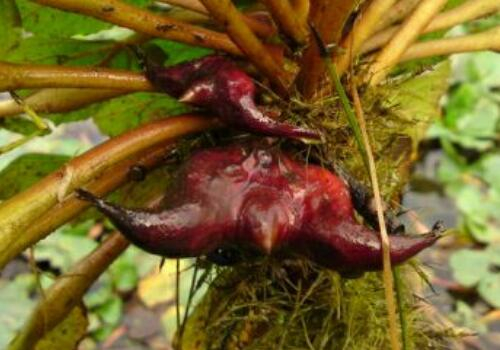
1. When is water chestnut harvested? About how many jin can be produced per mu?
For open-field cultivation, the water chestnut harvest period is from August to October, and the yield per mu is 2000-3000 jin; for greenhouse cultivation, the harvest period is from mid-May to November, and the yield per mu is 5000-6000 jin.
High-yield cultivation techniques for greenhouse water chestnut:
2. How is greenhouse water chestnut cultivated?
1. During the seedling stage of greenhouse water chestnut, the water layer should remain stable; otherwise, the growth of the water chestnut seedlings will be affected. According to the production target of 1.5 t of fresh water chestnut per 667 sq m, apply 15 kg per 667 sq m of ternary sulfur-based compound fertilizer (15-15-15), broadcast it, and then transplant.
2. During the stage of separate trays and full growth, thin the trays in time, leaving 15-20 trays per sq m. Later, during harvesting, also remove weak and small trays at any time so that the number of trays remains at 15-20 per sq m, and cultivate robust trays with a diameter of more than 30 cm to prevent the trays from sealing the water surface too early, resulting in small trays and reduced yield. Topdressing should be carried out in multiple applications.
3. At the early flowering stage (about 45 d after transplanting), apply 10 kg per 667 sq m of compound fertilizer. After that, immediately after each water chestnut harvest, alternately apply 5-8 kg per 667 sq m of Jiamei Yinglilai or 10 kg per 667 sq m of compound fertilizer. After the 3rd harvest, remove about 40% of the trays to thin the pond, and after thinning, apply 15 kg per 667 sq m of ternary compound fertilizer.
When topdressing, gently push away the trays with your foot at intervals of about 2 m, then grab 1 handful of fertilizer and apply it into the water. Starting from the beginning of flowering, spray 800-fold dilutions of Jiamei Brain Platinum or Jindian on sunny days at 7:00-8:00 or 17:00-18:00, combined with insect control spraying.
4. At the full flowering stage (that is, when each tray has 3-4 water chestnuts), use paclobutrazol for chemical control, which has a significant effect on increasing the fruit-setting rate of water chestnut. In water chestnut fields, attention should be paid to frequently changing the water and maintaining air circulation. Generally, change the water at around 6:00 and maintain a water layer of 20-30 cm. In summer, when temperatures are high, the water layer should be maintained at more than 30 cm.
5. The field must be level; uneven height makes weeds more likely to grow. Water chestnut is sensitive to herbicides. Once weeds are found, manual pulling should be carried out as early as possible.
6. At this stage, focus on managing moss in the greenhouse, control the harm of golden apple snails, and promptly remove four-leaf clover by hand to prevent it from spreading; otherwise, it will affect the photosynthesis of water chestnut. At the same time, reasonably control the greenhouse temperature, ventilate in time, and in the morning when the greenhouse temperature rises above 20°C, roll up the film roller to facilitate ventilation and cooling, keeping the temperature at 20-30°C. At around 15:00, lower the film roller to keep warm.
7. In June, when the temperature is slightly higher, tie up the greenhouse skirt film with rope to facilitate ventilation and cooling. After the plum rain period passes, remove the greenhouse film to prevent unstable temperatures and heavy rain from washing the trays, which is unfavorable for flowering and fruiting.
8. Pest and disease control: The main diseases are water chestnut blast and water chestnut brown spot. Attention should be paid to reasonable close planting, maintaining water circulation, and preventing pollution. Spray 750-fold dilution of 20% tricyclazole or 600-fold dilution of 50% carbendazim for control.
The main insect pests are flea beetles, leafhoppers, and aphids that damage the trays. A 1000-fold dilution of 25% beta-cypermethrin can be sprayed, and control 2-4 times depending on pest occurrence. According to recent years of practical water chestnut cultivation, to obtain high yield, pest and disease management must be done well, reducing the occurrence of water chestnut pests and diseases and allowing water chestnut to grow efficiently!