What to Do When the Leaves of Selaginella uncinata (Blue Spikemoss) Dry Out? A Detailed Guide to Growing and Propagating It
Selaginella uncinata may be relatively uncommon to many people. It belongs to the Selaginellaceae family as a perennial herbaceous plant, and is cultivated in many regions of China, possessing both medicinal and ornamental value. The whole plant can be used as medicine, either dried or fresh. It can also be grown well at home as a potted plant. So what should you do when the leaves of Selaginella uncinata dry out? What are the growing methods for Selaginella uncinata? How do you propagate Selaginella uncinata?
I. What to Do When the Leaves of Selaginella uncinata Dry Out?
Wild Selaginella uncinata grows along small streams, small rivers, small lakes, or in semi-shaded, moist spots in the mountains, which proves that Selaginella uncinata greatly loves a humid climate. When caring for it at home, you must pay attention to matching its growing habits. A lack of water directly causes insufficient moisture in the leaves, weak photosynthesis, and the leaves then develop a dried and yellowed appearance. In summer, high temperatures are common across China, and the light is intense. People can hardly stand it and want to find a shady spot to stay in forever, let alone these plants that love a semi-shaded environment?
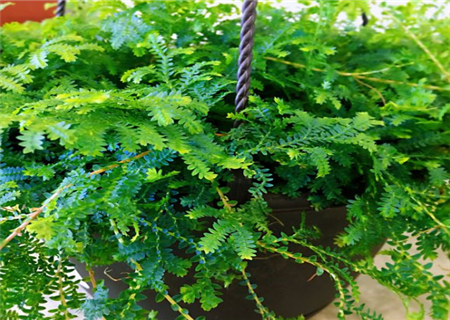
The leaves of Selaginella uncinata are delicate and emerald green, and the high temperatures and strong light of summer can easily scorch the leaves. The editor knows that some flower enthusiasts place the plant on a balcony for care. In summer, the balcony temperature is very high, and if shading is not provided, the leaves will be scorched and become very unsightly, dried out, and yellowed.
The potting soil for Selaginella uncinata needs to be loose, breathable, and well-draining, with leaf mold being best. If the potting soil is compacted and not breathable, making root respiration difficult, the roots will become black and rotten, directly causing poor absorption of water and nutrients by the leaves, and the leaves will show signs of drying out and yellowing.
For the care of Selaginella uncinata, you can spray a water mist on the leaf surface every day to keep the leaves sufficiently hydrated and the air humidity high. At the same time, the potting soil can also be kept moist to avoid dryness. In summer weather with high temperatures and strong light, be sure to move Selaginella uncinata to a place with cover, keeping it cool, comfortable, and breathable.
If the problem is with the potting soil, be sure to replace it promptly and keep the potting soil in a good state of breathability and drainage. When repotting, wash the black and rotten roots clean, cut off the really badly damaged ones, place it in a ventilated and shaded spot to dry, and then plant it back into the pot.
II. Growing Methods for Selaginella uncinata
1. Soil: Weakly acidic or acidic soil. The potting soil should be loose, permeable, and rich in humus. An equal mix of leaf mold or peat, loam, and plain sand can be used;
2. Water: It prefers a moist soil environment and cannot tolerate drought. Water it at fixed times every day, and regularly use a sprayer to spray water vapor to maintain leaf surface humidity, which helps it grow more vigorously. In winter, reduce watering and keep it only slightly moist.
3. Fertilizing: During the growing season, fertilize once every half month, and pay attention to the balance of nitrogen, phosphorus, and potassium. To avoid excessively long vine growth, control the application of nitrogen fertilizer. Stop applying fertilizer in winter.
4. Temperature: It prefers warmth and grows well at around 20°C, with a wintering temperature of 5°C. The ideal growing temperature is 10—15°C at night and 21-26°C during the day;
5. Light: It prefers semi-shade. In midsummer, pay attention to shading; it must not be exposed to harsh sun, otherwise the plant is prone to scorching and death.
6. Pruning: In spring, prune the plant once when repotting, cutting off aged vines and shortening overly long branches.
7. Potting and repotting: For planting, choose a flower pot with a diameter of 15-20 cm, planting 5-7 seedlings per pot. It prefers fertile, loose, and well-draining sandy loam. The substrate can be prepared with materials such as leaf mold, garden soil, and rice husk ash or coarse sand. Potted plants should be repotted every spring when the roots have filled the pot.
III. How Do You Propagate Selaginella uncinata?
Selaginella uncinata is a medium-sized creeping fern. The main stem creeps along the ground, about 1 m long, with sparse branches. There are adventitious roots at the nodes. The leaves are ovate and sparsely arranged in two rows. It branches repeatedly. The vegetative leaves are dimorphic, each in two rows on the dorsal and ventral sides. The ventral leaves are long ovate, and the dorsal leaves are oblong, with entire margins, spreading flat to both sides. The strobili are four-angled, and the sporophylls are ovate-triangular, arranged in four rows in an imbricate pattern.
Every spring, you can repot Selaginella uncinata and keep the potting soil well-draining. When repotting, you can carry out division. Pull apart the densely growing clumps and plant them separately, then place them in a shaded and moist environment.
After the divided seedlings are potted, avoid prolonged exposure to sunlight, otherwise the leaves will be scorched and become shriveled. You can spray water above the plant every day to increase air humidity. Half a month after potting, apply fertilizer once; decomposed fertilizer is fine. Ensuring sufficient nutrient supply is the only way the young seedlings can grow healthily and vigorously.
Selaginella uncinata is a creeping plant. If you do not pay attention to maintaining its shape, it will take on the look of a messy clump of grass. Therefore, in spring, shaping and pruning should be carried out to keep the plant in good condition and give it a beautiful form.
In spring pruning, the healthy branches cut off can be used for cuttings, with a high survival rate.
Select robust branches and insert them into a moist sand bed. Keep the potting soil moist within half a month, with air humidity above 50%. After half a month, you can see the plant grow roots. Then normal care can begin. Be careful not to expose it to prolonged light, as it will get sunburned.