Hydroponic growing methods for Bamboo Palm (Fernleaf Hedge Bamboo) and the causes and prevention of yellowing leaves
Bamboo Palm (Fernleaf Hedge Bamboo) can adapt to a relatively moist environment, so it is often grown at home using hydroponics, which is not only more attractive but also easier to care for. However, many people are not very familiar with its hydroponic method, which leads to the phenomenon of yellowing leaves in Bamboo Palm. So what is the hydroponic method for Bamboo Palm? Why do the leaves turn yellow? How can this be prevented? Let us tell you the answers.
1. What is the hydroponic method for Bamboo Palm?
1. Remove the leaves
It will not work to put it in a bottle without removing the leaves. But how many leaves should be stripped off to be appropriate? This mainly depends on the size of the bottle; there must be no leaves below the mouth of the bottle. Note that you cannot cut them off directly with scissors; you should pull them all off from the stem until the individual bamboo nodes are exposed, and it is enough when the slightly yellow stem below the nodes can be seen. In this way, the water is less likely to become smelly. After completing this step, cut the root end at an angle so it can easily absorb water.
2. Water techniques
For water, you can choose purified water and tap water. If you use purified water to grow it, even without adding nutrient solution, the bamboo can remain green all the time; if you use tap water, it needs to be left to stand for one or two days before use. Before Bamboo Palm has grown roots, the water needs to be changed about twice a week, and you cannot change the water every day. There is also one point to note: once the roots have grown out, there is no need to change the water; instead, you should add water in time. When you feel the water has become cloudy, you can change it, in the morning and in the evening, when the temperature difference is smaller and it will not harm the roots.
3. Water depth control
The water depth should also be controlled according to the size of the bottle, roughly between half and three-fifths of the bottle. If it is hard to determine, it is recommended to use a transparent vase. A transparent vase is best shaded from light, which helps rooting. After roots have emerged, move it to a balcony with more sunlight and change the water once a month.
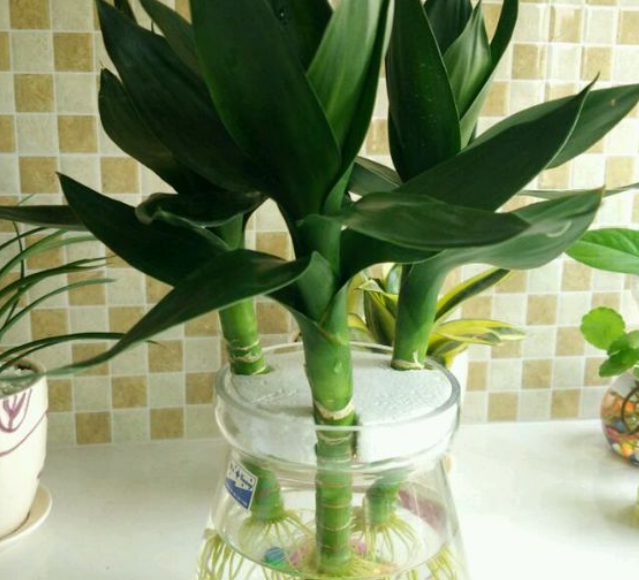
4. Placement location
Bamboo Palm cannot be placed in a position where air-conditioning airflow passes by, as its leaves will easily turn yellow. Bamboo Palm can be placed in a spot with bright scattered light or weak light, and it is recommended not to grow it hydroponically in a dark place. Also note one point: right after it has been planted, do not immediately change its direction, and do not move it back and forth; after one day, that is fine.
5. Growing temperature
Ensuring the temperature for normal growth of Bamboo Palm is very important. The root system of Bamboo Palm grows well within the range of 15°C-30°C. In winter, it is best to keep it above 10°C, and below 5°C it is prone to cold damage. In other words, in winter the temperature needs to be kept above 5°C to ensure that most plants can safely overwinter.
6. Adding nutrient solution
Please note that excessive nutrient solution is strictly prohibited, and shortening the interval for adding nutrient solution is strictly prohibited. Generally, add it once every 10-30 days. In spring and autumn, when plants have strong growth demands, generally add it once about every 10-15 days. In winter, when most plants are in a dormant period, generally add it once every 20-30 days. When adding it, you can pour out all the water or not, depending on how cloudy the water is. Generally speaking, replacing all the water can increase the dissolved oxygen content of the water, which is beneficial to the growth of hydroponic Bamboo Palm.
2. What are the causes of yellowing leaves in hydroponic Bamboo Palm?
1. The water level is too high. If the leaves of Bamboo Palm are dull and lack luster, and the branches are thin and yellowing, it indicates that the water level is too high, causing poor root respiration. It is necessary to reduce the amount of water, keep the water level at about half of the container, and ensure that at least half of the root system of Bamboo Palm is exposed above the water surface.
2. Too much light. Similar to light-related care in soil cultivation, hydroponic Bamboo Palm cannot be placed in sunlight for care, otherwise it will be scorched by exposure to strong sunlight. Therefore, it should be placed in a cool place for care.
3. Insufficient fertilizer. In hydroponics, it is generally necessary to add nutrient solution. If you only change the water for a long time without adding nutrient solution, it may cause nutritional deficiency, thereby making the leaves thinner and yellow. Therefore, after each water change, an appropriate amount of nutrient solution should be added.
4. The temperature is too low. As we mentioned earlier, Bamboo Palm is a plant that is relatively afraid of cold. Although room temperature is relatively easy to control in hydroponics, you should try to ensure the room temperature is above 10°C. If it is below 4°C, it is easy to cause the plant to suffer cold damage.
5. Sudden environmental changes. If the temperature and humidity of the environment suddenly change greatly, it can also easily cause the leaves of Bamboo Palm to turn yellow, so try to move Bamboo Palm as little as possible and keep it in a relatively stable and suitable environment, which is beneficial to its growth.
3. How can yellowing leaves in Bamboo Palm be prevented?
For potted Bamboo Palm, in summer it should be moved to a cool place outdoors, and attention should be paid to watering more to keep the potting soil moist. The leaves should also be sprayed with water and the ground sprinkled with water to keep the air moist, so that the branches and leaves of Bamboo Palm can remain green. Dry hot summer wind will cause the leaves of Bamboo Palm to scorch, so the temperature must be appropriately lowered to prevent stuffiness and heat. In winter, Bamboo Palm needs to be placed indoors, with water controlled and fertilizing stopped, and the indoor temperature needs to be kept above 10°C.
During the growing period, liquid fertilizer needs to be applied once about every 20 days. The liquid fertilizer can be fully decomposed diluted soybean cake water, or a compound liquid fertilizer. Fertilizing should be stopped in winter. Bamboo Palm does not need to be repotted every year; generally repot once every 2 years. The potting culture soil is made by mixing 1 part leaf mold, 0.5 part garden soil, and a small amount of river sand and rice husk ash, etc. In high-temperature seasons, Bamboo Palm should be moved to a cool place, avoiding exposure to strong sunlight, and water should be sprayed on the leaves of Bamboo Palm to keep the leaf color green.