Reasons for Thin Leaves on Clivia and How to Fix Them, Plus Care Tips
Anyone who has grown flowers knows Clivia, with its delicate and elegant appearance. But during cultivation, you may find that its leaves are very thin. What causes this? How do you solve this problem?
I. What causes thin leaves on Clivia? How do you fix it?
1. Insufficient light
For plants, insufficient light has a big impact on growth. If photosynthesis cannot be adequately supplied, the synthesis of nutrients will be a problem, making the leaf flesh thinner and the leaves correspondingly thinner as they grow. Only by giving it enough light and letting it photosynthesize to replenish the chlorophyll the plant needs will the leaves grow thicker and fleshier.
2. Poor growth
This cause is generally more common in summer. We all know that summer weather is very hot, and once the plant's growing environment exceeds a certain temperature limit, it enters a dormant state. So if care is not careful enough, growth problems will appear. In addition, under high temperatures water evaporates very quickly, and if nutrients cannot keep up, the leaf flesh will become thinner, and the leaves will naturally become thin.
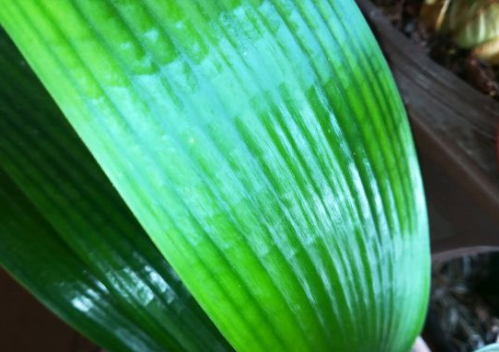
3. Insufficient soil fertility in the pot
Many people often neglect their flowers and do not care for them carefully enough. After being left for a long time, the soil's fertility is used up, and if the soil is not changed in time, the plant cannot absorb nutrients, so the leaves wilt and thin out, and some even turn yellow. So you must change the soil at intervals, otherwise the soil's fertility will not keep up.
4. Too much water, causing waterlogging
Watering is often a task that most people find hard to control and master; the amount is very difficult to get right. Here is a little trick for everyone: before watering, first touch the potting soil with your hand to feel how moist it is, so you can make sure your watering timing is right. Another point is that when watering, you must pay attention: if water flows out of the drainage holes into the tray, stop watering immediately. This way you can avoid thin leaves in the plant caused by overwatering.
II. Clivia growing methods and care tips
1. Clivia is shade-tolerant and likes a humid, cool environment. In summer, try to avoid strong sun. Above 15 degrees and below 25 degrees is most suitable for its growth. In winter, you need to think about how to create a warm environment so it can safely overwinter.
2. Clivia is certainly a famous flower, but the pot is not better the more exquisite it is. Although the cheapest unglazed clay pot does not look attractive enough, its breathability is unmatched by ordinary pots. For Clivia's roots, breathability is the most important thing. Old pots used for many years have poor breathability, so they must be soaked and cleaned, then sun-dried before use.
3. Soil is the foundation of growing flowers. The bottom of the pot is best lined with tile pieces to help drain away standing water. For the potting soil, you can refer to the following formula: leaf mold soil 50 percent, coarse sand 15 percent, charcoal and gravel 20 percent, rotted fertilizer 15 percent (rotted fertilizer should as much as possible avoid direct contact with the flower roots).
4. For grown Clivia, change the soil once a year, preferably in spring and autumn. When changing the soil, cut off rotten roots and dry roots. Use soil to fill in firmly around the roots, otherwise water and nutrients will find it hard to reach the roots. After changing the soil, water thoroughly.
5. Clivia's roots are fleshy, and standing water in the pot easily causes root rot. In winter, water evaporates less, so appropriately reduce watering frequency. Normally it is recommended to use a spray bottle, which cleans the leaves, increases humidity and waters all at once. During the flowering period, use the method of watering the roots, but the pot must never hold standing water.
6. The principle of watering is: do not water until it is completely dry, and when you water, water thoroughly. Clivia's root system is well developed, and combined with reasons such as soil compaction, it is sometimes hard to water thoroughly. You can put the whole pot into a bucket or laundry basin and take it out after about 1 minute.
7. When watering in summer, also pay attention to one thing: the water vapor isolation phenomenon. The soil on the surface of the pot looks dry, but the soil at the roots is actually still very wet. If you water at this time, it is very easy to cause root rot in Clivia.
8. Watering and fertilizing are best done at the same time. During the vigorous growth period, apply once every 15 days to 20 days a fully fermented fertilizer solution or rice-washing water, etc. You can buy special fertilizer to apply, but it is best not to use chemical fertilizers.
9. Summer is relatively hard for Clivia. Put Clivia in a ventilated place, preferably on a water pool or water basin (with a wooden board underneath), and often spray water around the plant and on the leaf surface to improve Clivia's temperature and humidity environment. Control fertilizing, applying as little as possible or not at all. When watering, be very careful not to let water run into the leaf center, to avoid rot in the leaf center.
10. Like other plants, Clivia also has phototropism, so you must often move its position and direction. Whichever side is not growing well, put that side in a sunny position, so it can grow symmetrically.