Lysimachia plant "Jinqiancao" (moneywort) market price per jin and hydroponic method and days to sprout
Jinqiancao, also known as Jingmiancao (mirror grass), symbolizes wealth, and because its leaves are round and petite it is kept as a small potted plant for viewing; at present many people like to plant it on their own balconies to enhance the indoor ornamental effect, so how much is the market price of Jinqiancao per jin? How to grow it hydroponically? How many days until it sprouts?
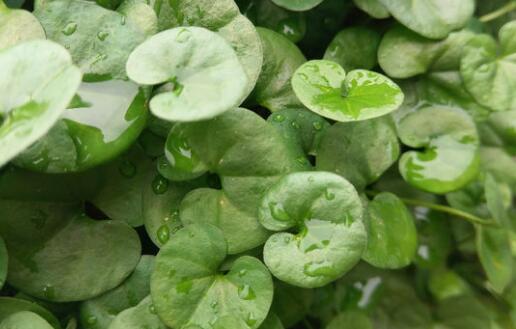
I. How much is the market price of Jinqiancao per jin?
The price of Jinqiancao is about 10-15 yuan per jin, but prices vary greatly depending on quality, place of origin, market and so on.
II. How to grow Jinqiancao hydroponically?
1. Flower pot
You may think flower pots are all about the same and there is no need to choose. Indeed, most flower pots differ only in appearance, and there are only a few materials in total, but relatively speaking, Jinqiancao has rather special requirements for its pot: the container for growing it must not have small holes in the bottom. In addition, if you choose a glass pot, the effect will be a little better. Because this plant needs a lot of water.
2. Water
Jinqiancao can be cultivated without soil, but if you grow it in water, you have to control the water level. A water amount about 1 cm above the bottom of the pot is just right. As for water quality requirements, it is not fussy; there is no need to choose water with mineral elements, ordinary groundwater will do. In addition, the frequency of changing the water also directly affects the growth of this plant; here it is recommended to do it once a week.
3. Nutrient solution
Adding nutrient solution regularly is necessary; although it is also dripped into the water, it is recommended to dilute it first. Only then will the leaves of the Jinqiancao grown this way be glossy.
4. Sunlight
The frequency of sunlight exposure can just follow the frequency of changing the water, also once a week, and it should not be too much. Although Jinqiancao is small, it can also purify the air through its own photosynthesis.
III. How many days does Jinqiancao take to sprout?
Sowing method one: Pour the seeds into a small container, add water just enough to cover the seeds; if the temperature is low, wrap it with plastic wrap, change the water frequently, and place it in a cool, ventilated place; after four or five days it will sprout, and when the sprout grows to about 1 cm you can plant it.
Sowing method two: Soak the seeds in a small amount of water for half an hour, put soil in a pot, water it thoroughly, pour the seeds together with the water they were soaked in into the pot, try to pour evenly and do not let them pile up, cover with a thin layer of soil, spray water twice a day, just keeping the surface moist. Place it in a warm, dark place, and in about three days it will sprout; once true leaves grow you can transplant it for hydroponics.
IV. What is the difference between Jinqiancao and Tongqiancao?
1. Difference in family and genus:
Jinqiancao: Jinqiancao is a perennial creeping herbaceous plant in the plant kingdom, Angiosperms, Dicotyledoneae, Sympetalae, Tubiflorae, Primulaceae.
Tongqiancao: Tongqiancao is a perennial herbaceous plant in the plant kingdom, Angiosperms, Dicotyledoneae, Archichlamydeae, Umbelliflorae, Apiaceae.
2. Difference in morphology:
Jinqiancao: The creeping stem of Jinqiancao is slender, covered with gray short soft hairs, and roots at the nodes. The leaves are kidney-shaped to round; flowers are solitary in the leaf axils, the flower stalk is shorter than the leaf stalk, thread-like; the leaves are green, and it bears small yellow flowers; the capsule is spherical, 3-5 mm in diameter, hairless, with sparse black glandular lines, valvate dehiscence; the flowering period is May-July, and the fruiting period is July-October.
Tongqiancao: The Tongqiancao plant has a trailing habit, with a plant height of 5-15 cm, often rooting at the nodes, the stem tip is brown, the leaves are alternate, with long stalks, roundly peltate, 2-4 cm in diameter, with wavy margins, grass-green, with 15-20 radiating veins; the flowers are bisexual, in umbels, the small flowers are white, and the fruit is a schizocarp; the flowering period is June-August.
Difference in alternative names between Jinqiancao and Tongqiancao. 1. Jinqiancao: Jinqiancao is also known as Guoluhuang, Jingmiancao, Cuipingcao, Hebaocao, Rouhunduncao, Jinsuochi, Lianqiancao, Duizuocao, Ye Jinqiancao, Qianye Cao, Qian Qian Jin and so on.
3. Difference in alternative names:
Duizuocao, Qianbi Cao and so on; in Hunan it is called Jinhua Cai and Pudi Lian, in Hubei it is called Lubian Huang, in Sichuan it is called Yi Chuan Qian, in Beijing and Guangzhou it is also called Sichuan Da Jinqiancao, in Yunnan it is called Zhenjin Cao, in Guizhou it is called Zouyou Cao, in Zhejiang and Jiangxi it is also called Linshi Jiu, and in Shaanxi it has the alternative name Cungu Qi.
4. Difference in medicinal effects:
Jinqiancao: Jinqiancao is sweet and slightly bitter in taste, cool in nature, and enters the liver, gallbladder, kidney and bladder meridians; it has the effects of promoting water excretion and treating strangury, clearing heat and detoxifying, dispersing blood stasis and reducing swelling, clearing heat and removing dampness, treating sandy strangury, painful difficult urination, jaundice with dark urine, and carbuncles and boils; it mainly treats liver, gallbladder and urinary stones, heat strangury, nephritic edema, damp-heat jaundice, sores and carbuncles, venomous snake bites, bruises and injuries and other conditions.
Tongqiancao: Tongqiancao is bitter and pungent in taste, cold in nature, and enters the liver, spleen and kidney meridians; it has the effects of clearing heat and removing dampness, and detoxifying and reducing swelling; it is often used for damp-heat jaundice, heatstroke diarrhea, stony strangury and bloody strangury, carbuncles and sores, falls and injuries and other conditions.