Chayote Growing Guide: What Varieties Are There? When Is the Best Time to Plant? How Do You Plant a Sprouted One?
Chayote, also known as penggua, shougua, yanggua, hezhanggua and so on, is a common plant of the Cucurbitaceae family in Yunnan, Guizhou, Sichuan and other places. Because it carries a meaning of blessing and can be eaten both as a vegetable and as a fruit, it is deeply loved by people, and it is now being planted in many regions. So what varieties of chayote are there? When is the best time to plant it? How do you plant a sprouted one?
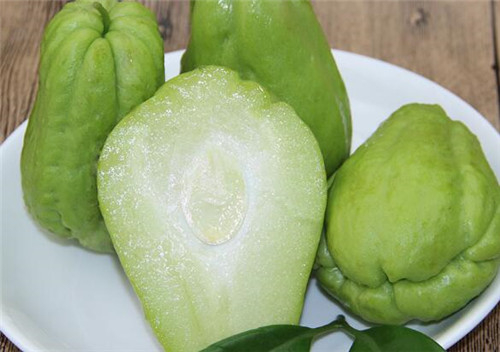
I. What varieties of chayote are there?
Chayote comes in many varieties and can be divided by color into white-skinned and green-skinned types, whose main characteristics are as follows:
1. Green-skinned chayote: The green-skinned type grows fast, produces large fruit and has a high fruiting rate, but its quality is not very good and its taste is a little bland, so it is not very popular, though it is still planted in some areas.
2. White-skinned chayote: The white-skinned type grows slowly and has a low fruiting rate, but its surface is smooth and thornless and its quality is better, so it is cultivated in many areas, with a relatively wide planting range in Yunnan, Guizhou, Sichuan, Xiangjiang and other places.
II. When is the best time to plant chayote?
Chayote is generally best planted in open fields in April to May, and in greenhouses around March, though the specific timing still needs to be decided according to local climate conditions.
III. How do you plant a sprouted chayote?
1. Choosing the site: Chayote does not have strong resistance and likes to grow in sandy soil with plenty of light, good permeability and good drainage, so when choosing a site, try to select sandy soil or weakly clayey neutral loam with plenty of light and good drainage.
2. Sowing and raising seedlings:
(1) Deeply plowing the soil: Before sowing the seeds, it is best to deeply plow the soil once and scatter in a small amount of farmyard manure to increase soil fertility, then plow deeply again so that soil fertility is even. When deep plowing, try to dig a small ditch to make later drainage and irrigation easier.
(2) Sowing method: Put the sprouted chayote into a soil hole, then slowly cover it with soil, and water lightly to let it grow on its own.
3. Field management
(1) Fertilizing: Chayote has low fertilizer requirements and generally only needs fertilizing three times during the growing period. During the growth period the main fertilizer is urea, during the flowering period it is mainly foliar fertilizer and farmyard manure, and during the fruiting period it is mainly boron fertilizer, so when fertilizing, try to get the timing right.
(2) Watering: Chayote needs a fairly large amount of water, especially in hot weather, when the soil must be kept moist, so that water is not evaporated and the vines do not stop growing, which would affect the growth of the whole plant.
(3) Pruning: During the growing period, chayote may produce densely set fruit, so according to the actual situation, poorly growing or overly crowded fruits around it should be removed to balance nutrients, help the later growth and development of the fruit and increase yield.
4. Branch and leaf management
Chayote is a vine plant, so when it grows to 40 cm, a triangular support should be used to fix it in place so that it can climb and grow, reducing the occurrence of pests and diseases and increasing yield.
IV. How much is chayote per jin on the market?
The market price of chayote is very affordable, generally around 1 to 2 yuan per jin, but because of differences in variety, quality, place of origin and market, prices also vary somewhat. For example, at the Zhejiang Shaoxing Vegetable and Fruit Wholesale Trading Center, chayote is 5 yuan/kg, and at the Jiangsu Lingjiatang Agricultural and Sideline Products Wholesale Market, chayote is 2 yuan/kg, so the specific price still needs to be checked at the local market. Recent chayote market prices are as follows:
| Date | Product | Price | Market |
| September 17, 2018 | Chayote | 2 yuan/kg | Jiangsu Lingjiatang Agricultural and Sideline Products Wholesale Market |
| September 17, 2018 | Chayote | 2.1 yuan/kg | Suzhou Nanhuanqiao Agricultural and Sideline Products Wholesale Market |
| September 17, 2018 | Chayote | 2.4 yuan/kg | Zhejiang Hangzhou Jianqiao Vegetable Wholesale Trading Market |
| September 17, 2018 | Chayote | 4.3 yuan/kg | Zhejiang Jiaxing Vegetable Wholesale Trading Market |
| September 17, 2018 | Chayote | 5 yuan/kg | Zhejiang Shaoxing Vegetable and Fruit Wholesale Trading Center |
| September 17, 2018 | Chayote | 3 yuan/kg | Anhui Dangshan Agricultural Products Center Huifeng Wholesale Market |
| September 17, 2018 | Chayote | 4 yuan/kg | Fujian Fuding Fujian-Zhejiang Border Agricultural Trade Center Market |
| September 17, 2018 | Chayote | 2.57 yuan/kg | Shandong Shouguang Agricultural Products Logistics Park |
| September 17, 2018 | Chayote | 3.5 yuan/kg | Yunnan Chenggong County Longcheng Vegetable Wholesale Market |
| September 17, 2018 | Chayote | 3.8 yuan/kg | Shaanxi Xianyang New Sunshine Agricultural and Sideline Products Wholesale Market |
| September 16, 2018 | Chayote | 2 yuan/kg | Jiangsu Lingjiatang Agricultural and Sideline Products Wholesale Market |
| September 16, 2018 | Chayote | 2.1 yuan/kg | Suzhou Nanhuanqiao Agricultural and Sideline Products Wholesale Market |
| September 16, 2018 | Chayote | 4.2 yuan/kg | Fujian Fuding Fujian-Zhejiang Border Agricultural Trade Center Market |
| September 16, 2018 | Chayote | 2.8 yuan/kg | Shandong Shouguang Agricultural Products Logistics Park |
| September 16, 2018 | Chayote | 3.8 yuan/kg | Shaanxi Xianyang New Sunshine Agricultural and Sideline Products Wholesale Market |