Detailed Guide to Growing and Caring for Peacock Flower (Caesalpinia pulcherrima) Indoors in Pots, Plus Its Benefits and Uses
The peacock flower (Caesalpinia pulcherrima) originates from the West Indies, and is cultivated in Yunnan, Guangxi, Guangdong and Taiwan, China. It is one of the valuable ornamental trees of tropical regions. So how do you grow peacock flower at home? What are the benefits and uses of peacock flower? What are the potting and care techniques for peacock flower?
I. Basic introduction to peacock flower
1. Morphological characteristics
The peacock flower is a large shrub or small tree, reaching up to 3 m in height: the branches are green or pinkish-green, with sparse prickles. It has 4 to 8 pairs of bipinnate compound leaves, opposite, with 7 to 11 pairs of leaflets, oblong-elliptic or obovate, with a slanted base and a notched apex, and very short petiolules. The raceme is terminal or axillary, the flowers are round with stalks, orange or yellow, and the pedicel reaches up to 7 cm. The pod is black. There are 6 to 9 seeds. It flowers and fruits almost all year round.
2. Growth habits and distribution
The peacock flower is a tropical tree species that prefers a high-temperature, high-humidity climate, with relatively low cold tolerance. With prolonged low temperatures of 5-8°C, the branches suffer cold damage, and it is sensitive to frost. In places such as Guangzhou and Nanning in southern South China, it can overwinter safely outdoors in normal years.
For potted peacock flower, move it into a warm greenhouse or indoors in winter, and the room temperature should not be lower than 10°. It likes light and does not tolerate shade; it withstands blazing sun and high temperatures, and should be planted in a sunny spot. It is not demanding about soil; both sandy soil and heavy clay soil are suitable. It prefers acidic soil, is relatively drought-tolerant, and also slightly tolerant of waterlogging.
It originates from the West Indies, and is cultivated in Yunnan, Guangxi, Guangdong and Taiwan, China. It is one of the valuable ornamental trees of tropical regions.
3. Propagation methods
The peacock flower is mostly propagated by seed. From mid-June to mid-December, the pods ripen successively, with September to October being the peak ripening period; collect the fruits that ripen at the peak, place them in the sun to dry, and after they split open, remove the seeds. They can be sown as soon as collected, with the seedlings protected from cold to overwinter, or the seeds can be stored and sown in spring the following year. The seed germination temperature needs to be above 20°, and sowing in mid-to-late March in spring is more suitable. Before sowing, soak the seeds in 60° warm water, then continue soaking for 12 hours after cooling; germination is rapid, starting three days after sowing and finishing within a week, with a germination rate of about 60brf.
Another option is to use the drill sowing method. The seedlings grow at a moderate rate; apply nitrogen fertilizer 2-3 times during the seedling stage to push the seedlings along, and after October, stop applying nitrogen fertilizer and apply potassium fertilizer once to promote early lignification. In winter, pay attention to covering to prevent frost. One-year-old seedlings can be lifted from the nursery and planted out, and two-year-old young trees can bloom for ornamental display. If leaf spot disease occurs, spray 50bf carbendazim wettable powder at 500 times dilution for control.
II. Benefits and uses of peacock flower
1. Ornamental value
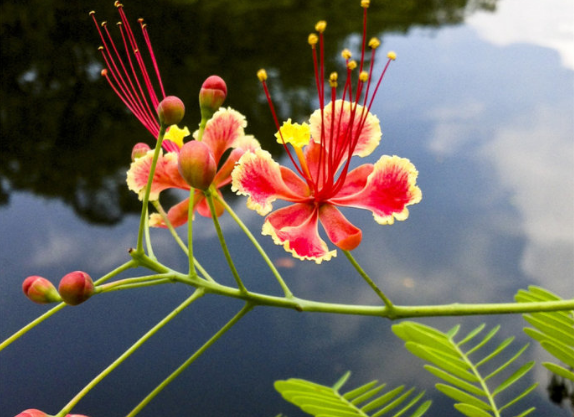
The peacock flower is an erect evergreen shrub of the genus Caesalpinia in the Fabaceae family. It reaches up to 3 m tall, with an orange-red corolla edged in golden yellow, blooming on the branches all year round like fiery butterflies, and is one of the valuable ornamental trees of tropical regions.
Among flowers, the peacock flower does not attract attention by color or fragrance, but mainly wins by its posture and form. The flower shape of the peacock flower is especially ingenious; the blossoms are just like flying phoenixes, with a head, a tail, wings and feet, vivid and lifelike, exactly like a phoenix in flight, leaving people no choice but to marvel at the wonder and brilliance of nature's creation.
2. Medicinal value
The peacock flower is a famous Chinese medicine; its seeds are used medicinally and have the effect of invigorating blood and promoting menstruation. The stem, pounded for juice and taken with yellow rice wine, can treat traumatic injuries.
The seeds of the peacock flower are also called "Ji Xing Zi" (impatient seed), and the stem is also called "Tou Gu Cao" (bone-penetrating herb); both can be used medicinally, with the effects of invigorating blood and resolving stasis, promoting diuresis and detoxifying, and promoting menstruation and penetrating the bones. Fresh herb pounded and applied externally can treat sores, boils, swelling and pain, and insect bites. The seeds are an antidote, with the effects of promoting menstruation, inducing labor, dispelling phlegm and reducing masses; pregnant women should not take them. The whole herb pounded for juice is used externally for traumatic injuries. The seeds contain saponins, fatty oil, sterols, polysaccharides, proteins, amino acids and volatile oil. It is cultivated in all provinces north and south of China: for ornamental display, and in addition to use in flower borders and bonsai arrangements, it can also be used as a cut flower.
The flowers are used medicinally, and can invigorate blood and reduce swelling, and treat traumatic injuries. Applying the flowers externally can treat tinea manuum. It can also remove body odor; the seeds made into a decocted paste and applied externally can treat numbness and aching pain. It invigorates blood and promotes menstruation, dispels wind and relieves pain, and is used externally for detoxification. It is used for amenorrhea, traumatic injuries, blood stasis swelling and pain, rheumatoid arthritis, carbuncles, boils and sores, snake bites, and tinea manuum. Modern pharmacological research has found that the peacock flower also contains various anthocyanins, which have inhibitory effects to varying degrees on various pathogenic bacteria such as Microsporum gypseum, Pseudomonas aeruginosa and Shigella dysenteriae.
In addition, Chinese folk medicine commonly uses pressed peacock flower petals to treat onychomycosis.
III. Potting and care techniques for peacock flower
1. Suitable soil
The medium for cultivating peacock flower is best a fertile, loose sandy loam, and the soil needs to be slightly acidic, which is more favorable for its growth. If the acidity is insufficient, an appropriate amount of ferrous sulfate solution can be added to the water when watering to improve it.
2. Moderate watering
The peacock flower is relatively drought-tolerant and not very demanding about water. During the peak growth period and full bloom period, it needs more watering to keep the potting soil moist; only with sufficient water can the plant grow and bloom normally. In spring and autumn, watering 2-3 times a week is usually enough; when temperatures are higher in summer, water once every 1-2 days; in winter, just keep the potting soil slightly moist, watering once every 1-2 weeks.
3. Appropriate light
The peacock flower is a light-loving plant; the more sufficient the light, the better it grows, and it can be kept in full sun. If light is insufficient or it is shaded for a long time, the branches and leaves will grow leggy, the leaf color will become dull and lusterless, and it may even fail to bloom.
4. Temperature control
The peacock flower is a tropical plant that likes to grow in a high-temperature environment, but its cold tolerance is very weak, so it is not suitable for planting in the north. In winter, keep the growing environment of the peacock flower no lower than 10 degrees, otherwise growth will be seriously affected and cold damage will occur.
5. Reasonable fertilizing
During the growth period of the peacock flower, apply a dilute nitrogen fertilizer once every half month, which can promote the growth of branches and leaves. But before the flowering period, apply phosphorus and potassium fertilizer as a top dressing and reduce the amount of nitrogen fertilizer, which can promote flower bud differentiation and increase the quantity and quality of blooming.
IV. Propagation methods for peacock flower
1. Seed propagation
The most suitable time for sowing is September to October, when the temperature and humidity are relatively sufficient for the germination and growth of peacock flower seeds. First place the seeds in warm water for 12-24 hours to let them absorb water and swell, then sow them, scattering the seeds on the seedbed, then covering with about 1 cm of soil, and then watering by the bottom-soaking method. As long as the environment is suitable, they will generally take root and sprout in less than two weeks.
2. Cutting propagation
Choose robust branches from the peacock flower plant as cuttings; the cuttings should retain three nodes. After preparing the branches, insert them into suitable soil, then water to keep moist, and spray with a chlorothalonil solution to disinfect. As long as care is good, 10-14 days is generally enough for rooting.
3. Common pests and diseases
(1) Leaf spot disease
After the peacock flower is infected with leaf spot disease, small spots appear on the leaves, then gradually expand and grow larger, and also infect other leaves and slowly spread to the whole plant. After discovering the disease, promptly remove the diseased leaves and fallen leaves, then spray with mancozeb for control.
(2) Nematodes
Nematodes mainly attack the roots of the peacock flower, causing tumor-like growths on the roots, making the plant grow slowly and gradually weaken and wither. After discovery, promptly take the plant out of the potting soil, disinfect and dry the soil, and eliminate the eggs in the soil.