The Pomegranate Tree as a Long-Lived Tree: Its Appearance, Planting, and Time to Fruit
The pomegranate is a long-lived and highly adaptable tree species. To consistently obtain high-quality, high-yield fruit and achieve relatively high economic returns year after year, it is essential to select superior varieties according to the environmental requirements of the pomegranate tree and carry out rational cultivation and management. So what does a pomegranate tree look like? How is it best planted? How many years does it take to flower and fruit?
I. What does a pomegranate tree look like?
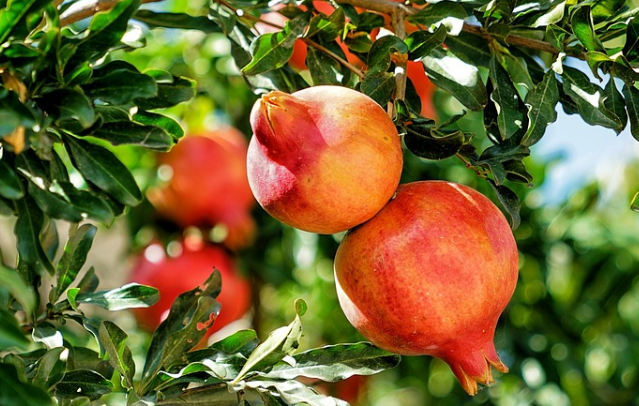
The canopy is heavily branched, and young twigs are angular, mostly square in cross-section. The small branches are flexible and not easily broken. Primary branches alternate oppositely on vigorous young twigs and bear small thorns. The length of the thorns is related to the variety and growing conditions. Vigorous trees have more thorns, while old trees have fewer. The color of the buds changes with the seasons, appearing in three colors: purple, green, and orange.
The leaves are opposite or clustered, long lanceolate to oblong, or elliptic-lanceolate, 2-8 cm long and 1-2 cm wide, with pointed tips, a glossy upper surface, and a raised midrib on the underside; they have short petioles.
The flowers are bisexual. Depending on whether the ovary is well developed, they are divided into bell-shaped flowers and tubular flowers; the former has a well-developed ovary and is good at fertilization and fruiting, while the latter often withers without setting fruit. Generally, one to several flowers are borne at the top of the current year's new shoots and in the leaf axils below the tip. The sepals are hard, fleshy, tubular, with 5-7 lobes, united with the ovary, and persistent. The petals are obovate, equal in number to the sepals and alternating with them, arranged in imbricate fashion. Flowers are divided into single-petaled and double-petaled types. Double-petaled varieties have many-petaled stamens and pistils and are mostly sterile, with petals numbering in the dozens. The flowers are mostly red, but there are also white and colors such as yellow, pink, and agate. The stamens are numerous, and the filaments are hairless. The pistil has one style, longer than the stamens, with 4-8 carpels and an inferior ovary. Fruit pomegranates flower from May to June, with pomegranate flowers like fire, and the fruiting period is from September to October. Flower pomegranates bloom from May to October.
II. How is a pomegranate tree best planted?
1. Time: The best time to plant a pomegranate tree is from late March to early May in spring. Pomegranate trees planted at this time are more likely to survive.
2. Soil: Pomegranates are not very demanding about soil. It is sufficient to plant them in soil with a deep soil layer, a groundwater level below 1 m, and a pH value of 4.5-8.2. If grown in pots, the soil should be loose, fertile, and well-drained. Use a culture soil mixed with leaf mold, garden soil, and river sand, and add an appropriate amount of decomposed organic fertilizer.
3. Temperature: The pomegranate tree prefers warmth. Its most suitable growing temperature is 15-20°C, and the lowest winter temperature should be above -17°C, otherwise it will suffer cold damage. If in cold northern regions, it should be placed in a cellar in winter to protect it from the cold.
4. Light: The pomegranate tree likes light. Especially during the growing period, it requires full sun, and the more sufficient the light, the more numerous and vivid the flowers. However, if there is insufficient light, it will only grow leaves and not bloom, affecting its ornamental effect.
5. Planting: When all conditions are suitable, you can plant the pomegranate sapling. When planting, choose a large seedling, bury it with soil after planting, then gradually expose the seedling after it sprouts, and water it thoroughly to settle the roots.
After that, simply pay attention to pruning and water and fertilizer management.
III. How many years does a planted pomegranate tree take to flower and fruit?
The age at which a pomegranate tree begins to fruit varies depending on the propagation method and variety.
1. Seedlings propagated by sowing pomegranate seeds require more than 10 years to flower and fruit.
2. Seedlings propagated by cuttings or division begin to fruit 3-4 years after planting.
3. Double-petaled red pomegranate or agate pomegranate, which are mainly grown for their flowers, can bloom in the same year they are sown.
Pomegranates bloom 3 times each year, hence there are 3 fruit settings, and generally the first or second crop of fruit develops well. Harvest should be done in stages and in a timely manner according to variety characteristics, fruit maturity, and climatic conditions. The signs of fruit maturity are: the skin turns from green to yellow, colored varieties become fully colored, and the fruit surface becomes glossy; the fruit ridges become visible; the red or silvery-white needle-like crystals in the fruit flesh cells become fully visible; the seeds are plump, and the soluble solids content of the fruit juice reaches the concentration inherent to that variety. Ripe fruit should be harvested before rain, and harvesting is prohibited in wet weather.
It should be noted that after ripening, the size of the fruit varies depending on the variety and age of the tree. For large-fruited varieties, the first ripe fruit is only slightly smaller, and by the third year the ripe fruit reaches its maximum size; for small-fruited varieties, no matter how many years they are grown, the fruit remains small from young fruit to maturity. Whether a large-fruited or small-fruited variety, as long as it is ripe, it can be eaten.
Of course, if your pomegranate tree's fruit remains very small from the second year all the way to maturity, you may have planted a flower pomegranate grown for ornamental purposes.