Is Mimosa pudica toxic? Medicinal value, indoor placement and the reason it is shy explained
In the plant kingdom there is a green plant whose leaves close at a touch——the mimosa (Mimosa pudica, also called sensitive plant). I believe many friends who like growing green plants at home have grown one. But do you know whether the mimosa, which can treat illnesses, is toxic? Can it be placed indoors? Why is it shy? Let us find out together below.
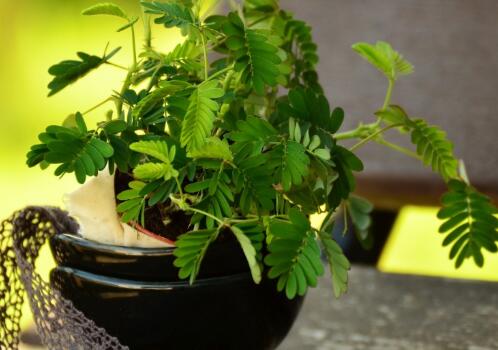
I. What does the mimosa look like?
1. Mimosa plants grown at home or sold in flower shops are usually in small pots and not very tall, but actually they can grow up to 1 m tall at most, and the mimosa also bears scattered, downward-curving hooked prickles.
2. The leaves of the mimosa look like small needles but bear bristles, and the flowers are very small, with pale red linear petals; the flowering period is from March to October each year; its pods are oblong and flat, slightly curved and wavy in shape, and the fruiting period is from May to November each year.
II. Is the mimosa toxic?
The mimosa is toxic.
1. The mimosa contains an alkaloid that is mildly toxic; if touched or contacted over a long period, it can cause the hair and eyebrows to turn yellow and fall out.
2. Mimosa has effects such as calming the nerves, clearing heat and detoxifying, but it cannot be used on its own; it needs to be used together with other medicines, and if mimosa is needed as an auxiliary treatment, it must be under a doctor's professional guidance. Never use it as medicine on your own, otherwise it can cause cataracts and other adverse reactions.
III. Can the mimosa be placed indoors?
It is best not to place the mimosa indoors.
1. The mimosa itself is a mildly toxic plant, and long-term contact is not good for the body. Especially in families with small children, do not place the mimosa within reach, so as to avoid harming the children's health.
2. Like other green plants, the mimosa performs photosynthesis during the day and can produce oxygen, but at night it performs respiration and releases carbon dioxide and other harmful substances, so it is better to keep the mimosa on a balcony or in another well-ventilated place.
IV. Why is the mimosa shy?
The mimosa got its name because its leaves fold up when touched, behaving as if shy. It is also called the sensitive plant, the shy plant, the call-and-shout plant, the bashful plant and so on. Although people know that the mimosa will be "shy," many friends are still unclear about exactly why it is shy, so let us talk about the reason below.
1. Environmental reasons in its place of origin: the mimosa originally grows in Brazil in South America. When the tropical rainy season arrives, the wind and rain are very strong, and to avoid damage to the leaves from large raindrops, it folds its leaves up. Do you not think it is really clever!
2. Botanical reasons: in order to investigate why the mimosa is "shy," someone has done related research. Through professional research it was found that around the vascular bundles of the pulvinus of the mimosa there are many parenchyma tissues. When a touch or vibration is transmitted, the cell sap in the parenchyma cells of the upper half of the pulvinus is expelled into the intercellular spaces, reducing the turgor pressure of the cells in the upper half of the pulvinus, while the intercellular spaces of the parenchyma cells in the lower half still maintain their original turgor pressure. In this way, the small leaflets of the mimosa stand upright and the two small leaflets close together.
V. How are potted mimosas grown?
1. For growing a potted mimosa, you can either directly buy an already planted pot on the market (if so, you only need to take care of it), or grow it yourself starting from sowing. If you choose to sow, do so in March or April each year, and generally it will sprout about a week after sowing.
2. The mimosa has very strong vitality, so it is not very demanding about the soil, and ceramic, plastic and other flower pots are all fine.
3. In summer, water the mimosa once a day, and each time water it thoroughly to keep the soil moist; in spring, autumn and winter, water about once every three days, and if the soil is especially dry, you can shorten the watering interval.
4. Fertilizing the mimosa once a month is enough; use fermented fruit peels or rice-washing water diluted with water and pour it on, or you can buy fertilizer from the market yourself.
5. The mimosa needs appropriate light, but be careful not to expose it to strong sun; in summer, place it in a cool, ventilated place to prevent the leaves from being sunburned; also, in winter, pay attention to protecting it from the cold and keeping it warm.