How to Grow Monthly Rose (Rosa chinensis) and How It Differs from Rose and Rambler Rose
Monthly rose, also called yueyuehong, yueyuehua, etc., is an evergreen or semi-evergreen low shrub in the Rosaceae family. It can bloom in all four seasons, with flower colors including red, pink, white, yellow, mixed colors, silver-edged, etc. Most varieties are fragrant. It is called the queen of flowers, ranks fifth among China's top ten famous flowers, and is the city flower of 52 cities in China. So, what are the growing methods for monthly rose? How does it differ from rose and rambler rose?
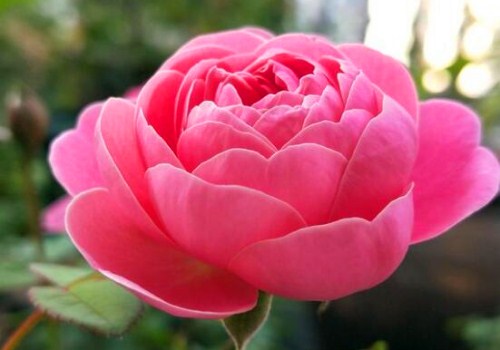
I. What are the growing methods for monthly rose?
1. Propagation: Monthly rose can be propagated by grafting, sowing, division, cuttings, and layering. Grafting commonly uses wild rose as rootstock, and includes bud grafting and stem grafting. Bud grafting has a higher survival rate and is generally carried out from August to September; sowing is generally done in spring, and can be done in holes or furrows. Usually, germination and seedling emergence occur in early to mid-April; division is mostly carried out in early spring or late autumn, and plants can bloom in the same year; cuttings are generally taken in early spring or late autumn when roses are dormant, using mature branches with 3 to 4 buds. They usually root in 30 days, with a survival rate of 70% to 80%; layering is generally carried out in summer.
2. Soil: Monthly rose can be grown in the ground, in containers, or hydroponically. The soil for growing monthly rose is preferably loose, fertile, rich in organic matter, slightly acidic, and well-drained loam. Alkaline soil is not suitable. It is suitable to repot, trim roots, and change soil before and after overwintering each year. Hydroponic monthly rose has a high survival rate and is not limited by time. After the flowers fade, cuttings can be taken. When the temperature is high, the water should be changed once a week.
3. Temperature: Monthly rose prefers a warm environment with ample sunlight and good air circulation. For most varieties, the optimum temperature is 15-26°C during the day and 10-15°C at night. When the winter temperature is below 5°C and the summer temperature remains above 30°C, it enters dormancy or semi-dormancy. During the growing season, it needs at least 6 hours of light per day; otherwise, it only grows leaves and does not bloom. Even if it blooms, the flowers are not brightly colored and not fragrant. Attention should be paid to ventilation. Only with good ventilation can it grow robustly and reduce the occurrence of pests and diseases.
4. Watering: Watering monthly rose should follow the principle of “water when dry, do not water when not dry, and water thoroughly when watering.” In midsummer, water when the surface of the potting soil turns white. In winter dormancy, water less and keep it semi-moist. During the peak growing season, flowering period, and high-temperature summer period, water more, but there must be no standing water in the pot, otherwise root rot is likely.
5. Fertilizing: Monthly rose likes fertilizer, so it should be fertilized frequently. During the growing season, apply dilute fertilizer water once every ten days, but do not overdo it, to prevent fertilizer burn that harms the seedlings. Do not fertilize during winter dormancy.
6. Pruning: When monthly rose first shows flower buds, keep one well-shaped bud and cut off all the rest. After each flowering period of the season, cut off the spent flowers and thin, crossing, or overlapping branches.
II. What are the differences between monthly rose, rose, and rambler rose?
Difference 1: Different species. Although they are all plants in the Rosaceae family, they are not the same variety. Monthly rose is an evergreen upright shrub; the original species of rose is Rosa gallica, a deciduous shrub; the original species of rambler rose is wild rose, a deciduous climber or shrub.
Difference 2: Different branches and leaves. The branches of monthly rose are upright and slightly spreading, often with a small number of hooked prickles, and the leaves are small, generally 3 to 5 leaflets, with a relatively flat leaf surface, not sunken, and without wrinkles; the branches of rose are upright, with many prickles and bristles, and the leaves are small, generally 5 to 9 leaflets, thicker in texture, with sunken veins, many wrinkles, and frost-like soft hairs on the underside; the stems of rambler rose are slender, and the branches are trailing or climbing and prickly, with small leaves, generally 7 to 9 leaflets, toothed leaf margins, and soft hairs on both sides of the leaves.
Difference 3: Different flowers. Monthly rose generally has terminal flowers solitary or several clustered, blooms 4 to 6 times each year, with large and richly colored flowers, mostly double, and a strong fragrance; rose flowers are solitary or clustered, bloom once each year from May to August, with small flowers mostly purplish red, single or double, and the strongest fragrance; rambler rose generally has 6 to 7 flowers clustered, blooms once each summer, with flower size the same as rose, and flower colors including red, pink, yellow, white, etc., with an attractive floral fragrance.
Difference 4: Different flower meanings. Monthly rose is one of China's top ten famous flowers and is praised as the queen of flowers. Its flower meaning is pure love, passionate love or commendable enthusiasm, chastity, etc. People often use it as a token of love and a synonym for love; rose is a world-famous flower. Its flower meaning is love, love and beauty, radiant glory, bravery, nobility. People regard it as the “flower of love” and “flower of friendship,” and call a beautiful woman with a strong personality a “thorny rose”; rambler rose has been a fine and famous flower since ancient times. Its flower meaning is beautiful love, longing in love, and virtue.
Difference 5: Different effects. Monthly rose has the effects of activating blood and regulating menstruation, reducing swelling, and detoxifying. It is often used to treat irregular menstruation, dysmenorrhea, and other conditions. Soaking monthly rose petals in water as tea can also promote blood circulation and beauty; rose has the effects of regulating qi and blood, detoxifying and beautifying, harmonizing blood and dissipating stasis, opening the orifices and resolving stasis, soothing the liver and awakening the spleen, promoting bile secretion, aiding digestion, and regulating body mechanisms. It can treat chest and diaphragm fullness and oppression, breast distension and pain, irregular menstruation, diarrhea and dysentery, etc., and can also remove acne and blackheads; the medicinal value of rambler rose includes clearing summer heat, harmonizing the stomach, activating blood and stopping bleeding, and detoxifying. It can treat stomach duct distension and oppression, vomiting blood, nosebleed, mouth sores, carbuncles and boils, irregular menstruation, etc.