What are the growing methods and precautions for air plants?
Air plants grow in the air and can help purify it. They are extremely adaptable and drought-tolerant; routine care is just a matter of misting them with water, making them very easy to look after, which is why they are called lazy person's plants. So how do you grow air plants? What precautions are there?
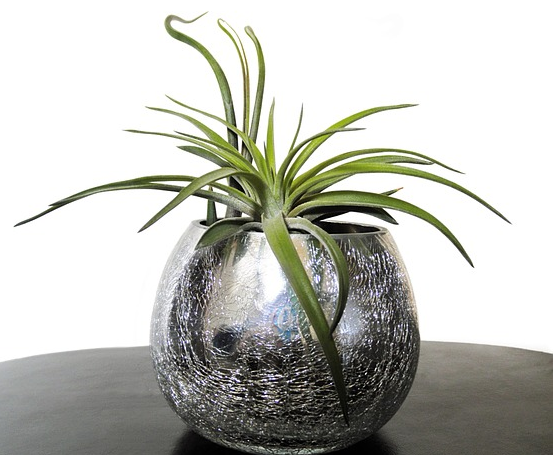
I. How to grow air plants
1. Light
Varieties with grayer leaves and more numerous, thicker, harder white scales need stronger light; not intense direct light, but rather a good amount of bright light. Placing them on a south-facing or east-facing windowsill is an excellent approach. Bright light and a suitable temperature difference are the key to air plants developing alluring colors.
2. Water
Air plants can be roughly divided into thick-leaved and thin-leaved types according to leaf thickness. Thick-leaved ones such as Tillandsia xerographica and Tillandsia intermedia like a relatively dry environment, so the frequency of watering should be reduced; thin-leaved ones such as Tillandsia nana greatly prefer a humid environment, so the frequency of watering can be increased.
For air plants grown indoors, watering two or three times a week is basically enough, best done as a mist; in dry seasons, mist once a day. Outdoors, increase or decrease watering appropriately according to the local climate (for example, during the plum rain season in Jiangnan, you can water less or not at all).
After misting, it is best for the plant to dry completely within 3-5 hours. When misting, just mist until the leaf surface is completely wet, and be careful not to let water accumulate in the center of the leaf rosette. Tap water can easily cause calcium ion poisoning, so purified water is best, and rainwater is even better. If too much water has been misted, the plant can be turned upside down to let the excess water drain out.
3. Temperature
Air plants can tolerate low temperatures of 5°C; below 0°C the plant will die. The suitable growing temperature is 15°C-25°C; above 25 degrees, ventilation should be strengthened and humidity increased. Under dry conditions, they can better tolerate lower temperatures and harsh climatic conditions.
4. Pests
Air plants have relatively few pests and diseases, but spider mites are a rather nasty thing, sucking the water from inside the leaves. However, if the environment is slightly more humid, they seem to disappear on their own.
Common ones also include scale insects, snails and slugs. For small air plants kept at home, it is recommended to improve ventilation and remove pests by hand. On a large scale, for scale insects you can use targeted pesticides such as acetamiprid. For snails and slugs, use 10% metaldehyde to kill them.
5. Diseases
Sunscald in air plants often occurs in environments with ample light. The cause is improper handling: water misted on the leaf surface does not dry in time, and the water droplets act as convex lenses, burning the leaf surface beneath them. However, it does not spread; in routine care, just pay attention to ventilation.
II. How do air plants absorb water
If you look closely, you will find many small white scales on the leaf surface. These scales are mostly shield-shaped and sunken; moisture or rainwater in the air is intercepted by the stomata in the depressions and then permeates through the gaps between parenchyma cells into the plant body.
Usually the stomata in these scales are half-closed during the day when the temperature is higher and the air is relatively dry, to reduce water evaporation; when night comes and the temperature drops and air humidity rises, they open completely to absorb moisture from the air.
III. How to care for an air plant just bought online
1. When an air plant is bought online from elsewhere, it is usually in a water-deficient state on arrival, so replenish water in time. If shipping took a long time and it is severely dehydrated, you can soak it in water for 2 hours, then shake off the excess water.
2. After that, you can make it a new home and label it. Iron wire oxidizes and rusts, which can cause harm, so you can buy a painted metal wire holder, or use aluminum wire, fishing line, or a flower pot, glass cup or shell, but note that it must be breathable and well ventilated, otherwise the roots will rot.
3. Place it in a shady spot and mist it lightly with a little water; once it regains its vitality, it is not too late to give it sunlight.
IV. Precautions for air plant care
1. Air plants will not die from drying out; they usually die from rot in the center caused by too much water on the plant and a poorly ventilated living environment. In cities with a lot of spring rain, they need to be placed in a ventilated environment. In spring, when sunlight is insufficient, the leaf color will be a little duller.
2. The lifespan of an air plant is much shorter than that of succulents; once the mother plant blooms and sets seed, it will gradually wither. And the more precious the air plant variety, the slower it grows. By the time it finally blooms and sets seed, the mother plant is very likely about to die. Because its life is limited, we should cherish it even more.