Where is the main producing area of Bougainvillea? Detailed explanation of cultivation methods and precautions
Bougainvillea is also known as paper flower, leaf flower, nine-fold ge, and baojin. It likes a high-temperature and humid environment and strong light. So, where is the main producing area of bougainvillea? What cultivation methods and precautions are there for bougainvillea?
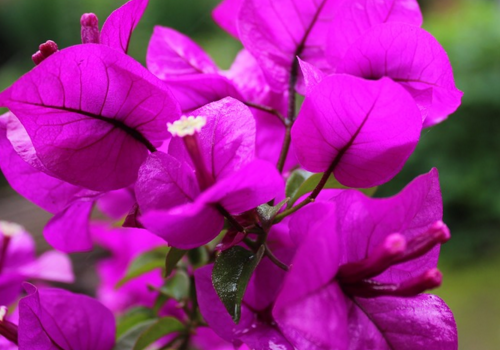
I. Where is the main producing area of bougainvillea?
Bougainvillea is native to South America. In the 1950s, botanical gardens in the southern provinces of the mainland and exhibition greenhouses in major northern cities gradually introduced and cultivated bougainvillea in large quantities. At present, it is commonly cultivated throughout the country and widely used for landscaping arrangements such as indoor balconies, windowsills, and public place decoration. Bougainvillea has also become an ornamental flower and tree widely used and deeply loved by residents in various places.
It is cultivated in various places in China. It is also the city flower of more than ten cities at home and abroad, including Sanya City and Haikou City in Hainan; Beihai City and Wuzhou City in Guangxi; Sanming City and Xiamen City in Fujian; Shenzhen City, Zhuhai City, Huizhou City, and Jiangmen City in Guangdong; and Pingtung in Taiwan, China.
II. Cultivation methods for bougainvillea
1. Water control to promote flowering: Bougainvillea especially likes strong light and high temperatures, is not afraid of direct sun exposure, has low water requirements, and the potting soil only needs to remain moist. In autumn and winter, be sure to control water for 1 month, keeping it half dry and half wet; even if green leaves fall off, it does not matter. Water control is instead beneficial for flowering. This is why home-grown bougainvillea "does not bloom when diligently cared for, but keeps blooming when neglected."
2. Root pruning and rejuvenation require water control: Bougainvillea is vigorous, has strong sprouting ability, and is especially tolerant of pruning. Regular pruning and shaping can make its branches numerous and flowers abundant. It should be noted that it has the unique habit of first sprouting buds and growing branches and roots. When repotting and pruning the roots of old potted plants, do not water immediately; you may water thoroughly once two days later. After that, keep moderately moist. After the new bud stems have basically grown out, gradually switch to normal watering, and place it in a place with sufficient sunlight at a temperature of about 25°C.
3. Keep warm and control water during overwintering: Bougainvillea likes warmth, is not cold-tolerant, and hates waterlogging, so attention must be paid to keeping it warm and controlling water in winter. In winter, the temperature must be kept above 7°C, otherwise it will freeze and die. Once the temperature drops sharply, the plant will lose a large number of leaves, and at this time it must absolutely not be overwatered. It should be placed in an environment of 10°C to 15°C, watered about once every 10 days, and after buds emerge and leaves grow in the coming spring, gradually increase the amount of watering. Otherwise, it will lead to root rot and death.
III. Precautions for cultivating bougainvillea
1. Bougainvillea is a light-loving plant. Whether potted or planted in the ground, it requires sufficient sunlight. Plants treated with strong sunlight have shorter internodes, fuller growth, more flowers, deeper flower color, and a longer flowering period. Insufficient light will cause new branches to grow weakly, leaves to become dull in color, and fewer or no flowers.
2. For bougainvillea bonsai, rectangular or oval purple clay pottery pots or glazed pottery pots are often chosen. The color should not be too dark, so as to set off the brilliance of the bougainvillea bracts. The potting soil should be nutrient soil rich in humus, loose, and well-drained. Choose a period in spring when the temperature is relatively stable for potting.
3. After the autumn temperature becomes cool, the supply of water and fertilizer can be reduced, keeping the potting soil moist is enough, and sufficient light should be ensured. When the temperature drops to about 10°C, it should be promptly moved indoors to a place with sufficient light or to a spot with light inside an enclosed balcony for cultivation. Because indoor air humidity is relatively low, water should often be sprayed on its leaves and surroundings to increase air humidity.
4. Bougainvillea is not cold-tolerant. When the winter temperature is below about 7°C, it will lose its leaves. However, if it loses leaves in winter, after the spring temperature rises, it will grow leaves again, but the growth will not be good. Therefore, the indoor temperature in winter is best kept at about 10°C. In winter, bougainvillea should be placed beside a windowsill with sufficient light, and water and fertilizer management should be carried out differently according to different temperatures. Several times a day, water should be sprayed around it to increase air humidity.