How to Grow Anthurium at Home and Care Tips
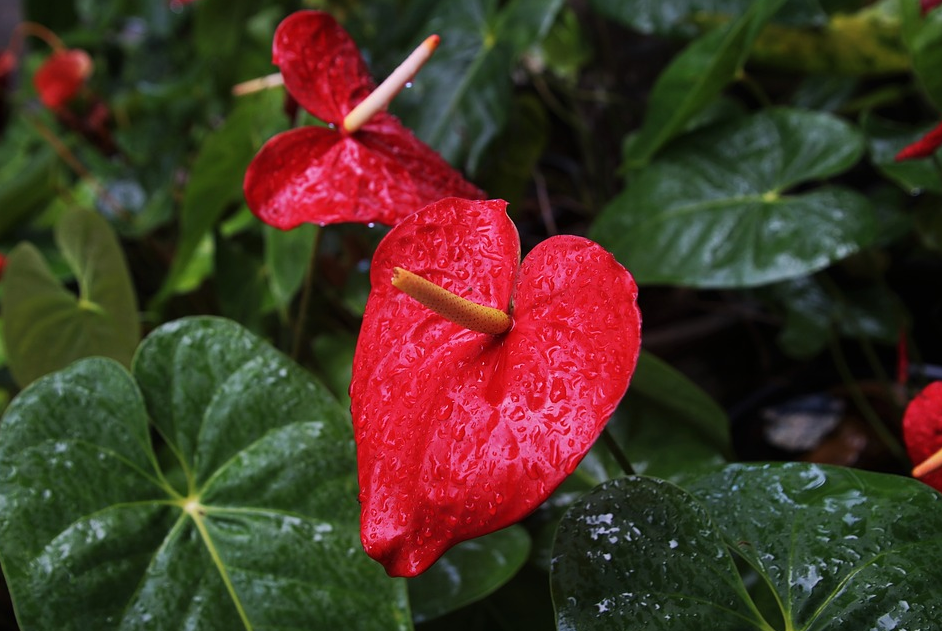
Anthurium, also known as flamingo flower (Anthurium andraeanum), is a perennial evergreen herbaceous plant of the Araceae family. Its leaf stalks are slender, and its spathes are held horizontally, egg-heart-shaped, leathery with a waxy sheen, orange-red or scarlet, and it can bloom continuously throughout the year, making it highly ornamental. Below are home gardening tips: how to grow anthurium.
I. Soil selection
For home growing, you can buy ready-mixed potting soil directly from a garden shop. After getting home, add a small amount of expanded clay pebbles or dry tree bark to the nutrient soil we bought. Expanded clay pebbles : dry tree bark = 2:1. However, the soil for planting anthurium must maintain good permeability and good drainage.
Before planting, the soil must be sterilized, but if you have prepared a special-purpose soil, you can skip this step. Sterilization is to make anthurium less likely to suffer from pests and diseases in the later stages of growth.
II. Temperature requirements
The most suitable growing temperature for anthurium is 14~35°C. If the winter temperature is below 10°C, anthurium is easily frostbitten, so increase the temperature in time. If the summer temperature is above 35°C, sprinkle water around the anthurium to cool it down.
III. How to fertilize
Anthurium likes fertilizer and has a higher demand for magnesium fertilizer. It is best to go to a professional flower shop to buy foliar fertilizer with a higher magnesium content and use it together. Or choose water-soluble compound fertilizer diluted into liquid fertilizer to fertilize the anthurium. Spray once a week during the growing period. When fertilizing, stick to the principle of “light fertilizer applied frequently”; better less than more, because too much will directly burn the seedlings~
IV. Watering cycle
Watering anthurium needs to be done according to how dry the potting soil is. According to the rules summarized by flower enthusiasts, in spring and autumn we water once every three days. In summer, once every two days, and in summer be careful to use a sprayer to mist the leaf surface at noon to increase humidity. In winter, watering once every 5~7 days is enough.
When the weather is cold, water between 9 a.m. and 4 p.m. When watering, pay attention to alternating dry and wet, and avoid watering when there is severe water shortage, which affects the growth and development of the anthurium.
V. Pay attention to controlling humidity
High temperature and high humidity are the environment anthurium likes. Humidity is related to temperature: when the room temperature is above 28°C, we need to manually increase indoor humidity. You can use a humidifier or sprinkle water to increase humidity. When the temperature is below 20°C, just maintain the indoor ambient humidity, no watering needed.
In winter, even if the indoor temperature is relatively high, it is best not to cool and humidify too much. If the plant's leaves are too wet at night, it will reduce its ability to resist cold, causing frostbite and making it unfavorable for overwintering.
VI. Prevention and control of pests and diseases
The pests that most commonly occur on anthurium are red spider mites, nematodes, cabbage caterpillars, whiteflies, thrips, snails, and scale insects, among which red spider mites, nematodes, and cabbage caterpillars are the main ones. However, anthurium is very sensitive to insecticides. If insecticides must be used, it is best to choose low concentrations. One point to pay special attention to is that all pesticides containing copper, such as dimethoate, dichlorvos, malathion, parathion, methamidophos, etc., will poison the anthurium, so it is best not to use them.
VII. How to prune
To prevent the anthurium from consuming too much energy, we should promptly cut off dead branches and remaining branches during the anthurium's growing period. As for the pruning techniques for anthurium, there is a saying of “three adjustments and two cuts”, namely adjusting direction, adjusting the plant, cutting suckers, cutting flower buds, and cutting old flowers.