How do you grow and prune vine jasmine so it produces beautiful flowers?
Jasmine's fragrance is fresh and elegant, and its pure white, fragrant flowers have won the affection of many flower lovers. Besides being ornamental, jasmine can also be made into flower tea. So how do you grow jasmine? How do you prune it? What should you do if the leaves dry out and scorch? Below is an introduction to jasmine cultivation methods and precautions.
I. Introduction to jasmine
1. Overview
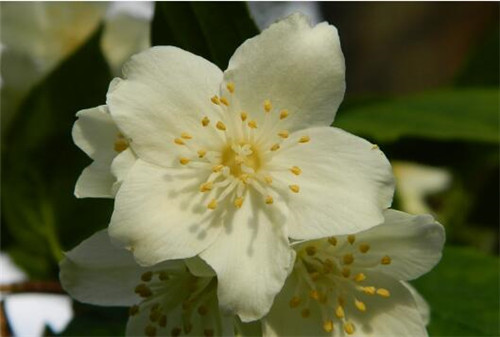
Jasmine, also known as moli, is the collective name for evergreen shrubs or vines in the Oleaceae family, genus Jasminum, and the jasmine genus. Its flowers are pure white and strongly fragrant, making it the most common fragrant potted flowering plant. The most famous type is double-petal jasmine, which is what people commonly call jasmine. Fuzhou City in Fujian Province, China, is a famous jasmine-producing area.
2. Morphology
Jasmine generally grows 0.5-3 m tall, with slender branches. The leaves are simple, opposite, elliptical or ovate, with entire margins, jade-green in color, thin in texture and glossy. The flowers are mostly white, with a rich, fresh fragrance. The flowering period is from May to October, blooming most abundantly in July and August, and fragrant.
3. Distribution
Jasmine prefers warm, humid conditions and a sunny environment. It originated in India and Pakistan, and was introduced to China long ago, where it is now widely cultivated.
4. Uses
The flowers, leaves and roots of jasmine can be used as medicine, and can also be brewed as tea. The main ingredient of the famous jasmine tea is its petals. Jasmine can treat externally contracted fever, disharmony of stomach qi, abdominal distension and diarrhea. Used in aromatherapy as an essential oil, it can help fight depression, sterilize and act as a sedative, and is helpful for anxiety, mood instability and other problems; it is also very good for the skin and scalp.
II. How do you grow jasmine?
Jasmine likes warmth and humidity, and grows best in a well-ventilated, semi-shaded environment. The most suitable soil is slightly acidic sandy soil containing plenty of humus. For specifics on how to grow it, let's look at the cultivation methods and precautions introduced below:
1. Soil: The soil for cultivating jasmine should be fertile sandy or semi-sandy soil, and it grows best in slightly acidic loam rich in humus.
2. Temperature: Jasmine likes high temperatures. It usually begins to sprout at around 20°C, forms buds above 25°C, and forms flower buds at around 28°C-33°C. Its optimum growth temperature is 22°C-35°C. If the temperature is too high, the plant enters a semi-dormant state, with fewer and uneven flowers. If the temperature is too low, the plant grows slowly and is not tolerant of low temperatures; after being below 5°C for a long time, some branches will freeze to death. Therefore, in southern regions it can be cultivated outdoors to overwinter, while in northern regions it needs to be kept warm in autumn and winter, moved indoors and placed in a south-facing direction.
3. Light: Jasmine likes humid, ventilated and airy environments and needs sufficient light. An unsuitable environment with insufficient light will cause the plant to grow leggy, with leaves turning pale green and thin, and the branches also becoming slender, with longer and tender internodes, fewer flower buds, fewer flowers, and small flowers with faint fragrance.
4. Water: Jasmine likes humid environments, so it has relatively high water requirements, but jasmine is afraid of waterlogging. If the potting soil remains wet for a long time, the root system will rot due to lack of oxygen in the potting soil, the leaves will gradually turn yellow and fall off, and the whole plant may even die.
Watering should be determined according to the season and temperature. In spring, starting from April to May, water once every 2-3 days, preferably around midday. In June, watering can be slightly more frequent, once a day. Summer, July to August, is the high-temperature period and also jasmine's peak flowering period, so it needs watering once in the morning and once in the evening, while also spraying water on the leaves 1-2 times a day and sprinkling water around the flowerpot to increase air humidity. In autumn, gradually reduce the amount of watering; in September to October, water once every 1-2 days. In winter, watering should be strictly controlled, keeping the potting soil only slightly moist; generally water once every 5-7 days.
5. Fertilizing: Jasmine's flowering period is relatively long, so the potting soil must have sufficient fertility. When fertilizing, follow the principle of "light fertilizer, frequent application," and do not apply too much at one time, especially in winter and during high-temperature seasons, when fertilizing should be avoided. Fertilizing after entering the growth period gives better results. The best time to fertilize is in the evening, and the potting soil should be loosened before application.
6. Repotting: Jasmine that has been grown for more than 2 years needs repotting. By then the fertility in the potting soil has declined, and the roots have become tangled and disordered, so it is necessary to change to a larger flowerpot and reconfigure it with loose soil.
7. Pests and diseases: Jasmine is susceptible to red spider mites, leaf spot disease, scale insects and other pests and diseases, with July to September being the most serious period, and prevention and control should be carried out promptly.
III. How do you prune jasmine?
Jasmine is generally pruned in early to mid-March each year. When pruning, branches can generally be left 20 cm long, and the rest should be cut off. Old branches should be cut off from the base, keeping 10 cm to 15 cm from the base, to encourage them to sprout robust new branches again. At the same time, remove overly dense branches, leggy branches and weak branches, and pick off old leaves. If new shoots grow very vigorously, pinch them back when they reach 10 cm to encourage secondary shoots, resulting in more flowers. After the flowers fade, the flowering branches should be cut off promptly to reduce nutrient consumption.
IV. What should you do if jasmine leaves dry out and scorch?
Because jasmine leaves are relatively thin, they are more sensitive than other flowers, and potted jasmine is prone to leaf drying and scorching. Treatment must be targeted, otherwise it can cause the plant to die. Specifically, the following points cause leaves to dry out and scorch:
1. Improper fertilizing: If the leaf tips scorch, it may be caused by improper fertilizing, such as fertilizing too concentratedly, too much, or applying unrotted fertilizer, causing "root burn."
Solution: In mild cases, water more to dilute the fertilizer. In serious cases, replace the soil and replant, place the pot in a shaded place, and after new shoots emerge, resume normal care.
2. Improper watering: Jasmine likes humid environments, and both excessive drought and lack of water, or too much water causing root rot, can lead to dried and scorched leaves.
Solution: For drought and lack of water, appropriately increase the frequency of watering; for too much water and root rot, control the frequency of watering.
3. Unsuitable soil pH: Jasmine likes acidic soil. If the pH is unsuitable, it can lead to dried and scorched leaves.
Solution: Change to acidic soil with a pH of 6 to 6.5.
In addition, the cause of jasmine leaves drying out and scorching may be that there are too many flowering branches that have not been pruned, affecting the plant's nutrient absorption.
V. The flower language of jasmine
Jasmine is pure and rich, and its flower language is loyalty, respect, purity, chastity and simplicity. Many countries have chosen jasmine as their national flower, and it also represents the flower of love and the flower of friendship.