How to grow the formaldehyde-absorbing Swiss cheese plant so its leaves split? Growing methods and precautions
The name Swiss cheese plant may be unfamiliar to friends who do not grow green plants. It is very popular in tropical regions and is generally cultivated in greenhouses. The Swiss cheese plant is also called ceriman, wire netting plant, and so on. As a plant of the Araceae family, it has its own unique charm. So what are the growing methods and precautions for the Swiss cheese plant? How do you get its leaves to split? Can it remove formaldehyde?
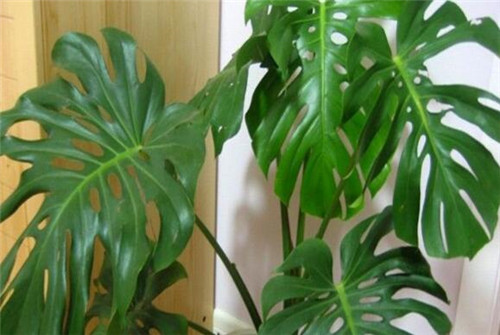
I. Growing methods and precautions for the Swiss cheese plant
Growing methods:
1. The Swiss cheese plant generally has a higher survival rate in warm areas, because it likes an environment with suitable light. If direct sunlight is particularly strong, it will also affect its growth. So remember that it must not be placed outdoors all year round for exposure to strong sun, and in winter, if the outdoor temperature is too low, it also must not be moved outdoors. In summer, you can move it to a well-ventilated indoor living room or a shady place, which can prevent the leaves from withering or aging.
2. The Swiss cheese plant absorbs a relatively large amount of water in daily life, so it needs to be grown in relatively fertile, loose, acidic loam soil. In flower markets, shops selling Swiss cheese plants will have pre-mixed soil, generally a mix of leaf mold and peat soil. This combination allows the Swiss cheese plant to fully absorb water and maintain healthy growth. Farmers growing it at home can choose pond mud, which is also a great use of resources.
3. Because the Swiss cheese plant is relatively popular in tropical regions, if it needs to be grown in the colder Jiangnan or northern regions, the temperature needs to be kept between 13-20°C. When the temperature is higher than 30°C or lower than 7°C, it may cause the Swiss cheese plant to grow slowly or even die.
4. Fertilization for the Swiss cheese plant is mainly based on high potassium nitrate fertilizer and general-purpose fertilizer. Both types of fertilizer are sold in flower markets. For the specific ratio, you can ask the shop owner and then mix it yourself.
5. The Swiss cheese plant relatively prefers a humid environment, so watering should be done frequently. Generally, in summer we can choose to water twice a day. If you have errands to run, you can water a bit more before leaving in the morning. In winter, the Swiss cheese plant generally needs to be watered twice a week. You can control this time interval according to the soil moisture.
Precautions:
The sap of the Swiss cheese plant is often toxic. Be sure not to touch the sap, otherwise it will cause stinging and corrosive effects on the skin. If this happens, you need to rinse with water immediately. If it is serious, you need to go to the hospital to check the specific situation. If you use the unripe fruit of the Swiss cheese plant, it will also cause the base of the tongue to burn or be scalded.
II. How do you get the Swiss cheese plant's leaves to split?
1. The splitting of the Swiss cheese plant's leaves depends on the surrounding environment and weather changes. Generally, after half a year of growth, small holes will appear in the leaves. After the holes appear, we should care for it even more carefully. Place it in an environment with suitable light and ventilation, and care for the leaves by removing dust and diseased dead leaves one by one. Fertilizing and watering are also indispensable. Only in this way can it split its leaves normally.
III. Can the Swiss cheese plant remove formaldehyde?
Many people only know that pothos can be placed in a new house to remove formaldehyde, and they still think of the Swiss cheese plant only as an ornamental plant. In fact, the Swiss cheese plant's ability to absorb formaldehyde is even more outstanding.
Research investigations by relevant forestry experts found that the Swiss cheese plant can remove 90% of the formaldehyde in a room, ranking first among home decoration plants. In addition to adding green plants, what is even more needed is for everyone to pay more attention to ventilation and not move into a home with excessive formaldehyde too early, causing physical discomfort.
After the Swiss cheese plant's leaves split, it will be very beautiful. As an ornamental plant, it has always been worthy of careful care, and its ability to absorb formaldehyde makes it seem even more excellent. I hope this article can also be helpful to you.