Spider Plant Soilless Cultivation Techniques and Planting Tips Explained
The spider plant has an elegant, distinctive form with unusual and varied shapes, and is deeply loved by people. Besides traditional soil cultivation, it can also be grown soilless, and this method has gradually replaced traditional cultivation. So what are the steps for soilless cultivation of spider plants, and what should be noted? Below are spider plant growing tips: soilless cultivation techniques for spider plants.
I. What Is Soilless Cultivation
Soilless cultivation, literally speaking, is a method of growing plants without soil, using other things instead of soil. It generally includes water culture, mist culture, and substrate culture. Some people may ask, without soil, how can plants get sufficient nutrients? Don't worry, we can use artificially prepared nutrient solutions to supply plant nutrients, which is more scientific.
Soilless cultivation of spider plants is mainly divided into two types: one is solid, that is, using stones and other particles to cover the bottom of the pot; the other is water culture. Today we mainly discuss the first type, cultivation with solid substrate.
II. Methods of Soilless Cultivation for Spider Plants
1. Substrate Selection
When spider plants are grown soilless, materials with good air and water permeability such as peat, river sand, sphagnum moss, vermiculite, and expanded clay pellets can be used as substrate. This is both attractive and suitable for spider plant growth.
2. Container Selection
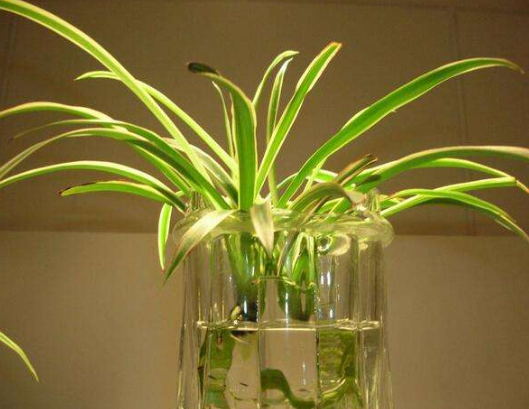
Without muddy soil, the spider plant's white, thick roots can be perfectly displayed. Therefore, we had best choose a transparent glass container to enhance the ornamental value. While viewing the leaves, you can also enjoy the roots, achieving two things at once.
3. Preparing the Spider Plant
Before soilless cultivation, our main subject——the spider plant——must be prepared in advance.
After digging it out of the soil, first wash the soil off the roots with clean water; then cut off old roots and rotten roots, keeping intact fibrous roots. In addition, remove diseased leaves, wash the leaf surfaces, and keep them intact.
4. Preparation of Nutrient Solution
Add 0.354 g calcium nitrate, 0.396 g calcium sulfate, 0.408 g monopotassium phosphate, 0.074 g potassium chloride, 0.493 g magnesium sulfate, and 10 mL trace element stock solution per liter. 2. Add 1.8 g calcium nitrate, 0.187 g ammonium sulfate, 0.62 g monopotassium phosphate, 0.54 g magnesium sulfate, 0.62 g potassium chloride, and 0.0278 g ferrous phosphate per liter.
When preparing, first mix and dissolve them, then dilute with water to 1 liter and stir evenly. If you find this troublesome, you can buy ready-prepared nutrient solution at a flower market.
III. Specific Steps for Soilless Cultivation of Spider Plants
In late spring and early summer, first place some water- and air-permeable expanded clay pellets at the bottom of the pot, 3 to 4 cm thick.
Then place the prepared spider plant in the center of the pot, add the solid substrate you have chosen until it is eight-tenths full, and gently press it down with your hands.
Finally, cover the surface with a layer of fine expanded clay pellets or sphagnum moss to decorate the appearance.
IV. Care and Management of Soilless Cultivated Spider Plants
1. Light
Spider plants like a lightly shaded environment, so ensure the plant receives 4 hours of scattered sunlight each day. Be careful not to expose it to direct strong light, otherwise the leaves will turn yellow and wither.
2. Water
Although spider plants can be grown in water culture, this time we are using substrate culture. Therefore, when replenishing water normally, just keep the substrate moist; it does not need to be too wet, to avoid root rot. You can sprinkle water on the leaves; the finer the water droplets, the better, to keep the leaves upright.
3. Nutrient Solution
After spider plants are grown soilless, the first nutrient solution application must be thorough. After that, add nutrient solution as appropriate according to the specific growth condition. In winter and spring, spider plants grow more slowly, so nutrient solution can be added once every 5——6 weeks; summer and autumn are the growing seasons, with a high fertilizer requirement, so the fertilization frequency can be increased, watering once every 10——15 days.