How often should you water the ornamental flower clivia? Varieties and how to deal with root rot
Clivia, also known as sword-leaf bush lily and large-leaf bush lily, is an ornamental flower of the genus Clivia in the Amaryllidaceae family. So how often should you water it? What varieties are there? What should you do if the roots rot? According to Amaryllidaceae data, clivia has fleshy roots that can store a relatively large amount of water and nutrients, so it is fairly tolerant of cold, but it cannot go without water forever. To prevent root rot from overwatering, during routine care you should regularly check how wet or dry the potting soil is. Water once when it is half dry, but do not water too much; just keep the potting soil moist rather than soggy.
In general, the watering methods for different seasons are as follows:
(1) In spring, water once a day;
(2) In summer, use a fine watering can to water the leaf surfaces and the surrounding ground together; on sunny days, water twice a day;
(3) In autumn, water once every other day;
(4) In winter, water once every other day; in winter, water once a week or less.
What varieties of clivia are there?
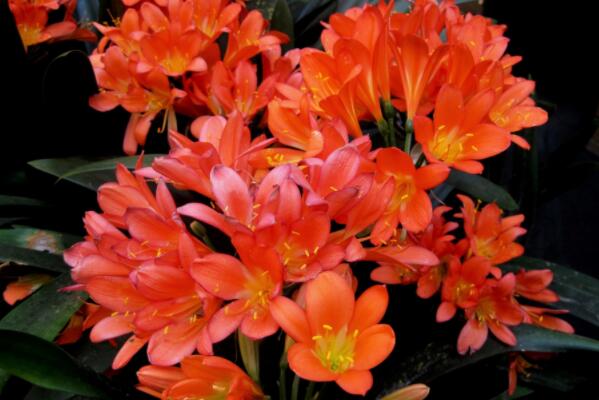
1. Clivia miniata, the flower color is generally orange, with a yellow-white inner core. Of course, there are also flowers in colors ranging from yellow-white to dark red. Flowers in very pale and very deep colors are relatively rare. When blooming, there are generally about 20 flowers in a bud, and some reach 40. The berries contain 1-20 seeds, generally fewer than 10.
2. Clivia gardenii (also called fine-leaf clivia), has a long flowering period, from late autumn to winter. The flower color is generally orange-red, with very obvious green at the tips of the petals. There are also other colors ranging from yellow to red. The flowers hang in an arc, not drooping as heavily as Clivia caulescens and Clivia nobilis. Each berry contains 1-2 seeds. The fruit takes 12-15 months to mature.
3. Clivia caulescens, generally blooms in spring and summer. The flowers droop like those of Clivia nobilis, the flower color is orange-red, and the petal tips are green. The round red berries contain 1-4 seeds, and the berries are 9-13 mm in diameter.
4. Clivia robusta, this clivia, like other clivias, is native to South Africa. It often grows in sandy acidic soil. It is currently the largest species of clivia, able to grow to 1.8 m tall, and generally blooms from March to August (the autumn and winter seasons in South Africa).
5. Clivia miniata var. citrina, robust by nature, likes a warm, humid, semi-shaded environment. It requires well-drained, fertile loam. It is not cold-tolerant.
6. Clivia mirabilis, likes humus-rich soil and a semi-shaded environment.
7. Clivia nobilis, its growth period is very long; from a seed to flowering takes 8 to 10 years, or even longer.
12