Can Pothos be placed in the bedroom? What to do if small flying insects and black bugs appear
Pothos plants are currently selling very well on the market. So can Pothos be placed in the bedroom? Will it attract small flying insects and black bugs? What should you do if they appear? Pothos itself does not attract insects, but many people who buy Pothos do find lots of bugs crawling out of it. In most cases, this problem is caused by the soil-culture method; these bugs are not attracted by the Pothos but come with the soil itself.
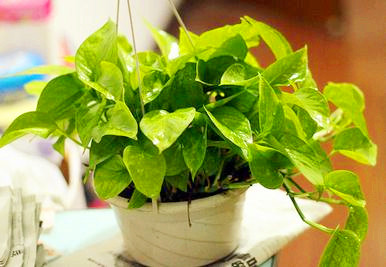
I. Where is Pothos suitable for growing?
1. Places with frequent family contact
Places where family members have frequent contact, such as the living room and bedroom, so the main table, coffee table, beside the TV, and the bedroom desk are good choices for placing Pothos. Pothos is one of the best indoor decorative plants, with relatively soft and slender stems and leaves and emerald-green foliage. It can be placed directly on a table or coffee table, or set on top of a cabinet to let its vines hang down naturally, or shaped into a ring, thus making full use of space, purifying the air, and changing the rigid lines at home. A bit of greenery at home brings abundant vitality and endless charm.
2. Kitchens with more cooking fumes
Placing it in the kitchen has two benefits: first, it is eco-friendly and can absorb cooking fumes in the kitchen; second, it adds greenery, so you have a green plant for company while cooking. Isn't that killing two birds with one stone?
Pothos has tenacious vitality. Unlike other plants that fear cooking fumes, in a fume-filled environment it activates its own purification system, absorbing the fumes and purifying the air. So when placed in the kitchen, water it in a timely manner, provide sufficient light, and clean the leaves about once a month to avoid cooking fumes clogging the leaf stomata. Leave the rest to the Pothos; with it, you can even skip the air purifier.
3. Windowsill position
If you look carefully, you will find that most households place a pot of Pothos on the windowsill. Pothos is relatively small, so you don't need to worry about crushing the windowsill, and it does not block our view of the scenery beyond the windowsill; it fits perfectly on the windowsill. In addition, the windowsill has good ventilation and plenty of sunlight, which is best for the growth of Pothos.
4. Newly renovated homes
In newly decorated homes, whether floors, doors and windows, or walls, there are large amounts of harmful substances, and Pothos can simultaneously purify benzene, trichloroethylene and formaldehyde in the air. One pot of Pothos can purify the air of 8~10 sq m, so placing it in a new home can speed up air purification and let you move in earlier.
II. Is hydroponic or soil culture better for Pothos?
1. Compared with soil-cultured Pothos, hydroponic Pothos has larger and more numerous leaf stomata and a stronger leaf transpiration rate, while the difference between the two in chlorophyll content and photosynthetic rate is not obvious.
2. Hydroponic Pothos has a small thickness ratio of palisade tissue to spongy tissue, and its leaf tissue structure is loose. In contrast, soil-cultured Pothos has a large thickness ratio of palisade tissue to spongy tissue, and its leaf tissue structure is dense.
III. Methods for controlling Pothos pests
1. Cigarette ash water: Take 50~100 cigarette butts left from smoking, add 200~300 milliliters of water, soak for a day and a night, then repeatedly mash them, filter out the residue with gauze, and spray. If you add a small amount (about 0.2 grams) of baking soda (sodium bicarbonate) or edible alkali (sodium carbonate), the effect is even better.
2. Laundry detergent water: Take 1 part laundry detergent and add 300~400 parts water. Add the laundry detergent to the water, stir or shake slightly, and spray after it has dissolved evenly. Dishwashing liquid (for cleaning tableware) diluted 500 times with water, or essential balm diluted 600 times with water, also works well when sprayed.
3. Egg-oil emulsion: Take 1 egg (remove the yolk for eating and keep the egg white), 2~3 milliliters of ordinary cooking oil (liquid), and 200 milliliters of water. First make the egg water, then add the cooking oil, shake up and down, and when no oil droplets can be seen on the liquid surface, it can be sprayed, but it should not be stored.
4. Flour paste water: Take 1 part flour and add 50~60 parts water. First moisten the flour, then scald it with boiling water until cooked and dilute it, without lumps or clumps. After it cools, it can be sprayed, and the effect is good when used at noon. In addition, when cooking rice porridge, millet porridge or other porridge, take a little of the thin soup, dilute it slightly and spray it, and it is equally effective.
5. Mosquito coil pest control method. Light a mosquito coil and place it on the flower pot below the flowering plant with pests, then cover the pot together with a plastic film bag for about 1 hour to kill aphids, red spiders, whiteflies, etc.
6. Essential balm pest control method. Spray with a 400~500 times dilution of essential balm. It has a fumigating effect and penetrates into the insect body, killing the pests. It is especially effective against waxy scale insects.
7. Camphor ball (mothball) pest control method. Grind camphor balls into powder, spread it and turn it into the potting soil to kill pests in the soil that harm the root system. It has a special effect on root-knot nematodes of bulb, tuber and fleshy-root flowers such as peony, dahlia, lily and lycoris.
8. Dish soap pest control method. Spray with a 500 times dilution of dish soap to kill pests within 24 hours, then spray clean water to reduce the side effects of the dish soap.
9. Color-based insect repellent method. Lay silver-gray plastic mulch under the flower pot or hang silver-gray plastic strips above the plant to repel migratory winged aphids. You can also hang yellow boards above the plants, coat the yellow boards with machine oil or vaseline, and trap and stick female aphids, reducing their occurrence and preventing virus transmission.
10. Plant pest control method. Interplant scallions, garlic, chives, etc. in the potting soil under flowering plants. They release volatile substances that not only repel and kill aphids but also have the effect of treating diseases.
11. Fertilizer pest control method. Using fertilizer to control pests can also supply nutrients, promoting healthy and robust flower growth, vivid flower colors and plump seeds.
① Spray with 20% wood ash extract (soaked for 24 hours).
② Spray with 0.2% urea or 1% ammonium bicarbonate or 0.5% ammonia water to fumigate and contact-kill aphids and mite pests.
③ Spray with a mixed liquid of 0.5%~1% urea plus 0.2% laundry detergent to control red spiders, aphids, etc.
④ For each 0.1 sq m (2 as superscript) of flower pot area, apply 4.5~6 grams of calcium silicate fertilizer. The flowers absorb it and it accumulates in the epidermal cells, making the epidermis harder and enhancing insect resistance, making it difficult for pests with piercing-sucking mouthparts such as aphids to cause damage.