How Do Mosquito Larvae Appear? Learn How to Eliminate Larvae in Fish Tanks and Bowl Lotus Water
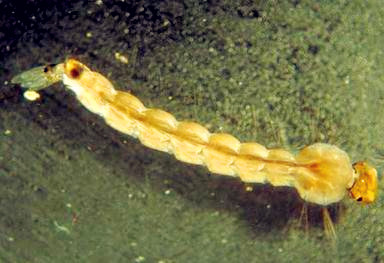
Wrigglers, the larvae of mosquitoes, are the intermediate stage between the egg and the pupa, hatching from mosquito eggs in water. So how do mosquito larvae appear? How do you eliminate mosquito larvae in fish tanks and bowl lotus water? Wrigglers hatch from eggs laid by female mosquitoes in fresh water. Depending on the species, mosquito eggs may be laid in three different positions: on the water surface, at the water's edge, or in the water. Those on the water surface include Anopheles and Culex mosquitoes, while those at the water's edge include Aedes mosquitoes. Anopheles and Culex mosquitoes hatch in about two days, while Aedes mosquitoes take three to five days. The larvae of mosquitoes are called wrigglers. Wrigglers breathe through a siphon. They feed on organic matter and microorganisms, and the bristles around their mouths create a current that flows toward the mouth. This stage lasts about 10 to 14 days, and after 4 molts they become pupae.
1. The life cycle of a mosquito can be divided into four stages:
Mosquitoes are insects with complete metamorphosis.
1. Eggs:
Depending on the species, mosquito eggs may be laid in three different positions: on the water surface, at the water's edge, or in the water. Those on the water surface include Anopheles and Culex mosquitoes, while those at the water's edge include Aedes mosquitoes. Anopheles and Culex mosquitoes hatch in about two days, while Aedes mosquitoes take three to five days.
2. Larvae:
The larvae of mosquitoes are called wrigglers. Wrigglers breathe through a siphon. They feed on organic matter and microorganisms, and the bristles around their mouths create a current that flows toward the mouth. This stage lasts about 10 to 14 days, and after 4 molts they become pupae.
3. Pupae:
Viewed from the side, the pupa is comma-shaped. It does not feed, but it can move through the water. It breathes through its first pair of respiratory trumpets. It reaches full maturity after two days.
4. Adults:
Newly emerged mosquitoes cannot take flight before their wings have hardened (eclosion). Within 24 hours of eclosion, the male mosquito rotates everything from the eighth abdominal segment onward a full 180° to assume the mating posture. Mating behavior varies by species; some form mosquito swarms at dusk in open fields and perform group dances. A mosquito swarm is not necessarily made up of a single species of male mosquitoes; it often consists of several different species gathered together. At this time, when the female mosquito sees the dancing swarm, she flies near the swarm to mate with a male of the same species and then leaves. Mating usually takes 10-25 seconds. A female mosquito mates only once in her lifetime; after mating, fluid secreted by the male accessory glands forms a mating plug in the female's mating pore, but it gradually dissolves and disappears completely after about 24 hours. Having mated only once in her life, the eggs she lays for the rest of her life (more than 100 days later) can still be fertilized.
2. Methods for Eliminating Mosquito Larvae
1. Common Methods
1) Plan ahead and start with the water!
The mosquito larva, or wriggler, has a thorax broader than its head and abdomen, and its body bends and stretches as it swims, which is why it is also called a tumbler.
It takes only a little over half a month for a wriggler to develop from a larva into an adult mosquito, so we need to start eliminating wrigglers early.
Because wrigglers must live in water until eclosion is complete, in late spring we should prevent stagnant water from appearing in the home.
You can also place basins of soapy water in some rooms of the house. Because soapy water is alkaline, and wrigglers cannot grow in an alkaline environment.
Of course, there is a precondition: the soapy water must also be changed frequently.
According to research by Japanese scientists, placing a copper coin in water where wrigglers are growing can also help eliminate them. However, I think the effect should not be great, otherwise it would have become widespread long ago. Also, the copper coin placed in the water must be clean.
Of course, based on the habit of wrigglers living in fresh water, we can also place a few basins of salt water in the home. Of course, this definitely has to be changed every day.
When the toilet is not in use, also drip in a few drops of 84 disinfectant.
2) Block the connections between rooms as much as possible, and households with pets should bathe their pets every few days.
Blocking the connections between rooms is very important, because this undoubtedly reduces the chances of mosquitoes making strategic moves, so doors and windows at home should be kept closed from dusk to early morning.
After all, houses are not designed with so many doors for no reason, so why keep them open all the time? Especially the kitchen and the storage room.
Also, in some rooms you can hang some garlic, which can repel mosquitoes and prevent them from coming to breed. Of course, ventilation can be done in the early morning.
If pets are too dirty, they will attract mosquitoes. And for those who keep shrimp, the only option is to change the water frequently.
It is also necessary to pay attention to wardrobes; mosquitoes will choose this kind of place to spend the winter.
3) Use medicinal powder in combination; realgar can be used!
Do not think that realgar's only use is to repel snakes and ward off evil; in fact, realgar can also be used to eliminate insects.
Because realgar is arsenic trisulfide, it has a certain toxicity, so it can kill wrigglers.
2. Methods for Eliminating Mosquito Larvae in Fish Tanks and Bowl Lotus Water
There is no need to worry about wrigglers in a fish tank; wrigglers are one of the foods of fish, and the fish will actively help you eliminate them. So let us mainly look at solutions for mosquito larvae in bowl lotus water.
1. Put in a few small fish
Koi are not recommended; small tropical fish such as guppies are recommended. Koi are cold-water fish, and bowl lotus must be sunned every day, which is not good for the growth of koi (if your goal is to collect dried fish, then it is fine; if you use a nested pot and the outer pot is large enough, then of course it is also fine). Those preparing to keep guppies should note that, based on my observation, guppies generally jump out of the pot when startled, so when keeping guppies, do not move the flower pot for no reason, do not knock on the flower pot, and so on, otherwise you will probably be waiting to collect dried fish, especially right after the fish are added.
Advantages: natural and ecological.
Disadvantages: if the water is shallow, you can only wait to collect dried fish.
2. Soak oleander leaves
Get some oleander leaves and soak them in the water; it is said that chopping them up works better, and grinding them into juice works even better. Oleander sap is highly toxic, so be sure to pay attention! You must wear gloves (impermeable to sap) when handling it, wash your hands after handling, and properly dispose of the tools used to avoid poisoning.
Advantages: being able to kill the insects is the advantage.
Disadvantages: oleander sap is highly toxic; for safety's sake, the lotus leaves and lotus roots treated this way cannot be eaten.
3. Soak mosquito coil
It is said that soaking an electric mosquito coil mat in the water also works.
Advantages: kills mosquitoes.
Disadvantages: not ecological.
4. Spray pesticide
When spraying pesticide, gently spray a little toward the water, and be careful not to spray it on the leaves. Pyrethroid insecticides break down after a few hours, and even if two or three leaves are damaged, it will not affect the overall health of the bowl lotus. There is also something called Huhuashen; I do not know whether it counts as a pesticide. When spraying, it is best to wear a mask to avoid poisoning and protect your health.
Advantages: being able to kill the insects is a bit of an advantage.
Disadvantages: burns leaves; dosage is hard to control.
5. Syringe
Use a syringe to suck them out
Advantages: natural and ecological, no pollution.
Disadvantages: heavy workload, tiring.
Summary: among the above methods, keeping fish is still the most recommended, as it is natural and ecological.