Is the pitcher plant the same as Nepenthes? A detailed look at its appearance and care methods
In the countryside fields there is a flower shaped like a bottle - is it Nepenthes? What does it look like? How do you grow it? Nepenthes is the general name for all species in the genus Nepenthes. It belongs to the tropical insectivorous plants, with its place of origin mainly the tropical regions of the Old World. It has a unique organ for absorbing nutrients——the pitcher, which is cylindrical, slightly swollen in the lower part, with a lid on the pitcher mouth, and is named Nepenthes because its shape resembles a pig cage. So "vase grass" is very likely referring to Nepenthes.
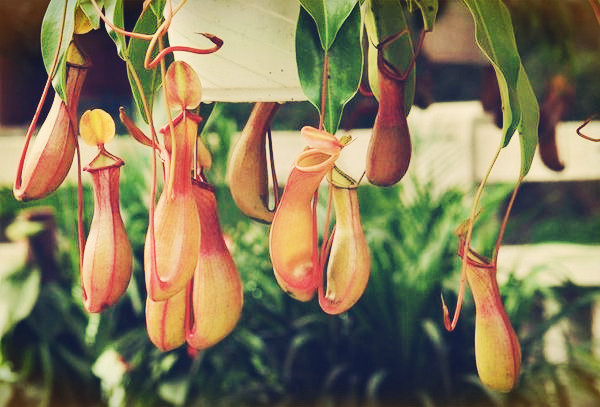
What do you need to pay attention to when growing Nepenthes?
The main purpose of growing Nepenthes is to admire its peculiar insect-catching organ——the pitcher.
1. Soil
The soil is best as loose, fertile and airy leaf mold or peat soil. For pot cultivation, a mixed substrate of peat soil, sphagnum moss, charcoal and fir bark shavings is commonly used.
2. Watering
Nepenthes is relatively sensitive to moisture. Nepenthes can only grow and develop normally under high humidity conditions, and during the growing period it needs frequent misting, 4 to 5 times a day. If the temperature changes greatly or it is too dry, this will all affect the formation of the leaf pitchers.
3. Sunlight
Nepenthes is an epiphytic plant, often growing under large trees or on the north side of rocks, and its natural conditions are semi-shaded. Under strong direct light in summer, shading is necessary, otherwise the leaves are easily scorched, directly affecting the development of the leaf pitchers. But under long-term dark conditions, the leaf pitchers form slowly and small, and the colors on the pitcher surface are dull.
4. Temperature
The suitable growth temperature for Nepenthes is 25-30°C, from March to September it is 21-30°C, and from September to March of the following year it is 18-24°C. In winter the temperature should not be lower than 16°C; below 15°C the plant stops growing, and below 10°C the leaf edges suffer frost damage.
5. Fertilizing
Nepenthes does not need special fertilizing, because Nepenthes can usually catch insects on its own to convert nutrients. If Nepenthes has insects to eat, then there is no need to fertilize it.
6. Pests
Nepenthes often suffers from leaf spot disease and scale insect damage. For leaf spot disease, spray with a 1000-fold dilution of 50% zineb wettable powder. For scale insects, spray with a 2000-fold dilution of 40% dimethoate emulsifiable concentrate.
7. Pruning
The pitcher of Nepenthes is a kind of modified leaf, so like the leaves of other plants it will also age and wither. Generally speaking, under suitable conditions each pitcher can survive for several months. When it has already withered, you can cut it off to make the whole plant look more attractive, but this is purely for appearance and has nothing to do with the health of the plant.
Nepenthes is a very magical plant, and raising it at home will, I believe, also mean noticeably fewer small insects such as mosquitoes.
The flowers of Nepenthes have little ornamental value; the flowers are small and plain, and only a few varieties have relatively brightly colored flowers. In addition, the flowers of Nepenthes also give off a not very pleasant smell, so try not to grow it indoors; a courtyard or balcony is the best choice.
Nepenthes is a vine plant and must have something to cling to in order to stand, so it needs a support frame set up for it. In order to set up the support, a larger flowerpot is needed; on the other hand, using a larger flowerpot can hold more cultivation material, making the flowerpot stable and heavy, able to support a large Nepenthes without being blown over by the wind.