How much does a jin of osmanthus seeds cost? When should they be sown? What are the planting methods?
Osmanthus seeds, that is, the seeds produced after the osmanthus blooms in autumn. They look like small green olives and are purple-black in color. So how much does a jin of its seeds cost? When should they be sown? What are the planting methods? Generally speaking, osmanthus seeds cost between sixty and eighty, though of course some better varieties may be more expensive. They mature around March or April. They can be sown in August to September of the same year, or in April to May of the following year.
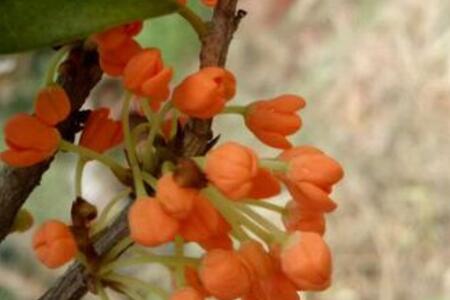
What are the planting methods for osmanthus?
Osmanthus propagation by sowing starts with selecting the seeds. You should choose osmanthus seeds of fine quality for sowing. In the north, the best time to sow is in May to June, when the temperature is 22 to 24 degrees.
1. First soak the osmanthus seeds in warm water for 24 hours, or in cold water for 48 hours, then take them out. Choose a leeward, sunny garden plot with loose soil and good drainage, and sow them in the potting soil by the dibbling method. After sowing, cover with a layer of fine sandy soil 2 to 3 cm thick. Spray once with water until thoroughly wet, then cover with glass or another covering (such as rice straw). After the osmanthus seeds sprout, remove the covering to let air in. Also guard against direct sunlight.
2. When the osmanthus seeds begin to sprout, the soil temperature should be 18 to 30 degrees. If the soil temperature is too low, or if the seeds are sown too long and the soil is too wet, the osmanthus seeds will fail to sprout and the attempt will fail.
3. If the moisture in the soil is uneven, sometimes too wet and sometimes too dry, especially after the osmanthus seeds have already sprouted and the roots have extended out of the seed coat, and the soil moisture content is insufficient, the roots cannot absorb enough water, causing the root hairs to dry out and die, and the osmanthus seedlings fail in the soil. At this time, if the soil contains too much water, the air content will inevitably be insufficient, causing the new roots to be unable to breathe, and after too long they rot and die, so the seedlings fail to emerge.
4. Improper choice of substrate. The sowing substrate should be fine sandy soil, humus soil, unfertilized leaf mold, vermiculite, perlite, and other loose, permeable, well-draining substrates. If the sowing substrate is too dense and too clayey, the osmanthus seeds will find it hard to emerge from the soil after sprouting, and after too long they will also suffocate and die.
5. Osmanthus seeds stored too long, also called seeds of the previous year or old osmanthus seeds. It is obvious that after drying, osmanthus seeds have entered dormancy. In reality they are still slowly consuming their own stored nutrients and water through physiological activity, but once these are used up they can no longer sprout.
6. After the seeds germinate, management work should follow promptly in order to cultivate strong seedling trees. Regarding the growth and development of the seedlings, the following should be done well in actual operation:
(1) Removing the straw and shading: after the seeds sprout and emerge from the soil, the straw should be properly removed on cloudy days or in the evening.
(2) Loosening the soil and weeding: loosening the soil should be done promptly, to a depth of 2 to 3 cm; it is better to keep it shallow rather than deep, to avoid damaging the roots.
(3) Thinning and filling in seedlings: osmanthus seedlings are relatively shade-tolerant and slow-growing, so generally there is no need to thin them; simply move some to fill in sparse spots as appropriate. When moving seedlings, do not damage the roots of the seedlings being kept, and after moving the seedlings, irrigate once so that the seedling roots and soil bind closely together.
(4) Irrigation, drainage and fertilizing: in the dry summer and autumn seasons, attention must be paid to drought resistance and protecting the seedlings; irrigation is best done in the morning or evening.
(5) Pest and disease control: osmanthus nurseries under continuous cropping are prone to brown spot disease and damping-off, causing large numbers of leaves to turn yellow and drop, or the bark at the root crown and roots of the seedlings to rot, leading to the death of the whole plant. At the same time, aphids are also likely to cause damage during the seedling stage.
(6) Timely transplanting: one-year-old sown osmanthus seedlings reach 20 to 30 cm in height and are transplanted in early spring the following year. Two-year-old seedlings are about 60 cm tall, and when three-year-old seedlings are about 1 m tall, they need to be transplanted again. For use as courtyard shade trees or avenue trees, they generally need to be cultivated for 8 to 10 years, reaching a height of 2 to 3 m and a diameter of 8 to 10 cm, before they are easy to maintain and manage after planting.