What Are Woody Flowers? A Detailed Guide to Weed Removal Methods in Nurseries
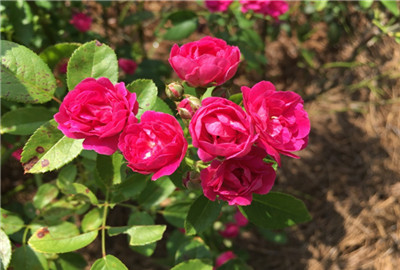
What are woody flowers? Simply put, woody flowers are flowers whose stems are relatively lignified and much harder than those of herbaceous flowers. Common woody flowers include Chinese roses, roses, and redbud. Today's main topic is weed removal in woody flower nurseries, so how can weeds be effectively removed in nurseries growing woody flowers?
01 Common Weeding Methods
At present, most methods for controlling weeds in woody flower nurseries are manual pulling, cultivation, plastic film mulching, and so on, but these methods are usually time-consuming and labor-intensive and not very effective, and the problem of recurring weed growth is relatively serious.
02 Using Herbicides
Generally, gardeners are not very willing to use herbicides in nurseries for fear of harming the flowers, but as long as the method is appropriate, it can achieve twice the result with half the effort. So how exactly should herbicides be used in woody flower nurseries? This depends on the situation.
(1) One- and two-year-old seedlings
Method 1:
Before weeds germinate, herbicides with relatively high safety for seedlings can be used. For example, use 400-600 grams of 2.5% nitrofen wettable powder per mu, mix with 40 kg per mu of sifted dry fine soil and broadcast, which can control 1-year-old aster family and grass family weeds, with an effective period of up to 1 month.
Method 2:
During the vigorous growth period of weeds, some herbicides can also be used for stem and leaf treatment, such as 40-80 milliliters of 12.5% haloxyfop emulsifiable concentrate per mu, add 40 kg of water, prepare into a medicinal solution and spray, which can effectively control many kinds of annual grass family weeds.
If there are many dicotyledonous weeds in the nursery, 10.8% high-efficiency haloxyfop emulsifiable concentrate can also be mixed with 3.5% guole emulsifiable concentrate at a ratio of 1:1, and leaf treatment can be carried out in a targeted way between seedling rows, which can effectively control annual monocotyledonous and dicotyledonous weeds, with no adverse effect on seedling growth.
(2) Seedlings over two years old
Nitrofen or 100-200 grams of 50% prometryn wettable powder per mu can be selected, mixed with 40 kg of sifted dry fine soil and broadcast, which can control weeds such as Alopecurus aequalis, Poa annua, Leptochloa chinensis, shepherd's purse, Echinochloa crus-galli, and crabgrass.
For large seedlings and young trees with higher trunks that have been transplanted twice, under the tree crown use 750 milliliters of 10% glyphosate aqueous solution per mu, or 100-200 milliliters of 20% paraquat aqueous solution per mu, or 150-250 milliliters of 40% atrazine suspension concentrate per mu, prepare into a medicinal solution, and spray on the soil surface.
(3) Apply according to differences in stem and leaf morphology
Some broadleaf seedlings such as camellia, Michelia figo, southern magnolia, and privet can also be treated on stems and leaves with directed spraying of glyphosate;
Other broadleaf seedlings such as silk tree, redbud, and rose of Sharon cannot use glyphosate, but before germination, 10-15 milliliters of 24% guole emulsifiable concentrate per mu can be mixed with dry fine soil to make dry herbicidal soil and broadcast, then wash the seedlings with clean water, which has a good effect on controlling annual monocotyledonous and dicotyledonous weeds while causing no harm to the seedlings.
Generally, coniferous flowering plants have stronger herbicide resistance than broadleaf flowering plants. For golden larch, pine and cypress, and Chinese arborvitae, 750 milliliters of 10% glyphosate aqueous solution per mu can be used, add water to prepare into a medicinal solution and directly carry out stem and leaf treatment, which can effectively kill perennial weeds such as thatch grass, thistle, and sow thistle, and is relatively safe for seedlings.
(4) Rare and precious flowers
For some relatively rare and precious flowers, such as azaleas and sasanqua camellias, herbicide use in planting plots must be especially cautious. When weeds are about 15 cm tall, use glyphosate prepared into a 0.3%-0.4% concentration solution and apply it to weed stems and leaves, which can avoid the solution touching the seedlings and causing herbicide damage. Before weeds germinate, 400-600 grams of 25% nitrofen wettable powder per mu can also be made into herbicidal soil and broadcast on the seedbed, then sweep away the herbicidal soil that falls on the seedlings.
In addition, before weeds germinate, 80-100 milliliters of 48% trifluralin emulsifiable concentrate per mu can be added to 50 liters of water, prepared into a medicinal solution and sprayed on the bed surface, then wash the seedlings with clean water. After the water on the seedlings has dried, cover with an appropriate amount of fine soil to prevent trifluralin from volatilizing and photodegrading and affecting efficacy.
(5) Pine and cypress flowering plants
For Michelia figo, camellia, privet, and southern magnolia, whose leaves are leathery and have a waxy layer on the surface, and pine and cypress flowering plants whose stems and leaves contain aromatic resin, because their resistance is relatively strong, herbicides with relatively poor selectivity such as glyphosate can be sprayed on weed stems and leaves in clear and windless weather. For flowering plants such as ornamental peach, French holly, and hibiscus and Spiraea thunbergii with fuzz on the leaf surface, which have thin leaves and little wax, because their resistance is relatively poor, only selective and highly safe herbicides such as haloxyfop can be used for stem and leaf treatment.
In addition, one point must be emphasized: the use of 20% paraquat aqueous solution must be carried out before the buds of cuttings sprout, and it is prohibited after the buds sprout!!! When using 65% glyphosate soluble powder and 20% paraquat aqueous solution in nurseries, micro ultra-low-volume spraying is generally not used, to prevent herbicide damage to seedlings caused by solution drift. When applying herbicides, you must pay attention to your own safety, cover your mouth and nose well, and do not get it on your skin.