Plumeria Blooming Time, Planting Methods and Benefits and Effects Explained in Detail
In Xishuangbanna, China and some Southeast Asian countries, plumeria is designated by Buddhist monasteries as one of the “Five Trees and Six Flowers” and is widely planted, hence it is also called “temple tree” or “pagoda tree”. So, in which month does plumeria bloom? How is it planted? What benefits and effects does it have?
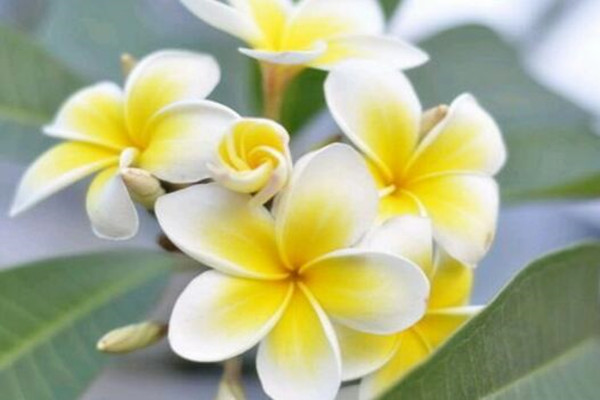
In which month does plumeria bloom?
The flowering period of plumeria is from April to December. It begins to bloom every year from April to May. Plumeria first grows flower buds at the tips of bare branches, or flowers and leaves emerge and grow at the same time; the flowers produced by each inflorescence open gradually, and different branches also bloom one after another, lasting a long time without fading, elegant and distinctive, with the whole tree full of blossoms, flowers and leaves setting each other off, overflowing with color and light. Plumeria also has a very notable characteristic: after the flowers open, the fragrance is fresh and subtly elegant; and even several days after the flowers fall, the scent can still be retained.
How is plumeria planted?
1. Propagation: Plumeria is generally propagated into saplings by cuttings or sowing.
(1) Cuttings: This is generally best done in mid-to-late May. Cut branches 20-30 cm long from the base of the branches. White latex flows out from the cut, so they need to be placed in a cool, ventilated place for 2-3 days so the wound forms a protective film before cutting; cutting while still bearing latex makes them prone to rot. Insert them into clean vermiculite or a sand bed or a shallow sand pot, spray water after changing, place indoors or under an outdoor shade shed, and spray water once every other day to keep the substrate moist. After cutting, move them to semi-shade after 15-20 days so they receive weak light; they root in 30-35 days, and after about 45 days they can be potted. After cutting, once the small seedlings have rooted and survived, they should be transplanted in time.
(2) Sowing: After the seeds of the plumeria follicle fruit mature, it splits open naturally. Take out the seeds from the pods and sow them in a sandy loam seedling bed in a rainproof shade shed. The suitable germination temperature for the seeds is 18-24°C, and they are generally sown as soon as collected. Sow evenly at a spacing of 5-6 cm, then cover thinly with a layer of sand or coconut coir. Water moderately to keep the substrate moist. In spring they generally germinate and emerge in 8-12 days, and in summer in about 5 days. After that, carry out general routine management, keeping it moist, but the seedling bed must not become waterlogged. When the seedlings grow to 10-15 cm, transfer them to bags, using 20 cm×30 cm seedling bags for cultivation, and when the seedlings grow to 40-50 cm, transplant them for final planting.
2. Planting
(1) Field planting: When planting, choose sandy loam rich in organic matter, and the cultivation site should have sufficient sunlight and good drainage. Before final planting, apply base fertilizer in conjunction with deep plowing of the soil. It is not demanding about fertilizer; chemical fertilizer and farmyard manure are both acceptable, but organic fertilizer must be completely decomposed and buried deeply, and should not come into direct contact with plumeria roots. The plant and row spacing is 2 m×3 m. During the growing season, apply organic compound fertilizer once each month, and stop fertilizing in winter. In dry seasons, pay attention to timely watering to keep the soil moist; in the plum rain season, pay attention to drainage and flood prevention, and loosen the soil and hoe weeds in time after heavy rain.
(2) Pot cultivation: Mix the potting soil in the ratio of garden soil: garbage soil: river sand = 4:4:2, and optionally add an appropriate amount of decomposed organic fertilizer. When planting, the roots may be slightly exposed when potting. After planting, first place it in a cool place, then move it to a sunny place after 15 d. In summer, let it be exposed to the sun so the branches can grow thick and strong. In the high-temperature seasons of summer and autumn, which coincide with the peak growth and flowering period of plumeria, pay attention to checking the dryness and moisture of the potting soil, and water according to the principle of watering when dry and withholding when wet.
3. Watering: Plumeria likes moisture and is also drought-tolerant, but fears waterlogging. Therefore watering should be moderate, following the principle of not watering when not dry, watering as soon as it is dry, watering thoroughly when watering, and not allowing waterlogging. In spring and autumn, water once every 1 to 2 days when the soil is dry; in summer on sunny days, water once every morning, and in the evening water again if the soil is dry; in the rainy season, pay attention to pouring out accumulated water in the pot to prevent root rot; in winter, water once every ten days to half a month, keeping the potting soil slightly moist but not dry.
4. Temperature: Plumeria is a strongly sun-loving flower. The more sufficient the sunlight, the more luxuriant the growth, and the more numerous and fragrant the flowers. Except that after potting or repotting and changing soil it needs shade for 7 to 10 days, at other times it should be placed in a sunny place. Before the minimum temperature drops to 10°C, move it indoors and keep the room temperature at 10°C to 15°C. Keeping it away from television radiation and air-conditioning warm air can prevent leaf drop, but if it is below 8°C or ventilation is poor, it will also drop leaves. As long as it stays above 5°C, it will not freeze to death, and the following spring it will sprout and grow leaves.
5. Fertilizing: It likes fertilizer. When potting or repotting and changing soil, it is advisable to add 20 grams to 30 grams of bone meal and 50 grams to 80 grams of superphosphate to the culture soil (because it likes to grow in calcareous soil, attention should be paid to calcium supplementation). From May to October, apply a light, thin decomposed organic fertilizer or nitrogen-phosphorus-potassium compound fertilizer once every 10 to 15 days. Avoid applying nitrogen fertilizer alone to prevent excessive vegetative growth. Do not fertilize in winter.
6. Repotting: Plumeria grows rapidly and needs to be repotted once every spring, generally into a flowerpot with a diameter of 30 cm. The potting soil can be mixed in the ratio of 4 parts garden soil, 4 parts horse manure soil and 2 parts river sand, and add 100 grams of cake fertilizer or sauce residue and 50 grams of superphosphate or bone meal to each pot. After repotting, water thoroughly, and move it outdoors to a sunny place around Grain Rain.
7. Pest and disease prevention: In plumeria rust, orange-yellow pustules or powder occur on the back of the leaves, and 25% triadimefon 1500-2000 times solution can be used for control.
What benefits and effects does plumeria have?
1. After being air-dried, plumeria can be used as a Chinese herbal medicine. It has the effects of clearing heat and relieving summer heat, moistening the lungs and throat, and can also treat diseases such as sore throat. In Guangdong, China, white plumeria is often dried to make herbal tea beverages, and it is very popular.
2. Plumeria as a Chinese herbal medicine has a slightly sweet and bitter taste. For treating summer heatstroke, dysentery that often occurs in summer, abdominal pain and stomachache and other diseases, it can be used together with other Chinese herbal medicines for treatment. It can also treat coughs after autumn turns cool, and has the effect of resolving phlegm and clearing the lungs.
3. The water extract of the stem, bark, leaves and peeled stem of red plumeria has local anesthetic and antispasmodic effects on rabbits, guinea pigs, cats and mice.
4. Besides white, plumeria also comes in red and yellow. Both can be used to extract essence for making high-grade cosmetics, soap and food additives. The price is quite high, and it has great potential for commercial development.
5. In landscaping, plumeria simultaneously has multiple effects such as greening, beautification and fragrance enhancement.